The Colorado River, a crucial water supply for about 40 million people and millions of acres of farmland across the West, including in the Coachella Valley, continues to break the wrong kind of records.
Lake Mead, one of two crucial Colorado River reservoirs and the country’s largest by capacity, reached its lowest level ever recorded in early August amid historic drought conditions fueled by climate change, and less than two weeks later, Lake Powell, the river’s other key reservoir, reached its own record low. Another recent analysis found the two reservoirs had jointly reached their lowest level since being filled in the 1950s.

In the arid Coachella Valley, which relies on the river for agriculture and to replenish the region’s aquifer, local officials say the region’s water supply remains in good shape for now due to ongoing conservation efforts and improved technologies. But the picture is less certain in the decades to come, when the river and its key reservoirs could continue to shrink.
Local water agencies aren’t expecting any immediate effects from a recent federal plan that will cut California’s share of river water, even as many details of the plan are yet to be pinned down by states, water agencies and tribes.
The 10-year plan released by the Trump administration in late July could allow for steep cuts to the three “Lower Basin” states that receive water from the river: California, Arizona and Nevada. The trio could see their water usage from the river cut up to 3 million acre-feet per year — potentially up to 40% of what they’re allotted under the original 1922 agreement setting the states’ shares of the river. (An acre-foot, about 326,000 gallons of water, is enough to supply about two to three households for a year.)
But over the next two years, the states are expected to avoid the steepest cuts, with California planning to reduce its use by about 12% through 2028, according to the Los Angeles Times.
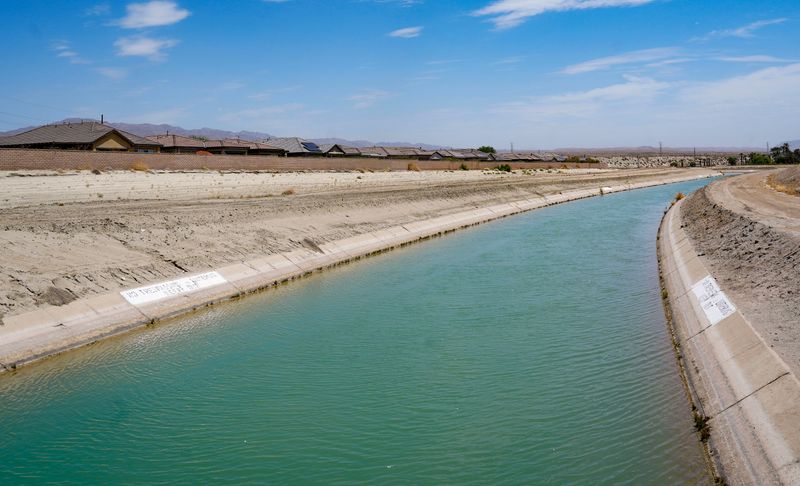
The river remains a crucial part of the Coachella Valley Water District’s overall supply — particularly for agriculture, which accounted for 84% of the water imported via the Coachella Canal last year — but the valley’s largest water district isn’t expecting any immediate cuts due to the latest federal plan.
In addition to using canal water for agriculture, CVWD also deploys imported river water to replenish the valley’s underground aquifer, which is then used to supply water to homes.
“At this time, there is no indication that agricultural customers will see an interruption in Coachella Canal water deliveries or that proposed Colorado River reductions will reduce aquifer recharge beyond CVWD’s ongoing voluntary conservation since 2022,” CVWD spokesperson Lorraine Garcia told The Desert Sun in an email.
The breakdown of the latest cuts in California is still under discussion, but Garcia said the agency is “actively engaged in those discussions and is committed to being part of a collaborative, long-term solution that protects the Colorado River while maintaining reliable water supplies for the Coachella Valley.”
“Although CVWD has reduced its use of Colorado River water since 2022 by more than 140,000 acre-feet, the district’s most recent engineering assessment shows that groundwater conditions remain balanced, reflecting decades of conservation efforts by our customers, stricter conservation laws, and careful water resource management,” Garcia added.
Still, the river’s long-term viability for the states that depend on it remains in doubt, leaving the future of the valley’s water sources uncertain in decades to come.
Less Colorado River going into valley aquifer
Local water agencies have already taken some steps to reduce their use of the river, and groundwater levels throughout the Indio Subbasin have either increased or stabilized since “historical lows” in the mid to late 2000s, according to an annual report.
The CVWD Board of Directors recently voted to extend conservation measures first adopted in 2022, agreeing to again conserve up to 35,000 acre-feet per year — about 10% of CVWD’s base allotment — mainly by cutting back on the amount of river water used to replenish the local groundwater basin via the Thomas E. Levy Replenishment Facility in La Quinta. That water will instead stay in Lake Mead.
Using funds from the Biden-era Inflation Reduction Act, the federal government has reimbursed CVWD for its conservation efforts to the tune of roughly $56 million over the past few years, and the next two years are expected to bring roughly $22 million to the district, according to a staff report.
When CVWD approved the extension in late July, board member Cástulo Estrada said he would like to hold a study session to discuss and gather feedback on what the agency should do with the conservation funds.
“If we go full in, by the end of 2028, we’ve probably gathered up about $78 million, so that’s a significant amount of money,” Estrada said.
The board also agreed to extend its agricultural fallowing program, which offers farmers funding to leave land dry.
Garcia said that CVWD’s fallowing program currently has five participants, some of whom have expressed interest in continuing with the program through 2028. The fallowing program has netted less money and water savings than the broader curtailment program.
CVWD is not the only valley water agency with a stake in the matter. Desert Water Agency provides drinking water to Palm Springs and parts of Cathedral City and Rancho Mirage, and it also receives water from the Colorado River in exchange for its allotment from the State Water Project, which doesn’t have infrastructure that reaches the valley.
Similar to CVWD, Desert Water Agency “does not anticipate any immediate impacts on its water supply and ability to meet customers’ water needs” due to the federal plan, according to agency spokesperson Victoria Llort.
Llort noted the valley’s groundwater basin offers “an important buffer” against annual changes in imported water supplies and during drier years to ensure water reliability.
“DWA continues to invest in sustainable groundwater management, conservation, and diversified water supply strategies to help meet the needs of today’s customers while protecting water resources for future generations,” Llort told The Desert Sun.
Local water agencies “anticipate being able to meet all demands through 2050, even through a near-term five-year dry period,” according to the latest regional urban water management plan adopted by those agencies.
“In the longer term, reliability depends on the continued replenishment of the groundwater basin with imported water supplies,” the report states.
Colorado River cuts have ‘serious effects’ on California water supply
Even as local water agencies say they’re prepared, the river’s long-term outlook is unclear, particularly given the seven states involved in negotiations have yet to reach any long-term agreement with the federal government.
Under the latest plan, the federal government is not requiring water cuts for the four Upper Basin states — Colorado, Wyoming, Utah and New Mexico — over the next two years.
“The Lower Basin cannot stabilize the river alone,” Imperial Irrigation District Board Chairwoman Karin Eugenio said in a prepared statement reacting to the plan. “A shared river requires a shared commitment, and every part of the basin must be actively involved.”
Between 2020 and 2024, the Lower Basin states used the most water from the river at 49%, followed by the Upper Basin using 29%, Mexico at 11% and another 11% lost to evaporation, according to the U.S. Department of the Interior.
The effects of the river’s long-term drought have increased over the last five years, with less snowfall and rain feeding into the basin paired with increasing soil aridity that increases the demand for water among farmers and cities, according to Brian Gray, a senior fellow with the Public Policy Institute of California’s Water Policy Center.
“There’s nothing in the document that really accounts for (the effects of drought) in a meaningful way,” Gray said in an interview.
Gray added he’s concerned about the long-term viability of agriculture in regions like the Coachella Valley, though he also noted many agencies in agriculture have already taken steps to make their water use more efficient.
The Coachella Canal, for example, completed a lining project in the 2000s that’s estimated to annually save tens of thousands of acre-feet of water.
“I give (the major water users in California) a lot of credit for the work they’ve been doing in the last several decades,” Gray said.
Despite his long-term concern, Gray also pointed to some reasons for optimism, such as recent legislation from U.S. Sen. Alex Padilla, D-Calif., that would provide millions of dollars in funding for farmers to use less water-intensive crops. The bill remains pending in a Senate committee.
Gray noted the approach would avoid some of the pitfalls of fallowing programs, which result in lower employment in rural areas and, as a result, less economic activity.
“I think those (proposed cuts) are big enough that smart business people, they’re going to respond immediately and make plans for the near- and longer-term future where those reductions may be even greater,” Gray said.
Peter Nelson, who retired this year after 26 years on CVWD’s board of directors, noted the challenges to local farmers go beyond water, with rising costs, labor shortages and red tape among the hurdles.
“That being said, agriculturists are resourceful, and I believe there will always be a place for agriculture in the Coachella Valley,” said Nelson, who’s worked for several companies growing citrus, grapes and dates in his career.
Nelson said the valley has “a lot of tools in (its) pocket,” with the aquifer providing a buffer to navigate drier years, and he emphasized the efforts already taken to reduce water use and make it more efficient.
“In spite of the drought, the district has been able to work with the growers and other industries to keep our aquifer sustainable,” Nelson said.
Asked about whether future cuts could hit farmers before residential developments, Nelson said those decisions “will certainly be a community-based discussion.”
“While there’s (currently) no direct impact to growers’ surface water deliveries, the long-term sustainability of our groundwater aquifer will be impacted with this dry hydrology,” Nelson said.
Beyond the more immediate negotiations over the Colorado River, any cuts absorbed in Southern California will have “serious effects” on California’s broader water policy, according to Gray.
For example, the cuts at the Colorado River could put more pressure on the Sacramento-San Joaquin River Delta, which is already overstressed and struggling with climate change.
“There will be ripple out effects that will extend throughout the rest of California,” Gray said.
Tom Coulter covers local government and politics for The Desert Sun. Reach him at thomas.coulter@desertsun.com.
This article originally appeared on Palm Springs Desert Sun: What will latest Colorado River cuts mean for the Coachella Valley?
Reporting by Tom Coulter, Palm Springs Desert Sun / Palm Springs Desert Sun
USA TODAY Network via Reuters Connect
By Tom Coulter, Palm Springs Desert Sun | USA TODAY Network