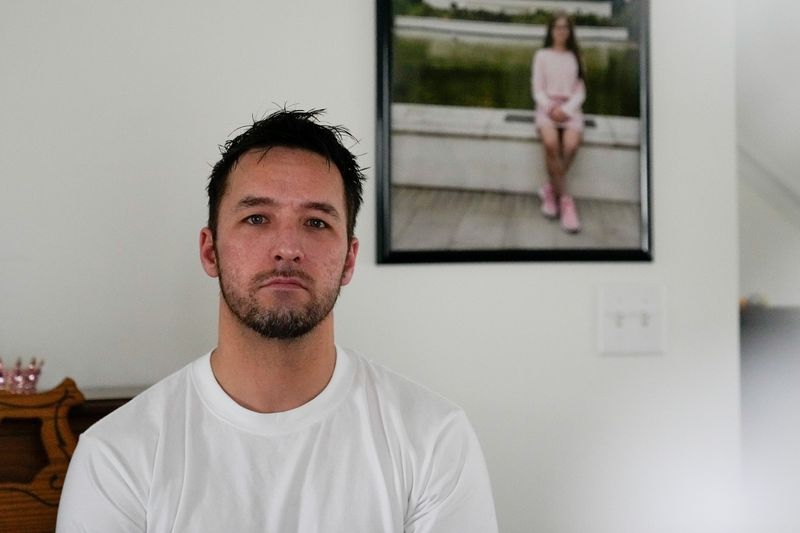
High school senior Anastasia Jehorek put on her helmet, hopped on her electric scooter and hugged the shoulder of Polaris Parkway as she headed to her job at Chipotle.
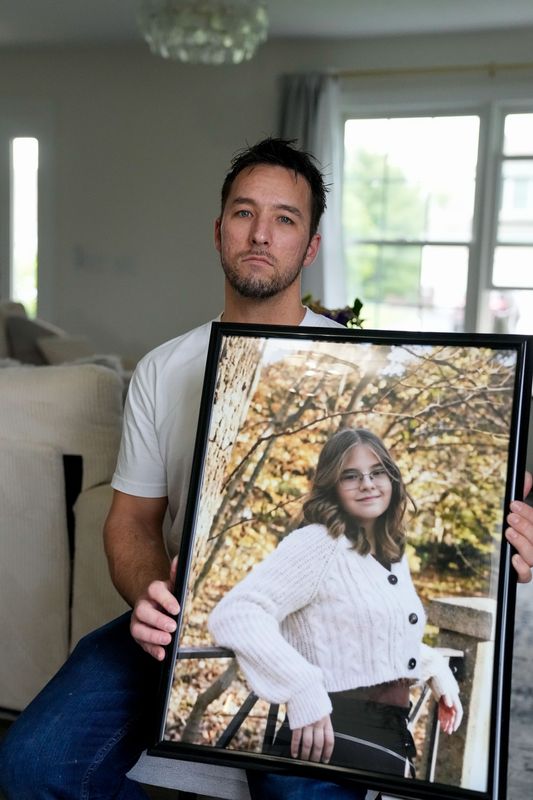
In an instant, a 22-year-old driving a Mazda SUV left his lane and crashed into her, sending the 17-year-old into a ditch. As he rushed home to talk to state troopers about what happened to his daughter, Dean Jehorek passed the emergency vehicles at the site.

Months after the February tragedy, Jehorek can’t bring himself to drive that section of roadway where his eldest child, who he described as “the perfect daughter, the perfect sister,” died.
“It’s the hardest thing I’ve ever had to deal with. By far. Every single day I wake up, it’s the first thing that pops in my head: she’s gone,” he said.
Jehorek blames his daughter’s death on distracted driving and a lack of sidewalks and protected bike lanes − a combination that puts pedestrians, cyclists and scooter riders in peril.
“They’re vulnerable because of the equation. Even a 200-pound man isn’t going to go up against a 2,000-pound vehicle,” he said. “The odds are stacked against you.”
“Unfortunately, when you combine distracted drivers and a vehicle versus a person’s body and the fact there is no designed spot for them to relatively safely move around the city is a combination for disaster,” he said.
Gas tax hike in 2019 earmarked for safety
After boosting the state gas tax, Ohio increased its roadway safety spending by 83%, from $104.5 million in 2018 to $191 million in 2026. Traffic fatalities declined 17% and pedestrian fatalities dropped 15%.
But there is still work to be done, especially when it comes to protecting pedestrians and cyclists. Cities and state governments are embracing Vision Zero – a plan to eliminate all traffic fatalities.
Ohio saw a hopeful decline in pedestrian deaths, dropping from a peak 172 in 2021 to 127 in 2024. But the number jumped back up in 2025 to 146. Data for the first six months of 2026 shows Ohio is on track for about 140 pedestrian deaths.
“We’re very concerned about the numbers we’re seeing not only with pedestrians but we’re not seeing good numbers in regard to vehicles either. And we really can’t figure out what’s going on,” Gov. Mike DeWine said. “It flies in the face of what been our long-term trend for a number of years.”
Ohio’s recent uptick in pedestrian fatalities runs counter to national trends. Last year, drivers hit and killed 7% fewer people walking on U.S. roads in 2025 compared with 2024, according to the Governors Highway Safety Association.
“So, while we are making progress this shows we still have a lot of work to do,” said Ohio Department of Transportation spokesman Matt Bruning. “Of course, engineering is only one portion of the equation. Education and enforcement are the other two legs of the stool that are required to achieve safety on the road.”
Why people die: speed, road design, big vehicles
Several factors contribute to pedestrian deaths, including vehicle size and speed, distracted driving and road designs that prioritize motorists over pedestrians. The faster the speeds, the more likely a pedestrian struck will die.
The United States has one of the highest road mortality rates among 29 developed nations. Pedestrian-crash deaths dropped 29% among developed nations between 2014 and 2024 but increased 49% in the U.S., according to data from the International Transport Forum.
American consumers are buying bigger trucks and SUVs, which have larger blind spots and higher bumpers. Those designs make it harder for pedestrians to survive vehicle strikes.
SUVs and pickup trucks accounted for more than half of pedestrian fatalities in 2024, according to the Governors Highway Safety Association.
What is Vision Zero? A goal of no traffic deaths
Columbus, Cincinnati and more than a dozen other Ohio cities have adopted complete streets policies, which require planning, designing and maintaining streets for everyone, not just vehicle drivers. Multiple cities have adopted Vision Zero as a goal.
Vision Zero is a push to eliminate traffic fatalities and severe injuries by prioritizing traffic safety as a public health issue. Governments and communities are advocating for better road design, enforcement of traffic laws, and public education campaigns.
The approach represents a shift from designing roads primarily for vehicles to designing them for all users.
“I think people are demanding that more and I think local officials are reacting to that,” DeWine said.
For Dean Jehorek, Shawna Rodriguez and hundreds of other Ohio families who lost loved ones in pedestrian crashes, it’s too little too late.
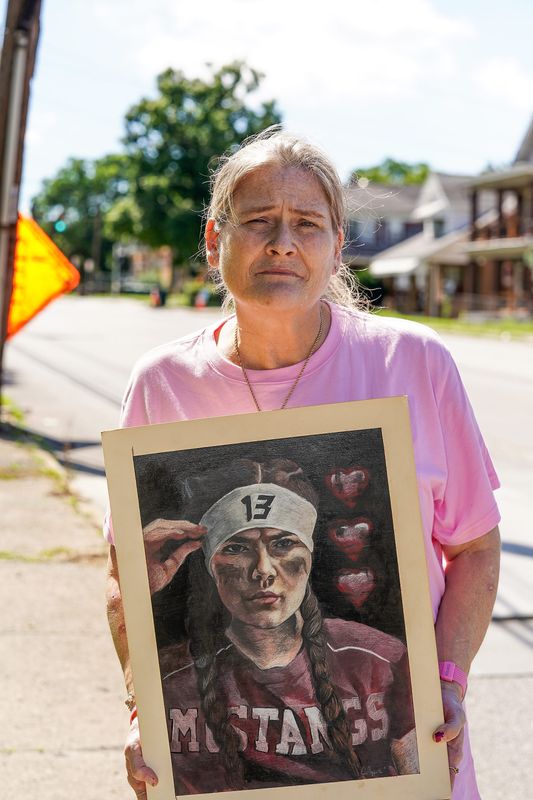
Rodriguez lost her 15-year-old daughter, Gabriella, in a hit-and-run on Cincinnati’s West Side in September 2018. Gabriella, her brother Sebastian and a friend tried to cross four lanes to get to their bus stop for school that morning. A silver SUV struck Gabriella, knocking her out of her Nike shoes, and then a second car hit her without braking.
In the years that followed her death, Rodriguez worked with city officials to install safety measures. In 2022, Cincinnati announced a $1 million boost in spending on pedestrian safety, including adding a set of speed cushions on Harrison Avenue near where Gabby was killed.
“It’s been a very long journey. I’m proud to say that we finally do have some changes. I know it was slow coming,” Rodriguez said.
It can take years to get a traffic study, make recommendations, find funding, request bids, design and build a project.
Andy Manka, founder of Akron Vision Zero, said it’s difficult to get people to campaign for safety improvements when the city’s process is so slow.
“It doesn’t have to be this way. The best cities in the U.S. and the best cities in the world operate more on the months timeframe,” Manka said. “In Berkeley, California, if someone dies on a road, they have a team that comes out and looks at the road. They implement changes on the scale of months…. I don’t know why it’s not like that here.”
Manka said cheaper, quicker safety measures, such as temporary concrete barriers, can be put in place and permanently incorporated later when a road is due for repaving.
Manka said he does see buy-in from Akron leaders, planners and engineers. The city just opened a multi-use path in downtown, he said, and has made street crossings safer along another bike path.
He also noted that giving local governments more control over speed limits would be helpful. “Speed kills. Every little bit of speed you can shave off makes a difference.”
Road Diets: Slowing drivers to protect walkers
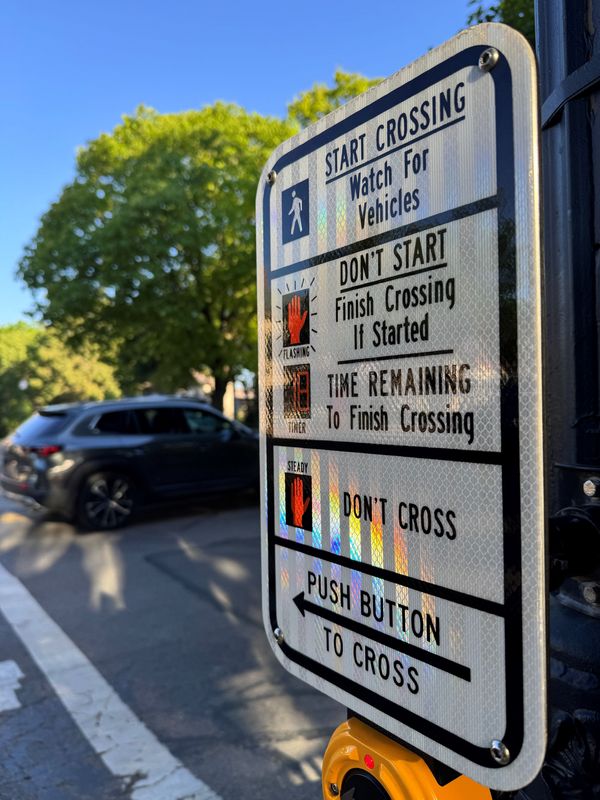
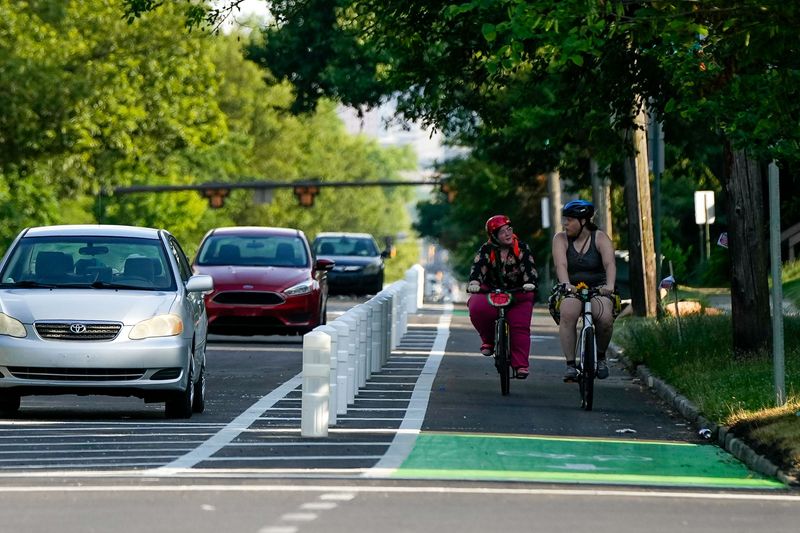
Ohio cities are putting roads on ‘diets’ – making them look skinnier so drivers slow down. Cities are installing speed cushions, extending sidewalk bump outs to shorten crosswalks, reprogramming crosswalk lights to give pedestrians a head start before lights turn green for cars, and building pedestrian islands in the middle of longer crosswalks. In some limited cases, driving lanes are being replaced with protected bike lanes.
“The more highway-like it appears, the more it gives permission and the psychological comfort to people to speed,” said Columbus Vision Zero coordinator Katherine Swidarski.
Changes such as narrowing roads are slowing vehicles and reducing crashes, she said. Traffic fatalities on Columbus surface roads fell from 25 in 2020 to 18 in 2024. Studies also show declines in excessive speeding after safety improvements were installed.
Here are some examples:
Columbus resident Amy Planchet said the city has north/south bike paths that are linked together but it needs more east/west routes and more protected lanes. “I don’t want paint. I want physical separation,” said Planchet, who added that the city’s investments are not evenly distributed.
LinkUs money could boost pedestrian safety
Central Ohio is poised to make big improvements with the passage in 2024 of a 0.75% sales tax for public transit, sidewalks and bike lanes. It’s expected to generate $285 million a year, nearly a quarter of which is supposed to be spent on sidewalks, bikeways and trails.
Local officials want to use data − where fatalities and injuries happen, neighborhoods with high percentages of households without vehicles − to drive where the money is spent, Swidarski and others said.
Columbus plans to build a two-mile loop around downtown that crosses the Scioto River to include COSI. The project, which cost about $100 million from public and private sources, isn’t billed as a safety upgrade so much as an economic development project.
Across the city of Columbus, 45% of streets lack sidewalks. Across a 15-county district covered by the Mid-Ohio Regional Planning Commission 41% of the major feeder routes that handle heavy traffic have sidewalks.
The Governors Highway Safety Association reports that three in five fatal pedestrian crashes happened in areas without sidewalks in 2024.
Jehorek moved to the Columbus area from Las Vegas.
“In Vegas, there are sidewalks everywhere, there are bike lanes everywhere. It’s just a very walking friendly city,” he said. “Coming here, it’s like every major road is considered a highway and there’s just no sidewalks in a lot of communities.”
Swidarski is hopeful, though, that in a matter of a few years, there will be fewer families like Jehorek’s who lose loved ones in traffic crashes.
“We’re going to be the first city of our size in the Midwest to achieve Vision Zero,” said Swidarski, who does not own a car. “Central Ohio wants it. They are loving and appreciating trails access. There is a lot of support for the work that we’re doing.”
State government reporter Laura Bischoff can be reached at lbischoff@usatodayco.com and @lbischoff on X.
This article originally appeared on The Columbus Dispatch: Ohio families push for safer streets after deadly pedestrian crashes
Reporting by Laura A. Bischoff, Columbus Dispatch / The Columbus Dispatch
USA TODAY Network via Reuters Connect
By Laura A. Bischoff, Columbus Dispatch | USA TODAY Network