

By Jihoon Lee, Daewoung Kim and Gregor Stuart Hunter
SEOUL, July 14 (Reuters) – When South Korean President Lee Jae Myung set a 5,000-point target for the KOSPI last year, it looked wildly ambitious and needed a market that was going sideways to nearly double.

Just barely a year later, the index blasted through 8,000 in a record run driven by an AI-fuelled surge, but Lee insisted South Korean stocks were still cheap.
Now that spectacular ascent has morphed into one of the market’s most bewildering reversals. The KOSPI has plunged into a bear market, shedding a quarter of its value since late June, yet remains by far the world’s best-performing major equity market this year.
The whipsaw highlights both the power and peril of South Korea’s AI-fuelled stock boom.
Explosive earnings growth at semiconductor giants Samsung Electronics and SK Hynix continues to underpin the investment case. But a rally turbocharged by margin debt, concentrated in just two stocks and increasingly disconnected from the broader economy, has left regulators wary and investors exposed to violent swings.
“It’s a wake-up call,” said Francis Tan, chief strategist for Asia at Indosuez Wealth Management in Singapore.
“Both for those who are greedy and those who are fearful,” he said. “For those who were fearful … it’s a great time to buy in, but if you are already overweight this gives you a reminder that exposure (to chips) can be a volatile game.”
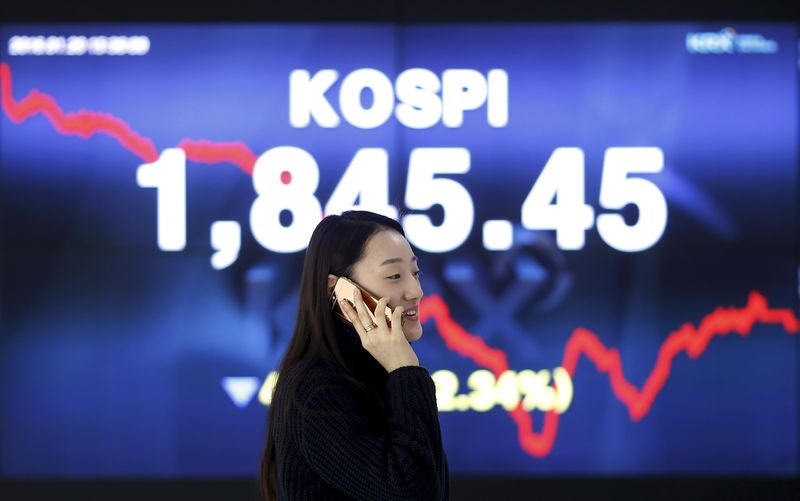
The KOSPI on Tuesday was trading below 7,000 points and has shed about 25% from its record closing high of 9,114.55 points, confirming it has been in a bear market since late June.
Even so, it remains up roughly 60% this year, trouncing the 10% gain for MSCI’s broadest gauge of global equities.
“Just as it went up explosively, it went down explosively,” said Lee Seung-ho, a 24-year-old college student. He took out margin loans to turn 10 to 20 million won ($7,000 to $13,000) into 300 million won in the bull run, before seeing it evaporate.
“I think people like my mom and grandma, while saying Samsung is South Korea’s No.1 company, do not fully understand the risks of leveraged investments (and) think about them rising twice as fast, without thinking of falling twice as fast.”
VOLATILE RIDE
Few stocks showcase the market mania like SK Hynix, which rode a tidal wave of borrowed money to a tripling of its share price, helping it pull off a record $26.5 billion U.S. listing by a foreign company. The stock debuted 14% above its offer price.
Yet the same stock is simultaneously experiencing the most wrenching volatility in its history, tumbling 14% in Seoul on Monday, while a twice-leveraged ETF tracking the shares plunged more than 30% in Hong Kong. The selling fed on itself, amplifying declines and helping drag the KOSPI 8% lower.
Samsung Electronics and SK Hynix together now account for just over half of the KOSPI, meaning sharp moves in either stock can overwhelm the broader market.
“The impact of single-stock leveraged products on the index is higher than in other countries due to the high share of Samsung and SK Hynix in the KOSPI,” said Park Woo-yeol, an analyst at Shinhan Securities. By comparison, a massive U.S. stock such as Nvidia represents only 7% of the S&P 500.
The KOSPI’s volatility index stood at 82.07 on Tuesday, after hitting a record high of 97.99 on June 29, compared with 28.85 at end-2025.
South Korea’s Financial Supervisory Service said it would monitor the products and investigate excessive marketing, if needed. The Bank of Korea told a lawmaker it was watching whether single-stock ETFs could distort markets and increase volatility.
FOREIGN SELLING
Foreign investors have pulled a record of nearly $110 billion from South Korean equities this year, largely to prevent the country’s soaring market value from skewing portfolio allocations. That has left domestic retail investors carrying much of the buying burden.
Retail investors bought 13.2 trillion won worth of KOSPI shares this month after purchasing 42.4 trillion won in June. Their borrowed investment in KOSPI shares stood at 28 trillion won on July 14, versus a record high of 29.8 trillion won on June 24.
“Korea is still the biggest portfolio overweight, but I started to reduce,” said Alexander Redman, chief equity strategist at CLSA. “What worries me is that retailers are in the driving seat, because they use a lot of margin.”
To be sure, forecast profits at Samsung and SK Hynix have risen so sharply that forward price-to-earnings ratios have actually fallen this year despite share prices more than doubling.
Yet some seasoned investors are staying away.
“I don’t like to buy markets that have been going straight up, so I’m not doing anything,” said Jim Rogers, co-founder with George Soros of the Quantum Fund.
“I like things to be depressed and to have lots of unhappiness and gloom around. That’s not the case in South Korea yet.”
($1 = 1,505.9000 won)
(Additional reporting by Heejin Kim, Jungmin Ryu and Heejung Jung in Seoul and Tom Westbrook in Singapore. Writing by Tom Westbrook. Editing by Shri Navaratnam)
By Jihoon Lee, Daewoung Kim and Gregor Stuart Hunter | Reuters | © Copyright Thomson Reuters 2026.
