

By Jim Bloch

Detroit could see temperatures above 100 degrees Fahrenheit in the days leading up to July 4. The city of St. Clair sweated under 97-degree temperatures on July 1 and 95 degrees on July 2.
Those were about 20 degrees above average.

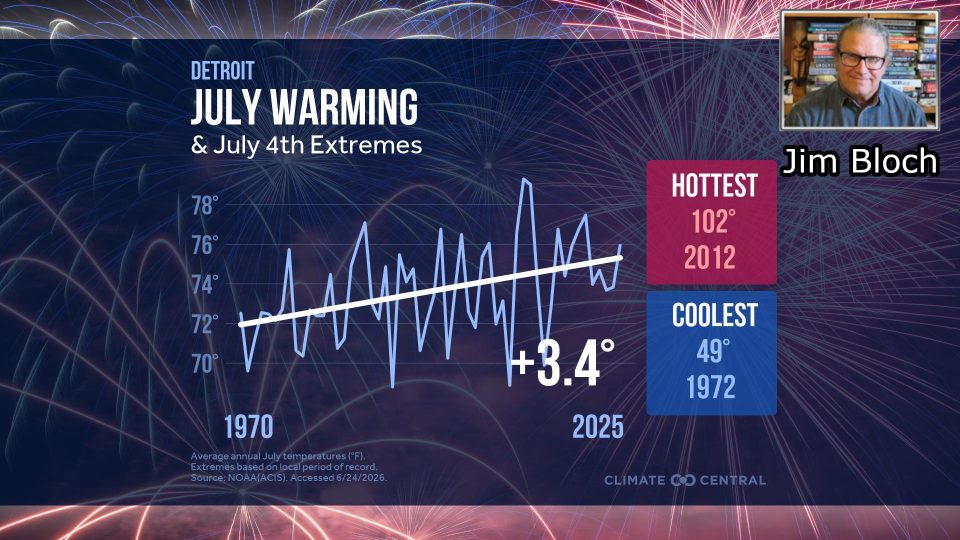
But the average temperatures for July have been increasing in metro Detroit over the past 25 years. The Motor City is now 3.4 degrees hotter than it was in 1970. In the U.S., temperatures in July have risen by about 2.6 degrees since winning its independence in 1776.
Cities in the Northwest U.S. have warmed the most, 4.9°F since 1970, followed by the Southwest at 3.5°F, and Northeast at 3.1°F.
Those are among the conclusions of a new report from Climate Central, the nonprofit organization that explores the causes and effects of – and solutions to – a warming planet as the U.S. marks its 250th birthday July 4.
“The nation’s history has unfolded during a period of unprecedented and accelerating global climate change,” according to the report, released July 1.
“The nation was founded in 1776 in a relatively stable climate before the peak of the Industrial Revolution when factories, transportation, and eventually electricity generation were powered by the surging use of coal, oil, and gas,” the report said. “Burning these fossil fuels led to remarkable economic growth while also releasing heat-trapping greenhouse gases that have accumulated in the atmosphere and transformed the climate.”
The gases block the warming rays of the sun from rebounding back into space, trapping them in the atmosphere and warming the planet. The primary heat-trapping pollution is carbon dioxide, accounting for 69 percent of the total, followed by methane at 26 percent and nitrous oxide at five percent.
“Today, concentrations of these gases have risen to levels unprecedented in at least 800,000 years and the world is warming at a pace unlike any experienced in modern human history,” Climate Central said.
Since the start of the Industrial Revolution, Earth’s average temperature has risen 2.2 degrees F, contributing to escalating climate disasters such as rising seas, melting ice
caps, hotter and longer heat waves, more drought, wildfires and stronger storms, among other things.
According to Our World in Data, the U.S. is responsible for 24 percent of all carbon dioxide emitted into the atmosphere since 1750, the most of any country; China is second at 15 percent; Russia is third at 6.7 percent.
“As a result of this pollution, the planet has warmed faster over the past 50 years than at any time in at least the last 2,000 years,” the report said.
Jim Bloch is a freelance writer based in St. Clair, Michigan. Contact him at bloch.jim@gmail.com.
