Although there hasn’t been tangible movement in the Legislature, Michigan lawmakers are increasingly exploring measures that would change how the state regulates data center development, a recent flashpoint for debate in communities where tech companies look to house the facilities.
Here’s three things to know about the ongoing data center debate in Lansing:

Guardrails for developers floated
Data centers are physical buildings where servers and other computer hardware are housed. They’re not new but data centers are getting bigger. Thanks to the rise of generative artificial intelligence, there’s a greater demand for computing power.
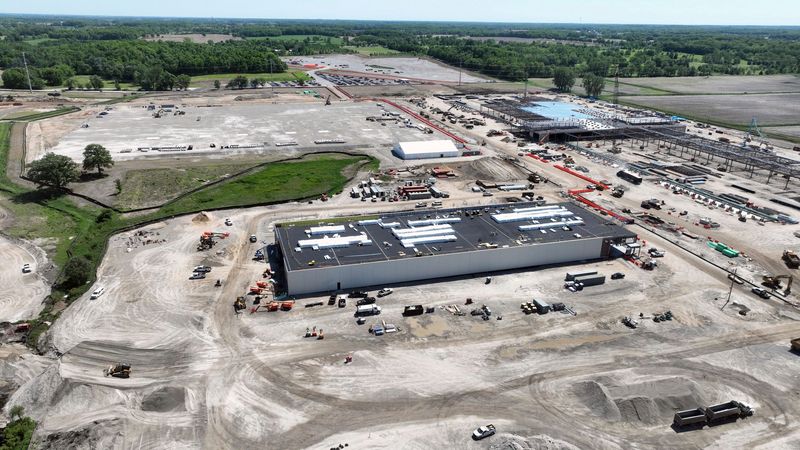
This is reflected in new proposals for larger, “hyperscale” data center in Michigan. Developers Oracle and Related Digital are behind a $7.4 billion data center campus currently under construction in Saline Township. Once built, the campus is expected to provide 1.4-gigawatts of computing power and support OpenAI’s “Stargate” project for AI development. OpenAI is the company behind the popular ChatGPT platform. In Van Buren Township, Google is moving forward with plans for a 1-gigawatt data center. Proposals for hyperscale data centers have also been raised in communities including Lyon Township, Ypsilanti Township, Dowagiac, and other spots around Michigan.
While proponents of data centers say they are necessary to power a modern, digital world, there are concerns from local residents where the facilities are proposed about how they’d affect local water supplies, energy costs and ambient noise. For reference, the 1.4-gigawatts of power the Stargate project is expected to use is enough energy to power more than a million homes. Some estimates state large data centers can use up to 5 million gallons of water each day, mainly for cooling.
Developers, in most cases, say they’ll work with local government units to ensure the new data centers aren’t too disruptive.
A group of Senate Democrats recently introduced legislation aimed at putting up guardrails around water usage, energy costs and community buy-in for large scale data center proposals in Michigan. If passed:
Some hardliners call for moratorium
Rather than provide additional regulations, other lawmakers in Michigan are calling for a one-year moratorium of new data centers in Michigan. Sen. Jim Runestad, R-White Lake, and Rep. Jennifer Wortz, R-Quincy, believe a pause is needed on new developments while lawmakers explore regulations. Senate Bill 1018 and House Bill 5594 would create such a moratorium, if passed.
At the local level, some municipal governments around Michigan have instituted moratoriums of their own. But state zoning laws make it difficult for communities to block data centers entirely — if a local government offers industrial zoning for certain projects, blocking a data center proposal seeking industrial zoning approval can leave the municipality vulnerable to a lawsuit, the Free Press previously reported.
Data centers can be assets, some say
A moratorium isn’t likely to pass statewide, however. Gov. Gretchen Whitmer is among those who’s said data centers can provide economic benefits to Michigan. She’s also called for responsible guardrails around projects and called the recent legislative package offered by Senate Democrats encouraging.
Other pro-business groups believe data centers can provide economic benefits as well. The consulting firm McKinsey estimated $7 trillion in data center infrastructure investment from 2025-2030. A recent report from Lansing-based Public Sector Consultants (commissioned by the Michigan Chamber Foundation) said Michigan stands to lose out on this spending (and the construction jobs it would create) if a one-year moratorium was put in place.
Michigan currently has tax incentives in place for data center developers. Proponents note that in order to qualify for the tax breaks, data centers have to comply with rules for protecting local water supplies and the energy grid.
The tax incentives were approved by lawmakers and signed by Whitmer in 2024, and pitched as a way to create jobs in Michigan. Studies have found that the main jobs benefit from data centers is in construction — since the facilities serve mainly as infrastructure, they often fall short of permanent job projections. The Public Sector Consultants report stated local communities should provide tax incentives for data centers if developers commit to additional investment in the area outside the data center.
You can reach Arpan Lobo at alobo@freepress.com
This article originally appeared on Detroit Free Press: 3 things to know about data center debate in Michigan Legislature
Reporting by Arpan Lobo, Detroit Free Press / Detroit Free Press
USA TODAY Network via Reuters Connect
By Arpan Lobo, Detroit Free Press | USA TODAY Network