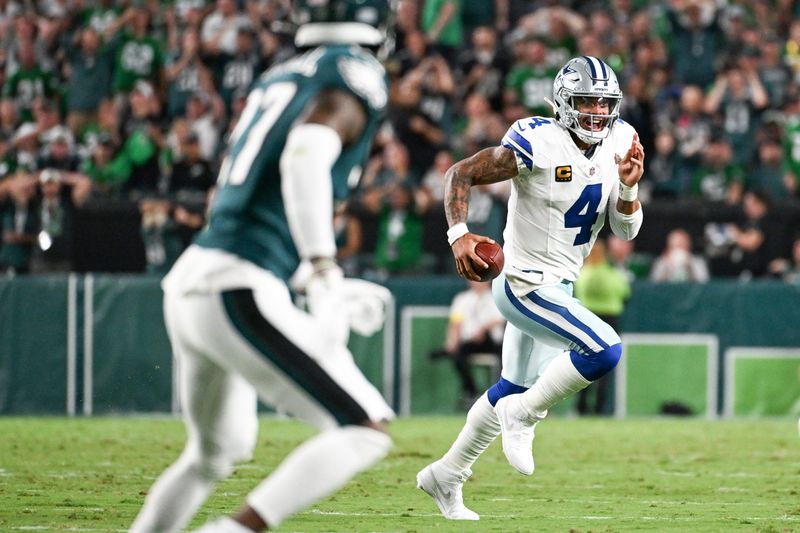
The Dallas Cowboys hired defensive coordinator Christian Parker to rebuild a defense that failed miserably last season. While Parker has been dead set on doing so, he also has a chance to make quarterback Dak Prescott even more dangerous than he was last season. Parker’s background is rooted in the schemes that have been an issue for Prescott throughout his career. Creating a rare opportunity for Prescott to face his toughest challenges every day in practice instead of only on Sundays.
Since entering the league, Prescott has thrived on pre-snap reads, timing, and rhythm-based throws. At his best, he diagnoses coverages before the snap and delivers with precision. Defensive coordinators like Vic Fangio and Vance Joseph have built game plans designed to take that advantage away, and their philosophies are simple: disguise their defensive intentions and force Prescott to play reactionary football, giving their teams a combined record of 6-2 against Prescott. Fangio’s success comes from rotating coverage after the snap, while Joseph simulates pressure and drops defenders into coverage. Different methods, but the same goal: remove Prescott’s ability to process at the line of scrimmage and force him to adjust in real time.

The results speak for themselves when compared Prescott’s career stats vs the rest of the NFL, according to Pro-Football-Reference and ProFootballFocus.
These aren’t minor drop-offs; they show just how effective each scheme was at changing how effective the Cowboys’ offense has normally been with Prescott under center. Drives stall more often, explosive plays disappear, and scoring efficiency drops. These coordinators have discovered the most effective way to limit Prescott and this is where Parker comes into play.
Parker has worked and learned under both Fangio and Joseph, meaning his defensive scheme will likely have elements of both systems. This gives Prescott something he hasn’t had before: daily exposure to his toughest matchup in practice, instead of a few times each season. For quarterbacks, repetition matters; quarterbacks tend to improve against what they see most, and for Prescott, he finally has a chance to figure out how to counter the schemes he’s yet to solve, but the benefit doesn’t stop with Prescott.
For Parker, as a first-time play caller, the practice reps against Prescott are just as valuable. There’s no better development tool for a new defensive coordinator than facing a quarterback with Prescott’s experience and ability to diagnose defensive coverages. Parker hasn’t had practice reps against a quarterback of this caliber. Now, he’ll be challenged daily to refine his disguises, pressure designs, and coverage rotations.
Prescott will certainly find weaknesses in Parker’s scheme, but it isn’t a bad thing; in fact, that’s exactly what teams want before the season begins. For every weakness found, Parker has an opportunity to adjust and improve. Over time, creating a defense that’s not just fundamentally sound, but battle-tested against a high-processing quarterback like Prescott.
This highlights the biggest upside of the Parker hire. Parker sharpens Prescott by forcing him to adapt to schemes that continue to give him the most trouble. Prescott sharpens Parker by exposing flaws that require schematic changes for better execution. These daily battles build something that can’t be duplicated in games alone. It takes time and practice before you see improved execution on both sides of the ball. But if this plays out the way Dallas hopes, the impact won’t just show up in practice reports; it’ll show up on Sundays, and once it does, it could be the difference between a good team and a complete one.
This article originally appeared on Cowboys Wire: Prescott, Parker present Cowboys with an ‘iron sharpens iron’ dynamic
Reporting by Terence Watson , Cowboys Wire / Cowboys Wire
USA TODAY Network via Reuters Connect
By Terence Watson , Cowboys Wire | USA TODAY Network