After Ball State University fired one of its employees over her comments about Charlie Kirk last September, the university spent nearly $500,000 fighting the resulting lawsuit that it ultimately settled for an additional $225,000.
In total, the lawsuit cost as much as in-state tuition for about 80 students.

In May, Ball State became one of several public institutions to pay employees hundreds of thousands of dollars to settle lawsuits after they fired them for potentially constitutionally protected speech. Former health director Suzanne Swierc and the American Civil Liberties Union sued Ball State President Geoffrey Mearns in federal court, claiming Swierc’s firing was a violation of her First Amendment rights. As part of the settlement, the university did not admit to any wrongdoing.
“Public universities should be a cornerstone for protecting First Amendment rights. But in this case, Ball State punished Suzanne Swierc for protected speech and then spent hundreds of thousands of dollars defending that decision,” said Ken Falk, Legal Director at the ACLU of Indiana, in a statement. “That has real personal and public costs, from what Suzanne was put through to the chilling message it sends across campus.”
In a May 26 email to university leadership, Mearns said the university settled with Swierc because the “modest” payout would be substantially less than their anticipated legal fees to continue litigation.
This lawsuit came at the same time Indiana’s state universities have been slashing costs after the state legislature provided less funding and prompted degree program cuts. Ball State is funded through student tuition, state government funding, fundraising and other revenue sources, according to its website.
The university did not provide additional comment to IndyStar regarding its legal spending.
Ball State hired four legal firms
Throughout the eight-month lawsuit, Ball State employed four different outside law firms, including two that were based outside the state, according to legal invoices and engagement letters obtained by IndyStar through public records requests.
The university hired Washington, D.C.-based Jones Day, a global law firm known for leaning into conservative politics and previously representing President Donald Trump, to litigate the case. It invoiced Ball State for the bulk of the case’s legal fees, totaling $311,000. The hourly rates of Jones Day attorneys were not included in returned records.
Ball State also hired Cleveland-based BakerHostetler for legal advice and was billed for $12,000. The primary lawyer on the case charged an hourly rate of $1,160, according to its engagement letter.
Two major Indiana firms also worked on the case, Taft Stettinius & Hollister LLP and Ice Miller LLP, through previous legal agreements with the university. The university confirmed invoices provided to IndyStar were solely related to the lawsuit or matters related to Kirk and free speech.
Taft invoiced the university for $154,000 over six months. According to its 2024 engagement letter, its attorneys were paid between $215 and $875 per hour. Ice Miller charged $10,000, according to the invoice, and the lawyers involved charged $975, $915, $825 and $675 per hour.
The external legal fees also do not include the university’s spending on its internal counsel. Sali Falling, its general counsel, made $273,000 in 2025, according to public salary records, and her office’s other seven employees earned about $884,000 in total.
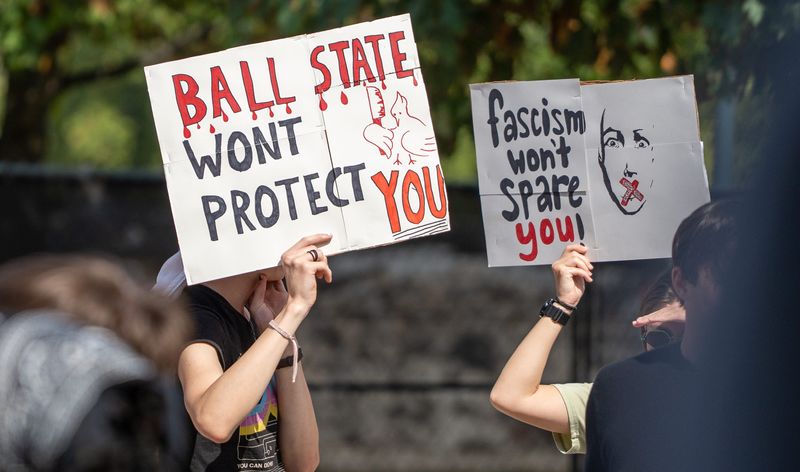
Ball State’s firing of Swierc drew praise from Indiana Attorney General Todd Rokita and conservative commentators but sharp criticism from free speech advocates and some in its university community.
“Some faculty, staff, students, and other people associated with our University have questioned whether my decision to terminate Ms. Swierc’s employment violated her First Amendment rights,” Mearns wrote in his May email. “They have also wondered how my decision comports with our University’s commitment to freedom of expression.”
Ball State, as a public institution, must consider constitutional protections for free speech, unlike private employers. A 1968 U.S. Supreme Court case established that public employees do not lose their First Amendment rights on matters of public importance when expressed in their private capacity.
However, there are limits, and Mearns felt the disruption warranted her termination. He said in his email that her comments were “extraordinarily damaging” to the university’s reputation and “exceptionally disruptive to our mission and our people.”
The USA TODAY Network – Indiana’s coverage of First Amendment issues is funded through a collaboration between the Freedom Forum and Journalism Funding Partners. All coverage is paywall-free.
Have a story to tell, tip or question? Reach Cate Charron by email at ccharron@indystar.com, on X at @CateCharron or Signal at @cate.charron.28.
This article originally appeared on Indianapolis Star: Firing staffer for Charlie Kirk comments cost Ball State $750K in legal fees, settlement
Reporting by Cate Charron, Indianapolis Star / Indianapolis Star
USA TODAY Network via Reuters Connect
By Cate Charron, Indianapolis Star | USA TODAY Network