Westland— Three days after the Archdiocese of Detroit announced plans that could end weekend Masses at 90 parishes across southeast Michigan, churchgoers at one Wayne County parish worry the next announcement could be even worse: a closure.
The archdiocese is reorganizing its parishes into regional groupings and consolidating Mass schedules to address priest shortages, declining attendance, demographic shifts and long-term financial sustainability.

“There’s a number of parishes, including our own, that don’t call for any weekend parishes,” said Richard Asher after a Sunday morning Mass at St. Mary, Cause of Our Joy Catholic Church in Westland. “Follow those churches and I believe those churches are going to be closed.”
On Thursday, the archdiocese released models for potential groupings for the final six of the 15 geographic planning areas associated with the restructuring. Up to 90 parishes could lose weekend Masses under the proposals.
“I bet most of those churches, including ours, will be closed,” Asher said. “I’m not so attached to my parish … if it’s not practical for us to stay open, I don’t wed myself to church, I wed myself to God.”
Jennifer Gonzalez, 44, is hoping to expand St. Mary, Cause of Our Joy’s programming for new Catholics to receive the Sacraments, in hopes of adding young adults and other Catholics to the parish’s numbers. Without a weekend Mass, she is concerned that new members might stray.
“We’re always looking for people to return to the church and working hard to make those programs happen,” Gonzalez said.
“It seems to me like if we reduced (Masses) at the parishes that have four weekend Masses and split those up, we could at least offer one Mass at each parish until we can do some more discernment. … Not offering a weekend Mass here, we’re not going to be able to do that.”
In a video posted to YouTube after the latest models were released, Archbishop Edward Weisenburger acknowledged the restructuring means that “difficult decisions must be made.”
“Brothers and sisters, I know this process has not been an easy one for many of us,” Weisenburger said.
The latest proposed parish reorganizations would eliminate regular weekend Masses at dozens of churches across southeast Michigan. Some church buildings in the archdiocese will have to close, said the Rev. Mario Amore, executive director of parish renewal for the Archdiocese of Detroit.
“I think it’s just the reality that we’re facing right now,” Amore told The Detroit News. “We simply can’t continue to fund all of the different maintenance needs of … some of these buildings.”
But he also noted that 20% to 40% of the models changed based on the feedback from parishioners in similar restructuring processes conducted in dioceses across the nation.
St. Mary Parish parishioners respond to a proposed loss of Masses
In Wayne County, up to eight parishes could lose Saturday Vigil and Sunday Masses under at least one proposal, while several Oakland, Macomb, St. Clair and Lapeer county parishes face similar possibilities.
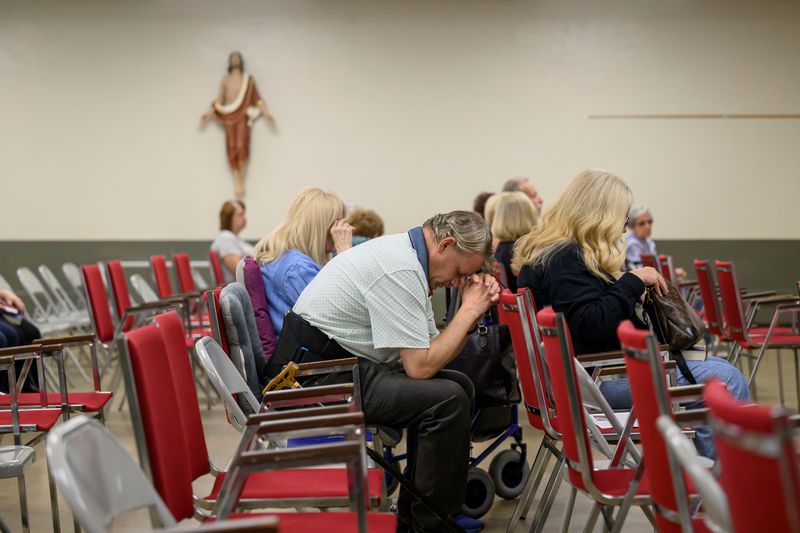
At St. Mary, Cause of Our Joy, Father Sean Bonner said losing Masses likely would mean a more manageable workload. But like Asher, other parishioners see it as a stepping stone to losing the place where they grew their spiritual faith.
“I hope they don’t have to close this church, because we really love the church, the priests and all the parishioners,” said Lelis Penas. The 81-year-old Livonia resident said the church is close to home. On Sunday morning, parishioners were in the church’s smaller building due to air conditioning issues in its larger building.
The Westland church can hold about 800 people for worship but sees only about 450 over the course of the weekend, Bonner said.
“It’s like that in a lot of churches,” Bonner said. “This is reality. Restructuring is going to happen whether we like it or not and it needs to happen. … I think we can build the church together if we bring the churches together rather than trying to do our own thing.”
The church is operating with just under $750,000 in debt. The parish has been making its debt payments, which are $10,000 a month, Bonner said.
About 39% of parishes in the archdiocese had budget deficits in the 2024-25 fiscal year, according to data from parish workbooks on the archdiocese’s website. St. Mary had about $1 million in payable loans in 2024-25, according to parish workbooks.
It built a new activity center in 2000 and 2001. It borrowed money for that effort and some other projects, but financial difficulties led to an inability to pay down all of the borrowing, Bonner said, adding that the debt grew because of interest.
Although Bonner has been at the parish since 2017, he’s been spread wide and thin while overseeing two other parishes.
“Once upon a time, every parish had two or three priests; now just about every priest has two or three parishes,” Bonner said. “I have a Mass schedule that’s, quite frankly, unsustainable. … It’s just too much. I can’t be in any one place because I’m trying to be everywhere. Then, it’s hard for people to find me when people need me.”
Julie Barile, who’s been attending the church for 26 years, is just happy to have a consistent priest.
“We’ve had a revolving door of priests here. There’s some issues with some of the priests who have come here, where they’re only here short-term and then I have to transfer somewhere,” said Barile, 69.
She added: “I was married in this church, and my daughter was baptized here.”
That’s why Bonner believes it’s difficult for many parishioners to contemplate losing their usual worship space.
“I see the bigger picture. … (But) the people that are here, this is their home, this is where they’ve been for years, they’ve gotten married here, they’ve buried their family members here … so it’s tough to see that slipping away.”
Weisenburger is hopeful the restructuring will lead to “vibrant faith communities, flourishing priests and sustainable, mission-ready parishes,” he said online.
Archdiocese officials said churches without scheduled weekend Masses could still host weddings, funerals, weekday liturgies and other activities at a pastor’s discretion.
The archdiocese’s restructuring plan, announced last fall, comes as parishes are facing declining attendance. About two-thirds of its parishes have fewer than 600 weekly Mass attendees, according to the archdiocese. In the next five years, more than three-quarters of its parishes are projected to shrink.
Sacraments such as baptism and First Communion have also experienced a dramatic decline in the past 25 years, according to the archdiocese, which serves about 900,000 of the region’s Catholics.
This spring, the archdiocese conducted more than 400 listening sessions, visiting each parish in its area and seeking parishioners’ feedback regarding which portions of the proposal “might work and what might need additional refinement and other insights into the local communities of each parish,” Weisenburger said in the YouTube video.
Parishioners have expressed hope that their feedback will preserve weekend worship and maintain their communities’ parish identities.
What happens next in the archdiocese restructuring process
Weisenburger thanked everyone who had a part in coordinating and executing the listening sessions, from priests and deacons to volunteers and participants.
Once the survey closes, “further discernment and refinement will continue as we review and analyze all the data from the parish listening sessions, the online survey responses and ongoing feedback from our priests,” Weisenburger said.
Parishioners can also access videos of the listening sessions, the model proposals and information on the restructuring website.
Weisenburger invited parishioners to “thoughtfully and prayerfully engage” with the information before sharing their feedback.
“Your suggestions, insights and recommendations are essential to this next phase of our restructuring,” he said.
The archdiocese is receiving, reviewing and considering all feedback, alternative proposals and additional data submitted by parishes and individual parishioners, Fournier said. The feedback will help to “refine the proposed models as we move into the fall,” she said.
The archdiocese’s plan will go to the Archdiocesan Restructuring Commission and then an advisory body of priests, which would have to sign off on it. Changes can be made during these steps.
It will then go to Weisenburger for his final approval, Amore said.
The archdiocese is planning to announce the final plans in April 2027, and the implementation of the plans is expected to begin on July 1 of that year.
While the sessions are complete, parishioners can still share input through an online survey available through July 31.
“We do not want to assume our draft models are what’s best for every parish in the Archdiocese,” archdiocese spokeswoman Holly Fournier has said. “The purpose of sharing them was to generate the kind of feedback and dialogue that will help shape the final outcome.”
mreinhart@detroitnews.com
mjohnson@detroitnews.com
This article originally appeared on The Detroit News: Archdiocese of Detroit parishioners worry, wait for final decision on Masses
Reporting by Max Reinhart, Myesha Johnson and Anne Snabes, The Detroit News / The Detroit News
USA TODAY Network via Reuters Connect
By Max Reinhart, Myesha Johnson and Anne Snabes, The Detroit News | USA TODAY Network