

Ask anyone who knew Gilda Radner what they cherished about her most, and it’s rarely a single character or sketch. Of course, fans still adore Roseanne Roseannadanna and Emily Litella. But those who knew Gilda off-screen remember her for simply being herself. On June 28, Radner would have turned 80, and long before the days of influencer culture and female comedians, she made a name for herself through her comedy and vulnerability.
Gilda’s Club locations nationwide will celebrate her birthday with parties featuring food and laughter.

“When you talk to somebody and mention Gilda Radner, somebody who knew her or knew of her, they never say, ‘I liked her,’” said Radner’s older brother, Michael, now 84. “Nobody ever liked her. They all say ‘loved her.’”
As the first cast member on “SNL,” Radner inspires comedians over half a century later. Killed by ovarian cancer at 42, she also left another major legacy: supporting over 6,000 cancer patients and their loved ones annually through 200 Cancer Support Community and Gilda’s Club locations. This includes 3.2 million in-person visits, support calls and digital connections.
“If somebody does not know who Gilda Radner is, I think it’s important that people understand that she was integral to a huge paradigm shift in television, at least American television,” comedian, author and sketch comedy chronicler Jason Klamm said.
Born in 1946, Radner always loved to perform. Growing up in Detroit, she considered herself “a child of comedy.” She studied theater at the University of Michigan for six years and, without completing a degree, moved to Toronto. She sold tickets at the box office there and started performing in a children’s theater production. Soon, she got her big break in the Toronto production of “Godspell” alongside Martin Short, Andrea Martin and Eugene Levy. In the early ‘70s, Gilda left “Godspell” for the Toronto Company of The Second City improvisational troupe. From there, she went on to join John Belushi in “The National Lampoon Show” in New York. Lorne Michaels selected her to be a cast member on NBC’s “Saturday Night.” What was an experiment for “Saturday Night” turned into the beloved sketch comedy show “Saturday Night Live,” which celebrated its 50th anniversary in October.
A performer from the start
Gilda’s brother, Michael Radner, said his sister was an entertainer from the time she was young. He still lives in Southfield, where he and his sister were born and raised. He recalls her performing for their father in the backyard as a child, but never expected her to pursue a career in comedy. “You don’t waste your funny around your family,” he said.
Even if it’s not “wasted” by cracking jokes around relatives, it’s clear humor runs in the family.
“Her most important legacy is the residuals that I get that allow me to maintain my lifestyle,” Radner said. “Just two days ago, I received a check from NBC for $6.07.”
Throughout her life, Gilda struggled with her weight. This challenge started when she was young, and her nanny, Dibby, suggested using comedy to handle the teasing at school for being overweight. In her memoir, “It’s Always Something,” Gilda wrote, “She would tell me, ‘Say you’re fat before they can. Let them know that you are fat and you don’t care.’” This simple advice given to a child led to a life of using comedy as a coping mechanism.
When the 11:30 p.m. slot opened in 1974, NBC approached Dick Ebersol, the vice president of late-night programming, and Lorne Michaels, a comedy writer, to create something new for that empty slot, targeting the 18-to 34-year-old demographic. On Oct. 11, 1975, Gilda Radner took the stage for the first episode of “Saturday Night,” an experiment that turned into an award-winning late-night series.
Judy Levy became friends with Gilda as a fellow 8-year-old camper at Camp Maplehurst in Kewadin, Michigan. Though she remembers her always being funny, Levy never thought Radner would become a famous comedienne. In fact, she said she only realized her friend’s impact on the world when she sat in the audience of “Gilda Live” on Broadway.
“I couldn’t stop crying,” Levy said. ”I never realized that this person who’s making me laugh all of these years is funny to everyone else, too.”
To Reggie Sidell, 73, Gilda never changed — she was as authentically funny on television as she’d been at 17, when she was a counselor at Camp Tamakwa. Though they reconnected later in life, Sidell lost touch with her in the 12 years between summer camp and the premiere of SNL. Sidell was touched to see the “special soul” she adored on television.
“Everybody watched it (Saturday Night Live) every week, and we loved it,” Sidell said. “It was so irreverent, and it was really different than it is now… and the fact that Gilda was part of it, I just used to get a huge smile every time I’d see her.”
Alan Zweibel, one of the show’s original writers and Gilda’s close friend and creative partner, praised her vulnerability. In her impromptu “What Gilda Ate” segments, she invited viewers into her life with the intimacy of a close friend. Zweibel recalls the audience roaring with laughter at comments that weren’t intended to be jokes, like when she pulled a lint-covered gumball from the bottom of her pocketbook.
Nearly half a century later, Gilda’s iconic characters Roseanne Roseannadanna, Emily Litella and Judy Miller, are still admired by fans, including Steve Abel. He sells merchandise with her quotes, and still loves her characters. “She’s just a classic,” he said. “Particularly, her Roseanne Roseannadanna character. You don’t see humor like that these days.”
Supporting other cancer patients
Following her ovarian cancer diagnosis in 1985, Gilda found support at the Wellness Community in Santa Monica, California. The four-year-old nonprofit organization provided support and education to patients and family members affected by cancer. In May of 1989, she died after her battle with ovarian cancer.
“After Gilda passed away, her wish was that everyone would have access to what she had access to at (the) wellness community,” said Megan Borowski, Gilda’s Club Chicago clubhouse and virtual program manager.
In honor of Gilda, her friends and family gathered to create a cancer support community in the early ‘90s. As a result, Joanna Bull, Gene Wilder and Joel Siegel established the first Gilda’s Club in New York in 1991 as a nonprofit organization.
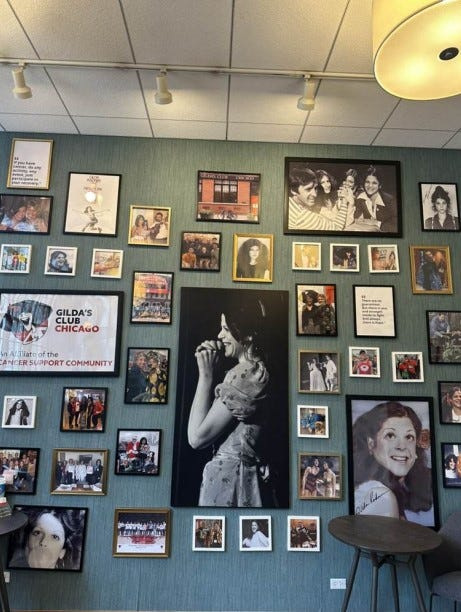
Today, over 200 Gilda’s Clubs and Cancer Support Communities are scattered around the world. Gilda’s Club Chicago serves between 3,000 and 4,000 members each year with over 240 events each month. Zweibel said Gilda would be so pleased with the social, fun and supportive cancer community that the organization has become
“So many people’s lives are extended, and their last years are filled with hope and fun and laughs under a canopy that bears her name,” Zweibel said. “Boy, I think she would be so proud and so thrilled.”
Her messages were clear
A clear message from Gilda’s friends and family: she radiated authenticity and was unapologetically herself. She broke the silence around life’s most unglamorous challenges, including eating disorders, infertility, cancer and messy relationships.
“She did have her vices and her demons, but if you needed advice on your own life, there was no one better,” Zweibel said.
Looking back, Michael said Gilda was always nice to everyone, especially her fans. She would always reply to fan mail – and would greet fans when he picked her up at the airport.
“Lisa Tabulito, the director of Love, Gilda, when she was interviewing people, she had trouble finding anybody who had anything bad to say about Gilda,” Michael said. “She was actually a nice person.”
In 1994, Zweibel wrote “Bunny Bunny” as a part of the grieving process following Gilda’s death.
He said it felt cathartic to revisit his fondest memories from their friendship.
“I didn’t want the book to end when I was writing it, because I knew she died at the end,” Zweibel said. “I wanted to keep her alive.”
Today, Michael still has Gilda’s name in Google Alerts, and he said a day doesn’t go by without her name popping up at least a few times.
Gilda Radner’s 80th Birthday Celebration
5-7 p.m., June 26
3517 S. Rochester Road, Royal Oak
Visit gildasclubdetroit.org to register
This article originally appeared on The Detroit News: Remembering ‘Saturday Night Live’ alum Gilda Radner on her 80th birthday
Reporting by Kaitlyn Luckoff, Special to The Detroit News / The Detroit News
USA TODAY Network via Reuters Connect
By Kaitlyn Luckoff, Special to The Detroit News | USA TODAY Network
