When Eric Moskowitz met to discuss book proposals over coffee in 2016, the literary agent rejected his first three suggestions before he could take that first sip.
But when pressed for another idea, Moskowitz thought back to a story that had stuck with him more than most he’d explored during his years as a Boston Globe reporter.

He told her Ford had “cheated to win” a cross-country automotive race to promote the legendary Model T.
Her reply?
That is a book.
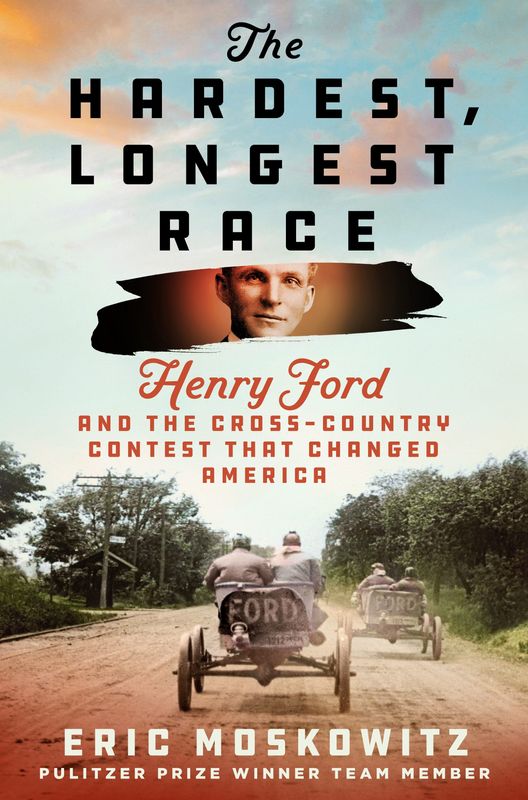
It took a number of years and a lot of digging, but the story that Moskowitz referenced during that meeting is now out in hardback, “The Hardest, Longest Race: Henry Ford and the Cross-Country Contest that Changed America.” (355 pages, St. Martin’s Press)
Moskowitz, who is scheduled for an online author talk that’s free to view through the Dearborn Public Library at 6:30 p.m. June 23, told the Detroit Free Press the episode has been treated as a historical footnote but he considers it a vastly underappreciated part of the Model T’s origin story.
And he stumbled upon the story by chance.
The year was 1909, and two Model T’s were entered into the cross-country Ocean-To-Ocean Race, an approximately 4,100-mile trip from New York to Seattle that would test the mettle of the cars and their operators. The automobile race was promoted by millionaire M. Robert Guggenheim.
Traveling long distances by car in those days could challenge even the most skilled drivers because of treacherous conditions and poor pathfinding. Cars weren’t unknown, but they were not necessarily prevalent across the country. One in 500 people owned a car at that time, Moskowitz said, describing it as comparable to the rate of personal computer ownership in the late 1970s.
So this race offered a chance to make a statement when the industry was still in its early days.
Henry Ford, in particular, saw an opportunity.
Ford entered a pair of Model T’s in a contest that pitted them against a handful of other cars and the elements.
But the race became a “dogfight” between the Model T’s and a car from a company that few remember today, the Shawmut Motor Co.
Like many other automakers of the day, Shawmut was a small operation. Moskowitz said the company had plowed a ton of money into its research and development, was actually building something good and had even received some favorable press, but a factory fire had upended its fortunes.
“When they heard about this race, they entered it as a Hail Mary to try to save the company,” he told the Free Press.
Ford’s Model T’s were unique in the field of racers, designed to be lightweight and affordable. The others were larger luxury models and more expensive.
The Model T wasn’t the first lightweight car, but it was also meant to be durable, which would make it a standout offering.
“Ford is confident with the Model T that he has cracked the code,” Moskowitz said, of a vehicle that could appeal to the masses.
During the race, which kicked off on June 1, 1909, the Model T’s were often in the lead, and one would be first to the finish about three weeks later. Ford leaned heavily on its large network of dealer representatives along the race route, which helped particularly with navigation along the way.
But leaving things to chance wasn’t apparently the goal.
Moskowitz, 46, described a number of events that he said suggest cheating but aren’t provable. One incident involved a ferry that “broke down” only after getting the two Model T’s across the Missouri River, failing to return for the other cars.
But the incident that cost Ford the race title involved an improper engine swap and repair along the way, something that was uncovered later.
“By this time, Shawmut has ceased to exist, and Ford has reaped like four months of not only national but even global publicity out of ‘winning this race,’ ” Moskowitz said.
Although Ford stopped promoting the race outcome at the corporate level, that initial version of events continued to circulate among local dealers, helping boost the Model T’s reputation, Moskowitz said.
The Detroit Free Press reached out to a Ford spokesman for comment on the contentions for this article.
Moskowitz stumbled on the story during his Globe reporting days. (He now works as a writer for Harvard University.) He had been receiving news items from Stoneham, Massachusetts, where he had previously covered a budget crisis, and happened to spy an announcement about a proclamation to honor the forgotten Shawmut Motor Co. That sparked his interest while he was still a reporter, and he considered it a topic he might return to if he ever got the time to delve into it more.
The book is filled with colorful characters based on accounts from newspapers of the day, letters from those involved and other resources, including The Henry Ford’s Benson Ford Research Center.
Moskowitz, who has lived in the Boston area for most his life, said he was most surprised to learn that there were more than 250 automakers in existence around the time of the race and that just as many had come and gone in the years prior.
“The industry was in its infancy then, and It was kind of the Wild West,” he said.
That included the unique way boosters promoted automobiles at the time.
One memorable example mentioned in the book involved the slog through Kansas with the cars grinding through the mud in what Moskowitz described as Biblical rains. In the town of Abilene, Kansas, the most famous resident wasn’t Dwight Eisenhower or his brother, Edgar, recent graduates and “scholar athletes,” but 6-year-old Bessie Coulson, who was the daughter of a local Buick dealer. He promoted his daughter’s driving around town to show that people shouldn’t be intimidated by driving because “even a child could do it, literally.”
Moskowitz told the Free Press that he has a son the same age today, and “no way in a million years would I let him drive a car. Of course, there was less to hit back then.”
Eric D. Lawrence is the senior car culture reporter at the Detroit Free Press. Send your tips and suggestions about cool automotive stuff to elawrence@freepress.com. Become a subscriber. Submit a letter to the editor at freep.com/letters.
This article originally appeared on Detroit Free Press: Ford lost this race title. Author says it was because of cheating.
Reporting by Eric D. Lawrence, Detroit Free Press / Detroit Free Press
USA TODAY Network via Reuters Connect

By Eric D. Lawrence, Detroit Free Press | USA TODAY Network