The pilots and crew looked on as meteorological technician Duane Robinson pulled up the satellite radar on a TV screen. Incoming storms, the radar showed, and the crew discussed avoiding the threat. A threat that would later dump rain, spawn tornadoes and delay commercial flights for hours.
But this was earlier June 17. Before the storms burst into Indiana mostly south of Grissom Air Reserve Base near Kokomo, Indiana. These storms wouldn’t interrupt the mission at hand: refueling the famed U.S. Air Force Thunderbirds that were heading from the Washington D.C. area to Columbus, Ohio, for an air show.

After the weather briefing pilots and crew – with me and my camera gear in tow – went out to the KC-135R Stratotanker. The crew walked around the massive aircraft, inspecting the wings, tires and engines. While they worked, I spoke with Senior Airman Madison Addington, who was functioning as a boom operator on the flight.
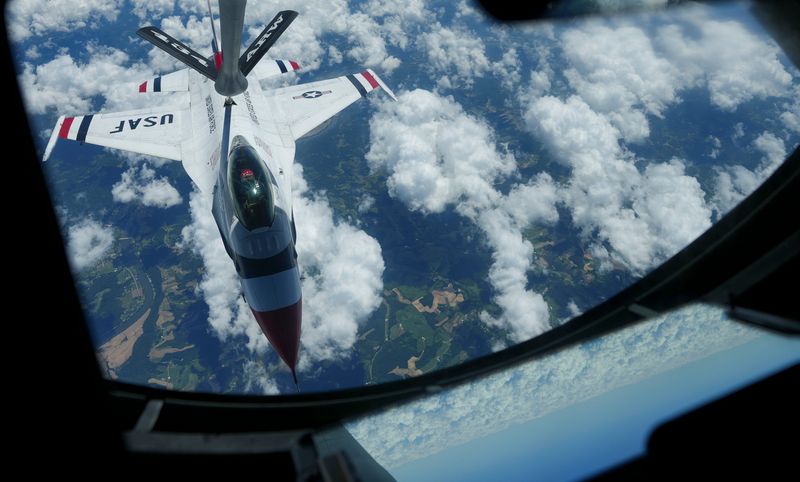
Addington stood in front of the plane as she spoke. Her job was to maneuver a boom, the part of the plane where fuel is transferred, to the receptacle of the U.S. Thunderbirds and pass jet feul to them.
“You get to be at the back of the airplane and looking out the window and just watching, you know, seeing the planes come up to you,” Addington tells me. “It’s just great.”
One of the pilots, 2nd Lt. Mark Balashov, shared his excitement.
“Having a once in a lifetime opportunity, like refueling the Thunderbirds, is amazing,” Balashov said. “I can’t believe I’m doing that as a copilot.”
We then board the aircraft, becoming among the maximum 322,500 pounds the KC-135R Stratotanker can hold at one time. Along the sides of the plane, inward-facing seats provide a spot for me to buckle in. I put on a pair of ear plugs during takeoff, as the sounds of the aircraft are much louder than on a commercial flight.
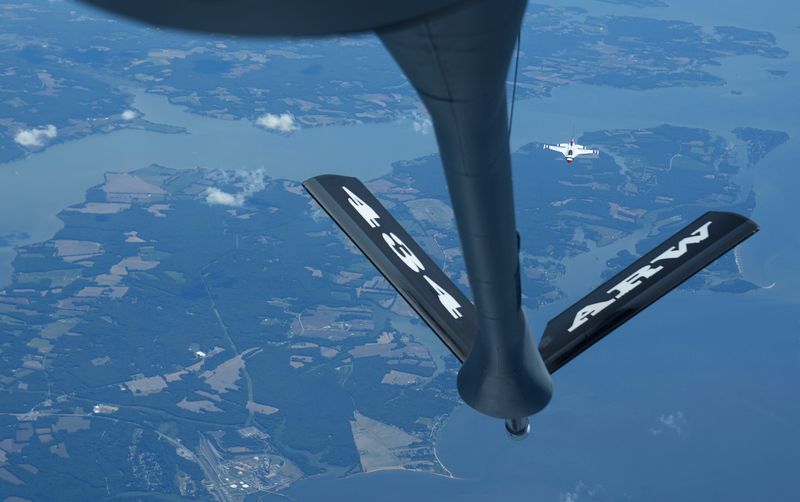
We meet the Thunderbirds in the air. The first Thunderbird appears quickly, flying toward us from the back of the plane. Addington lays on her stomach and maneuvers a hand control while looking out a window to refuel the plane.
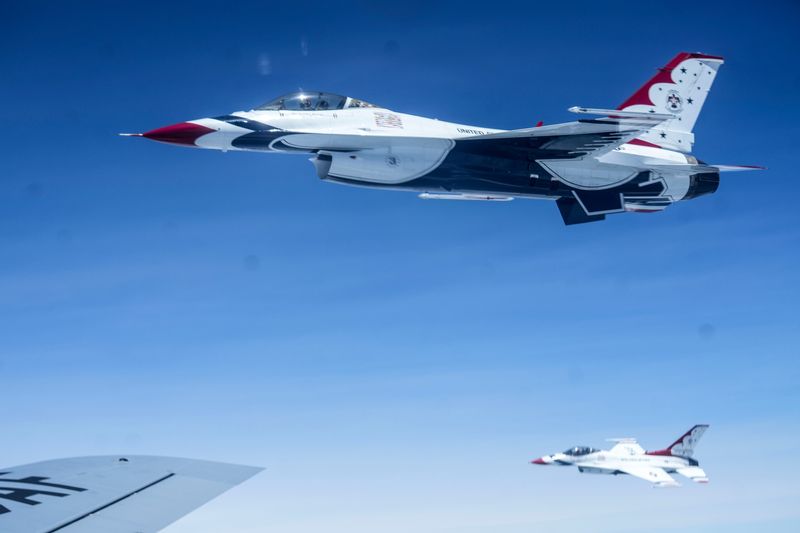
I lay next to Addington, photographing the Thunderbirds as they each approach the aircraft one after the other, receive gas, and fly to the side of the Stratotanker to make room for the next plane to fill up. I even get the opportunity to look out the side windows, where the other Thunderbirds wait, flying what seems like feet from the wings to get refueled.
In total, the Thunderbirds refueled in about an hour. When they were finished, our plane departed from the Thunderbirds as they continued along to Columbus. I sat in the cockpit, listening as the pilots spoke while landing. Wipers cleared rain off the windshield of the plane as we touched down on the runway. Within an hour of the Thunderbird’s departure, we were back in Indiana.
This article originally appeared on Indianapolis Star: An inside look at the mission to refuel the USAF Thunderbirds midair
Reporting by Christine Tannous, Indianapolis Star / Indianapolis Star
USA TODAY Network via Reuters Connect
By Christine Tannous, Indianapolis Star | USA TODAY Network