

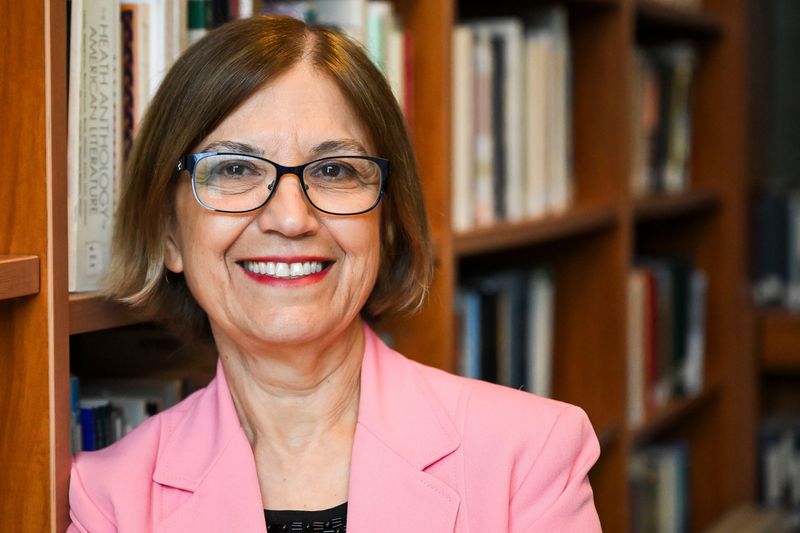
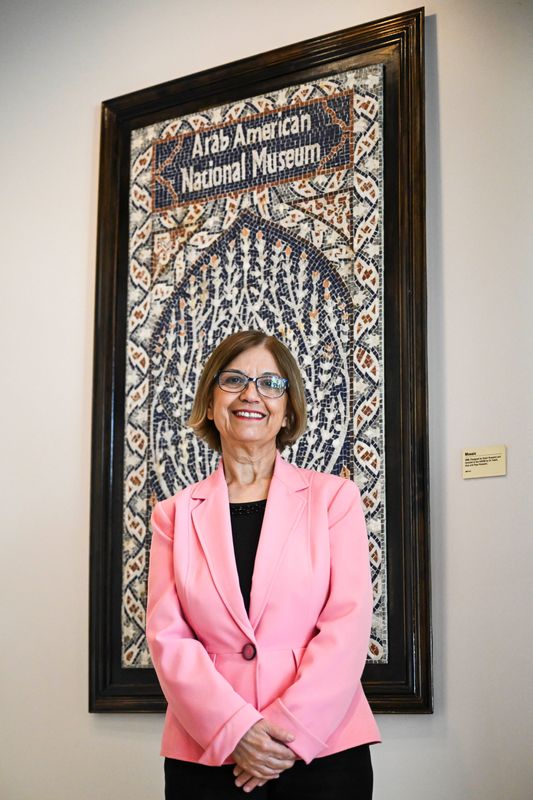
Maha Freij opened the doors of the Arab American National Museum recently to greet a visitor and quickly asked if they wanted tea or coffee.
As Freij entered the spacious three-story museum on Michigan Avenue, she stopped to chat with some of the organizers of the 2026 Arab Film Festival, who were setting up for the day. The annual event highlighting Arab and Arab American filmmakers is among the scores of cultural events the museum hosts.

Freij gave no indication she was president and CEO of the Dearborn nonprofit, Arab Community Center for Economic and Social Service, ACCESS, that created the museum more than two decades ago.
“Trust and connection get people through doors,” Freij said.
The museum is just one example of her extraordinary skill to advocate for Arab Americans and others, often amid the fierce backlash that Muslims, Arab Americans and immigrants from the Middle East and North Africa face.
Freij, 63, joined ACCESS in 1991 when it was a small storefront nonprofit in the shadow of the Ford Motor Co. Rouge complex, on Dearborn’s southeast side. By the time she joined, two previous ACCESS offices had been destroyed by arson.
She has been the driving force in raising tens of millions of dollars that helped turn ACCESS into the largest Arab American community nonprofit in the nation. It has 11 locations in Metro Detroit, including the ACCESS Community Health and Research Center, which is the largest Arab-community-based health center in North America, according to the group.
ACCESS offers more than 120 programs across health care, workforce development, entrepreneurship, and education. Many of its programs have long served Dearborn and other residents beyond the Arab American and Muslim communities.
“We impact more than 100,000 people each year, but we touch them in more than a million different ways, ” she said. “We have a nice balance sheet right now. We have endowments, we have reserves, we own our buildings, and at the same time, our operational budget, right now, it’s about $45 million.”
ACCESS is more than a solid regional nonprofit. Its impact is national. Under Freij’s leadership, ACCESS formed the Center for Arab American Philanthropy, CAAP, in 2010. It is the only national Arab American community foundation in the U.S. connecting philanthropists across the country. It is affiliated with around 200 philanthropic and other funds that have collectively granted more than $20 million.
The idea of the museum gained momentum after the Sept. 11, 2001, attacks that killed nearly 3,000 in New York City, Arlington, Va. and Shanksville, Penn.
“We were under the microscope in a big way, you know, and that’s very scary,” Freij said, referring to the Middle Eastern and Muslim communities. “Many of us realized that we needed a place to celebrate our success stories, to share our American experiences and community.”
Freij led the campaign to raise more than $20 million from major foundations, corporations and individual donors to convert a former furniture store on Michigan Avenue into the museum, which is now affiliated with the Smithsonian Institution.
“We opened debt-free. That was very good,” she said.
Freij grew up in the Palestinian community of Umm Al-Fahm in Israel. Her father worked in a factory, her mother was a seamstress — “an excellent, sought-after seamstress,” Freij pointed out. Freij refused to learn how to sew, though she helped with plenty of household chores.
“I really just wanted to study.”
She is the second oldest of seven children. She recalls the strength of her family, and that her mother and grandmother were “very strong women,” she said.
She excelled academically. She attended Ben-Gurion High School, named after Israel’s first prime minister David Ben-Gurion. She was one of six Arab students in a student body of 2,000, she said. “Of course, there was racism,” she said.
But she leaned into her studies, becoming one of the high school’s top students. She became friends with other top students, most of whom were Jewish.
“I ended up going to their homes, even spending the night there. You start seeing how they live, how they are like us. We are all human.”
She was among the few Palestinian students at Hebrew University of Jerusalem, where she earned dual bachelor’s degrees in accounting and economics.
“I was alone in a sea of other people who maybe don’t think like me, and I managed very well,” she said. “I was always a favorite with many people, even if I don’t agree with them politically. You find a connection, and you focus on what brings you together.”
In 1989, she became the first Palestinian in the state of Israel to earn certification as a public accountant, she said. That was the year she immigrated to Michigan; she had recently married a Palestinian American from Metro Detroit.
She was 26 when she arrived in Michigan with her husband. She initially worked for a corporate accounting firm in Southfield.
She jumped at the chance to work at ACCESS, taking a major pay cut. At the time, it had a budget of around $1 million and staff of around 25, she said.
“If someone were to ask for a pen, I couldn’t give them one because we didn’t have the budget,” she recalled.
The nonprofit at that point relied mainly on government contracts for funding. Freij tapped into the world of corporate philanthropy, foundations and also into the growing wealth of the local Arab American and Muslim communities.
It’s not just her ability to raise funds, several of her colleagues said. It’s also her ability to inspire.
“Maha gave me back my identity,” said Lina Hourani-Harajli, ACCESS’s chief operating officer.
Hourani-Harajli was born in Lebanon and immigrated with her family to Dearborn when she was a young child. Balancing the identity of being an immigrant from a war-torn country is challenging, she said.
“She showed many of us of our place in American civil society,” Hourani-Harajli said.
Brigitte Fawaz-Anouti has been involved with ACCESS since 1980, when, as a teenager, she participated in its summer youth program.
“It was a really wonderful, somewhat diverse neighborhood, but it was isolated. ACCESS was a safe place,” she said.
“What Maha taught me was that you might be living in this isolated neighborhood, but your community goes beyond these borders,” Fawaz-Anouti, who is ACCESS’s director of projects.
Wisam Qasem Fakhoury, ACCESS’s chief financial officer, praised Freij’s ability to build teams and take on daring projects. One of the latest examples is the planned ACCESS Recovery Center, a three-story treatment center for people dealing with substance abuse. It was the rise of opioid addiction that sparked the $25 million venture. The facility is expected to open this fall.
“Maha doesn’t shy away from anything,” Fakhoury said. “Not many leaders would have taken on that project. But if there’s a need in our community, we are going to try to find a solution.”
Now, at age 63, Freij knows that she will eventually have to stop working 60 hours a week and step down from her CEO position. But she’s not worried about the transition, she said.
“It is not a solid organization if you don’t build a great team. I’m proud to say that all of these achievements are due to the solid foundation we have built,” she said.
Maha Freij
Age: 63
Occupation: CEO, Arab Community Center for Economic and Social Services (ACCESS)
Family: Husband Roy, 62; son Laith, 32; son Omar, 31
Education: Hebrew University of Jerusalem, bachelor’s degrees in accounting and economics
Why honored: For leading ACCESS as its CEO and helping build it into the largest Arab American nonprofit in the country with 11 locations.
This article originally appeared on The Detroit News: How Maha Freij helped turn a small nonprofit into a major lifeline for Arab Americans
Reporting by Louis Aguilar, The Detroit News / The Detroit News
USA TODAY Network via Reuters Connect
By Louis Aguilar, The Detroit News | USA TODAY Network
