Susan Cox was just a few weeks into a job volunteering at Revivals, a popular thrift store in Palm Springs, when she recently made an unforgettable discovery.
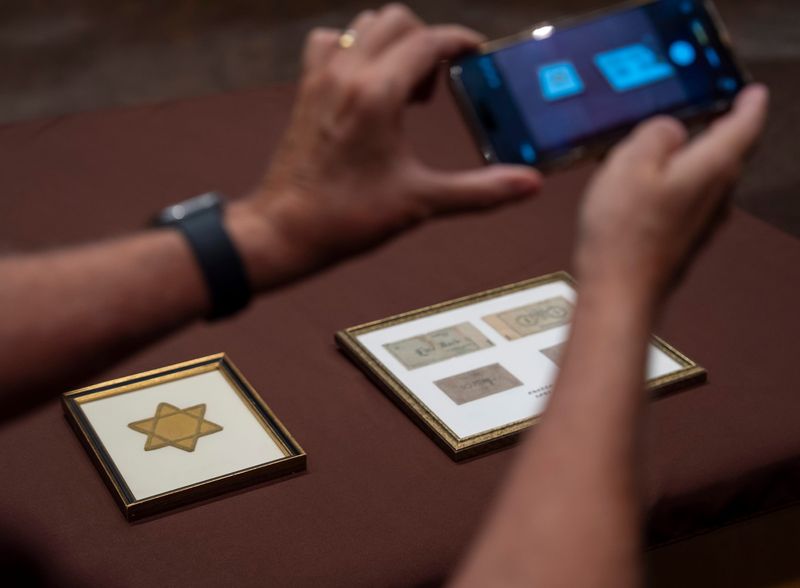
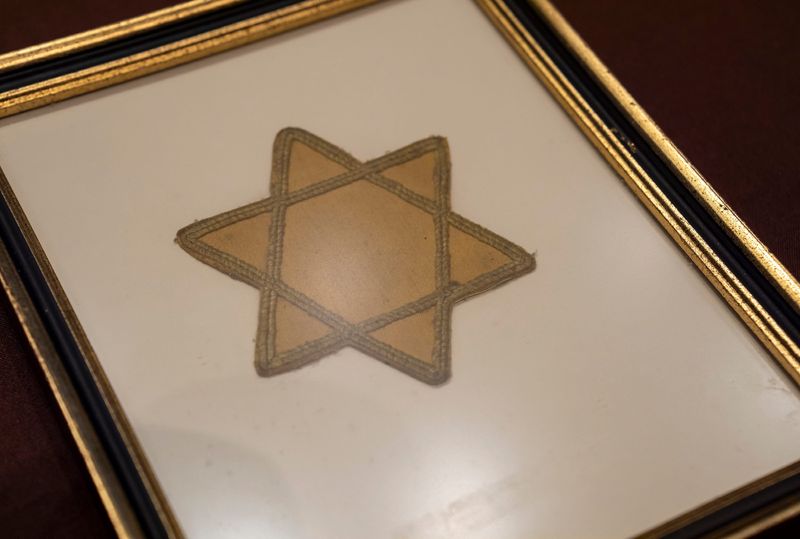
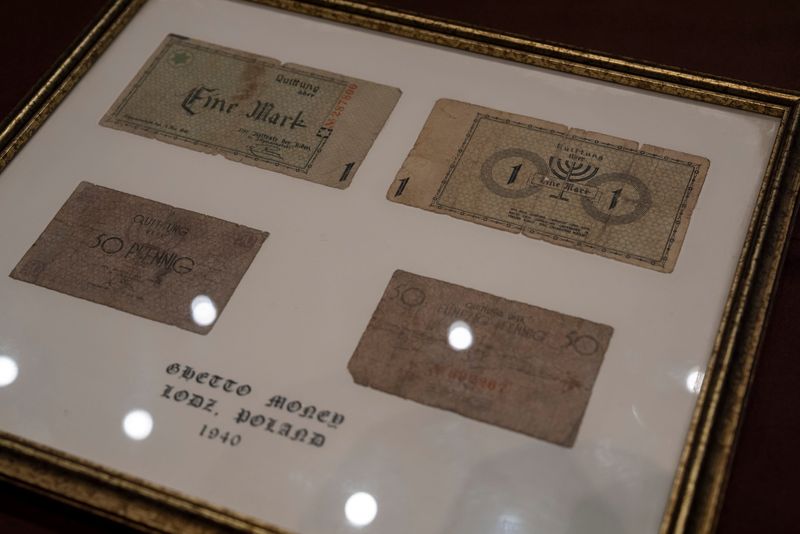
As Cox was sorting through donated items in the store’s back room, she came across a couple of glass frames. Enclosed in one of them was a handwoven Star of David, while the other held some sort of currency.

Right away, Cox said, she could tell that the Star of David was older, cut out and with crude stitching, but when she saw the currency came from the Lodz ghetto — an area of Poland where Nazi Germany incarcerated tens of thousands of Jews — something clicked.
“I started putting them in the boxes, and I took a second look and thought, ‘Holy cow, I think this might be real!’” recalled Cox, who lives in Palm Springs.
As Cox’s mind flashed to black-and-white images she’s seen of Jewish people in the Warsaw ghetto, the largest ghetto in Nazi-occupied Europe, she knew she was dealing with something important. She immediately sent a note to her supervisor.
As Cox suspected, the pair of items came from the Holocaust, the systematic persecution and murder of six million European Jews by Nazi Germany from 1933 to 1945. As part of that system, Jewish people were required to wear armbands or badges with the Star of David as a way for Nazis to isolate, humiliate and intimidate them.
“This is like a first-hand thing. Someone had to sew this on their clothes and be looked down on and spit on because they were Jewish,” Cox said.
Her discovery led workers at Revivals to connect with DAP Health, the health care nonprofit that owns the thrift store, as well as local Jewish organizations. It remains unclear who donated the items to Revivals or why, as the store doesn’t track donors, according to DAP Health CEO David Brinkman.
“Had there been a way, I definitely would’ve reached out,” Brinkman said in an interview this week.
The items found a new home this week at the Tolerance Education Center, a facility in the Coachella Valley that promotes acceptance and educates visitors about the Holocaust. Brinkman presented the artifacts to the center’s leaders during a Rancho Mirage City Council meeting Thursday, June 18.
‘Never allow the past to become our future’
Several people who spoke during the meeting emphasized the artifacts’ importance, particularly amid increases in reported incidents of antisemitism in the United States.
Michele Gold, executive director of the Tolerance Education Center, said the artifacts will serve as crucial tools “to ensure the stories that they carry are not forgotten and that the lessons of the Holocaust continue to inspire vigilance against all hatred and all prejudices and all injustices.”
“As the daughter of a Holocaust survivor, these artifacts are a deeply moving experience,” Gold said, adding the items serve a reminder to younger generations “to never allow the past to become our future.”
The generational lineage was on display during the meeting, as Rose Peppin — a Holocaust survivor who lives in the valley — was in attendance and drew widespread applause upon her introduction.
While the mood at the ceremony was positive, Jewish Federation of the Desert CEO Danny Labin noted the artifacts were being donated at a time when “hatred is resurfacing in ways we haven’t seen, for many of us, in our own lifetimes.”
Labin noted the United States saw over 10,000 incidents of antisemitism in the year following the Oct. 7, 2023 Hamas terrorist attack in Israel, according to data from the Anti-Defamation League. (2024 marked the highest number of antisemitic incidents reported by the organization since it began tracking data in 1978.)
Labin also thanked Rancho Mirage Councilmember Eve Fromberg Edelstein — a DAP Health board member — for ensuring the artifacts remain in the Coachella Valley, where thousands of students visit the Tolerance Education Center on field trips.
“I can imagine that some may have thought (the artifacts) should belong to the Holocaust Museum in Washington or in Los Angeles, but I think the impact they will have here locally is going to be extraordinary, so thank you,” Labin said.
In a video shown during the meeting, Gold noted that the 1940 currency was worthless outside the Lodz ghetto “and almost worthless inside the ghetto,” because prices of goods were deliberately inflated for people living there.
“You can see how worn they are,” Gold said of the money. “Some are slightly torn, and some have marks on them. But to me, the most moving thing about them is imagining the amount of people that have actually touched them.”
Tom Coulter covers local government and politics for The Desert Sun. Reach him at thomas.coulter@desertsun.com.
This article originally appeared on Palm Springs Desert Sun: Holocaust artifacts found at California thrift store will be preserved
Reporting by Tom Coulter, Palm Springs Desert Sun / Palm Springs Desert Sun
USA TODAY Network via Reuters Connect

By Tom Coulter, Palm Springs Desert Sun | USA TODAY Network