Anyone with an ounce of doubt that the scammers aren’t ridiculously clever needs to step back and hear Kendale Dennis teach us a thing or two.
Like many people, Dennis decided to shop online to find a high-paying certificate of deposit for his savings. He spotted what he thought was a good deal at 5.625%. Yet making that kind of money could have cost him big time.

Fraudsters had sneakily set up shop online to promote that CD — and steal cash.
We’ve all heard of crooks selling fake concert tickets, counterfeit medication, and shoddy dresses online. But I’ve never heard a CD saga like this one. Saver beware.
The scammers are out in full force trying to impersonate banks — putting up ads for fake CD deals and investments, spoofing a bank’s website to make you think you’re logging in at the right spot when you aren’t, and yes, trying to get you to panic into thinking that you need to act now because your account has been compromised.
There are even names for some of this nonsense, like, “malvertising,” where scammers buy ads targeting bank customers, redirecting them to fraudulent websites that mimic the bank’s website, and ultimately stealing the customer’s log-in credentials.
CD-related scam sounded fairly convincing, up to a point
As part of the CD scam, Dennis was asked to submit his email and phone number so that the bank could contact him directly. The emails he received back and forth even contained the Fifth Third Bank logo. He has been banking at Fifth Third for decades, so the email was reassuring.
The man he spoke with on the phone was named Andrew Dilz. Dennis called a Fifth Third branch to confirm that an Andrew Dilz worked at Fifth Third. And he did.
Yet Dennis, who is 78 and lives in Tustin south of Cadillac, told me that some things sounded suspicious.
Dilz had a British accent but explained that he had moved from Great Britain to California, where he was working.
And Dennis became suspicious again when the CD seemed to be something from the Federal Farm Credit Bank. Later, the CD shifted over to JMCB Investment LLC. Dilz explained that Fifth Third investment arm could handle CDs from anywhere to offer great rates.
Dennis was to wire his money — $90,000 in savings — from his bank to open the CD.
He drove to the Fifth Third branch in Cadillac to complete the final step.
But the Fifth Third employee at the branch saw red flags and questioned what was really being done here.
Why would you need to wire money out of your Fifth Third account to move it to another account within Fifth Third? Bankers note that you wouldn’t need to do that. She decided to reach out to the real Andrew Dilz, who worked somewhere at the major regional bank, which has customers in 15 states.
And that’s how Dennis discovered that the crooks were not only impersonating his bank but also going a step further and impersonating a bank employee whose name can easily be found online.
Dennis came awfully close, but he didn’t lose his money.
“I thought ‘Thank you, Lord,’ ” said Dennis, who had served for years as a pastor for East Bay Calvary Church in Traverse City before semi-retiring. He’s now a church consultant working with religious communities that are preparing to find a new pastor.
Comerica and Fifth Third customers warned to watch out for scams
Scams seem to be around every corner, text, phone call and potentially big bank acquisition.
The massive $12.7 billion all-stock deal where Cincinnati-based Fifth Third acquired Texas-based Comerica in February could create even more opportunities for fraudsters to play into some potential confusion as some branches are closed and Fifth Third converts all Comerica customers to the Fifth Third system.
Kris Edwards, head of Fraud Prevention at Fifth Third, told the Detroit Free Press that customers will receive letters in the mail to spell out the steps to take as they migrate their online banking from the Comerica system to Fifth Third. And the bank is making clear when customers could be contacted. Some information also will be provided by email.
Fifth Third, he said, is not going to be sending out texts saying anything like: “Welcome to Fifth Third, now log in here to activate your account.” Do not click on any such links, if you see them.
Edwards warned that bank impersonation scams are on the uptick throughout the industry, and bank impersonation scams tripled at Fifth Third from 2024 to 2025.
“It is now our most common scam type we’re seeing,” Edwards said.
While efforts continue to prevent fraud, banking experts say, consumers need to step back and take at least a minute before making any moves that ultimately could drain their life savings.
This year, Fifth Third launched a Report Phishing feature through its SmartShield Security experience on its mobile app where customers can upload suspicious texts and find out whether the text is legitimate.
Fifth Third noted that since the soft launch in January the Report Phishing feature has detected malicious activity and stopped scams. Nearly 25% of user-submitted content was flagged early on as fraudulent, according to the bank’s June announcement.
It’s true that banks will alert customers in many cases when there is fraud or fraud is suspected — but consumers are warned to take extra steps so that they don’t respond to crooks impersonating banks.
Some of the costliest impersonation scams start with a fake security alert, often from a bank, according to the Federal Trade Commission. Such losses often are limited, according to the FTC, only by the amount of money that’s available in someone’s account. The FTC said people reported losing $3.5 billion to a variety of imposter scams in 2025.
Local consumers learn more about protecting their money
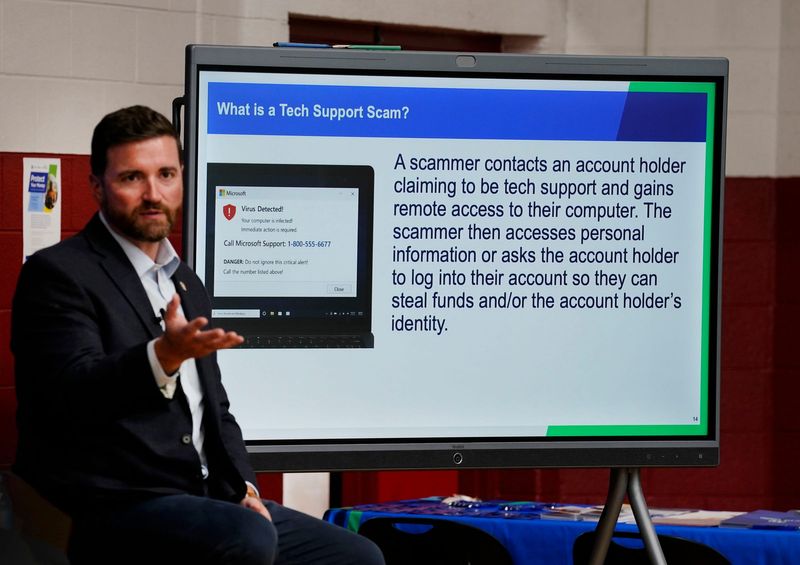
Fifth Third launched a series of community education events in 2026, which kicked off with a “Protect Your Money” program Monday, June 15, at the Matrix Center on Detroit’s east side.
The session gave metro Detroit consumers a chance to vent about their frustrations when it comes to all these texts, emails and calls from scammers.
Denise Davis, 70, of Oak Park, is thankful that she has never been scammed personally. “Not as far as I know,” she told me after event in Detroit.
But Davis said she has received fake alerts that her Amazon account has been compromised and unsolicited inquiries about selling her property. She expressed concern for her mother, who has been targeted by home warranty programs.
Another woman at the event told the group that she receives calls seven days a week about how she qualifies or a $75,000 loan. She isn’t applying for such a loan — and she’s doing her best to report and ignore such calls.
Consumers are advised to let calls they don’t recognize go to voice mail, block calls and not click on links included in any suspicious texts or emails.
“The more you answer, the more they’re going to call,” warned LaToya Hall, SAFE program director at Wayne State University’s Institute of Gerontology.
The Successful Aging Through Financial Empowerment program, known as SAFE, educates seniors, caregivers, and professionals on financial exploitation prevention and financial management. It provides one-on-one services to assist older adult victims of financial exploitation to regain their financial footing.
How crooks use AI and other technology in impersonation scams
What makes bank impersonation scams more worrisome is that the crooks do their research well in advance and increasingly are leveraging AI and technology to make impersonation pitches more sophisticated.
“It’s working, so they’re just going all in on it,” Edwards said.
Bryan Drake, supervisory special agent with the FBI field office in Detroit, shared a particularly chilling story at the Detroit event involving how scammers targeted his great aunt, who is 101 years old and lives in metro Detroit.
“My great aunt received a phone call from her son who told her that there was something wrong with her bank’s username and password and that they needed to be changed,” Drake said.
“She told her son it would take a minute to find her username and passwords. Her son said that is fine and to call him back on the number he called her,” Drake said.
She then gathered all her information.
But when she called back, she did what every person should do, Drake said, and she called her son back from her contact list on her phone — not the phone number that she was given during the earlier conversation.
“This saved her from losing all her money,” Drake said.
When she spoke to her son and said she had everything ready to fix her online bank accounts he said: “What are you talking about? I didn’t call you.”
Drake said the scammers used AI to clone her son’s voice, and she could not tell it wasn’t her own son.
“She could not tell the difference, that it wasn’t her own son’s voice,” Drake said.
All that saved her, he noted, was that she did not call back the number that was left for her to call.
Unfortunately, consumers need to be wary of many texts and calls
“Sad to say but you shouldn’t trust anyone who calls you,” said Paul Benda, executive vice president of risk, fraud and cybersecurity at the American Bankers Association.
Benda shared a story of a friend’s family member who lost thousands of dollars after taking a call from fraudsters impersonating her bank.
The person on the other end of the line knew that the woman’s husband had recently died. (The crooks likely obtained information from obituaries or elsewhere.) They spoofed the bank’s name on the caller ID. (Cyber criminals easily use technology to deliberately falsify the information that shows up on your caller ID.)
After engaging in a conversation, the con artists convinced the widow that she needed to transfer the money in her deceased husband’s account to a new account immediately before fraudsters could tap into it.
What actually happened: The crooks claimed to have opened an account in her name. But the new account was in reality an account opened by the crooks and she transferred the money in her husband’s account to their account.
She lost somewhat less than $10,000. And the money was gone by the time she talked to a friend or relative who told her that it had to be a scam.
Why did she believe these crooks? Well, the person on the other end of phone actually knew her bank account number and other ID information — which made them sound more legitimate.
“What people forget is that they can buy this information on the dark web,” Benda said.
“Pretty much every American has information that’s available for sale online. So just because someone knows your name, where you live and the last four (digits) of your Social doesn’t mean it’s your bank.”
What they’re doing is setting you up to believe a story, possibly one that causes you to panic.
You do not need to ‘move’ your money to protect it
Scammers use all sorts of impersonation tactics to steal your money. This spring, the FBI warned that scammers or a group of scammers — potentially outside of the United States — are reaching out by text messages, emails or phone calls, impersonating federal prosecutors or agents and claiming you have been a victim of fraud or are a suspect in a fraud investigation.
The FBI isn’t going to ask you to send money, Drake warned, to participate in any such investigation. But scammers will try such tactics.
Drake stressed that it’s essential to give yourself 60 seconds, a full minute, to think before responding to any calls that claim to be from law enforcement, your bank or even a utility company, such as Detroit-based DTE Energy, where con artists frequently threaten to shut off your electricity or gas because you didn’t pay the bill.
“They’re trying to get you to act emotionally, instead of rationally,” Drake said.
Once the crooks hook you in, they know a variety of steps to talk you into wiring money directly out of your account. Or they might convince you to withdraw money and send the cash through a bitcoin ATM or even hand over cash to couriers or Uber drivers.
One common pitch is that you need to move that money out of the bank to protect it.
“Your money is safe at your bank. We’re not going to ask you to move your funds to protect them,” Benda said.
Remember, once crooks have those login credentials, they work the system to reset a password and gain full control of your account. And you might not recover the money.
Drake, of the FBI, said it’s important that consumers act quickly to report fraud, especially if they’ve wired money, which has a chance of being recovered within the first 24 hours to 48 hours.
If you lost money, you’re advised file a report with your local police department, contact your bank, and immediately go to the FBI at www.ic3.gov to report fraud. That IC3 site is monitored 24/7 by analysts at the FBI, Drake said, and that team goes straight to the individual banks to try to put a stop to wire transfers in particular to put the money back in a customer’s account. But that can only happen, he said, if a report is made quickly.
In metro Detroit, you can also call the FBI at 313-965-2323 and ask for the duty agent.
Victims age 60 or older who need assistance filing an IC3 complaint can contact the Department of Justice Elder Justice Hotline at 833-372-8311.
Cryptocurrency and other investment scams soar
Drake warns that older adults who have built up savings should remain wary of anyone who tries to encourage them to invest in cryptocurrency, too. The FBI issued an alert Monday, June 15, indicating scammers have been going so far as arranging for couriers to meet the victims in person to retrieve cash for fraudulent investments, such as fake crypto schemes.
New FBI data shows that Michigan ranked in the top 15 nationwide for cybercrime in 2025 with more than 22,000 cases reported. Consumers in Michigan reported losing more than $381 million to cybercrime in 2025, according to FBI data.
The FBI Internet Crime Complaint Center received more than 1 million complaints nationwide in 2025 with $20.87 billion in reported losses, which was up 26% from 2024.
About $2.1 billion was lost in tech support or customer support scams alone, and more than $8.6 billion was lost in investment related scams, based on FBI data.
Adults age 60 and older reported losing nearly $7.75 billion to fraud in 2025, up 59%, according to FBI data. The average loss was $38,500.
According to the FBI report, 201,266 older adults filed complaints with the Internet Crime Complaint Center at www.ic3.gov. That’s up 37% from 2024.
And 12,444 older adults reported losing more than $100,000.
In 2025, those who filed reports nationwide with the FBI’s Internet Crime Complaint Center reported losing $359.7 million alone in what’s known as account takeover scams where crooks impersonate financial institutions. Money from victims can be sent to multiple banks and accounts through ACH transactions.
Brokerage firm customers are hit by account takeover incidents, too. FINRA, the Financial Industry Regulatory Authority, reports that it has seen a notable increase in this type of fraud. Account takeover attempts can also result from data breaches or the sale of stolen customer login credentials on the “dark web,” according to the nonprofit, self-regulatory organization.
Later, victims can also end up being targeted in recovery scams, where crooks claim to help recover lost money only to steal more cash.
Edwards, of Fifth Third, said many times fraudsters will move extremely quickly when it comes to moving money out of accounts through bank impersonation scams — unlike romance scams that can lead to big losses but evolve over months.
“It either works or it doesn’t — and then the fraudsters move on,” Edwards said.
Contact personal finance columnist Susan Tompor: stompor@freepress.com. Follow her on X @tompor.
This article originally appeared on Detroit Free Press: Saver beware: Crooks increasingly impersonate bankers to steal cash
Reporting by Susan Tompor, Detroit Free Press / Detroit Free Press
USA TODAY Network via Reuters Connect


By Susan Tompor, Detroit Free Press | USA TODAY Network