Perhaps you’re not caught up on Michigan’s latest political “oops”: Gov. Gretchen Whitmer was, apparently, caught on a hot mic at a June 1 event at the site of a hyperscale data center in Saline Township. In a video, Whitmer seems to tell Oracle CEO Clay Magouyrk that she had pushed the data center development forward over the objections of residents: “We’re used to people saying f*** no and doing it anyway.”
Reporting on a garbled recording captured at a distance is always dodgy, and this one is especially so.

The governor’s face is turned away from the lens for most of the clip, which is largely inaudible. The sound is clear only for Whitmer’s supposed remark and for Magouyrk’s response, seemingly a compliment to Michiganders’ ability to survive winter.
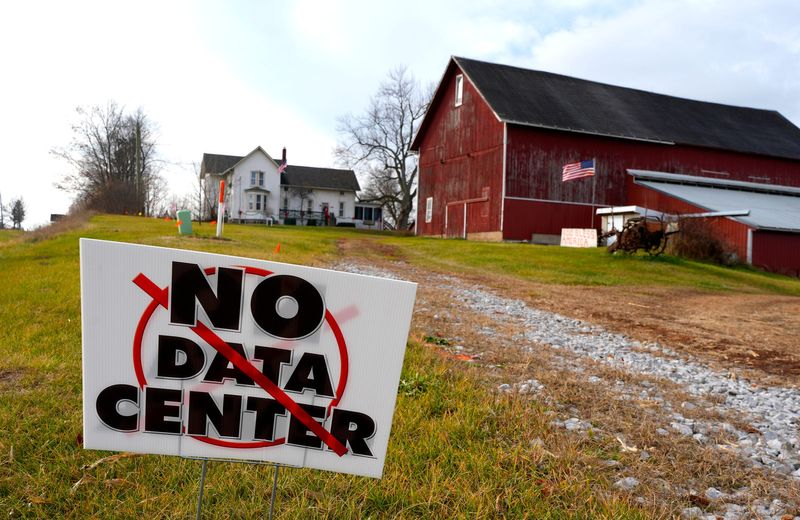
Thanks to the audio quality, there’s no context; Whitmer’s location ― after Saline Township trustees voted the data center down, deep-pocketed developer Related Digital sued ― infers the object.
Days later, a new story broke: Magouyrk and Whitmer maintain that the recording had been manipulated, and that the governor never said anything of the sort. “I guarantee that the clip was not manipulated, and the audio was not manipulated,” videographer Priscilla Creswell told The Detroit News ― but declined to name the individual or organization that paid her to take video at the event, and went on to share critical thoughts about Whitmer’s handling of data centers.
Did Whitmer say it? Was it a deepfake? l have no idea, but the irony is killing me.
Let me put a fine point on that for you: Whitmer claims that a recording of her has been manipulated, in a video taken at the site of an Open AI data center.
AI couldn’t make this up
AI’s ability to manipulate our perception of the world around us grows more sophisticated by the day.
Earlier this month, state Senate Minority Leader Aric Nesbitt, also a GOP gubernatorial candidate, released an AI deepfake campaign ad featuring himself on a tractor, chasing Whitmer and Secretary of State Jocelyn Benson, the Democratic gubernatorial frontrunner, with a “disclaimer” at the end from an AI-generated Attorney General Dana Nessel.
If you’ve met any of these officeholders, it’s clearly a fake.
If you hadn’t? Well, you might be fooled.
In another Nesbitt AI ad, a hulked-out Mike Rogers, the GOP frontrunner for Michigan’s open U.S. Senate seat, terrorizes the women, who are, inexplicably, gathered around a campfire. They’re the first deepfakes I’d been aware of in Michigan politics, but surely won’t be the last.
We’re inserting the infrastructure for this new technology into our communities, and embracing it in our lives, without much thought for the consequences.
When our eyes and ears can’t be trusted
AI data centers in Michigan are largely regulated by a 2024 law offering a rebate for the state sales and use tax in exchange for compliance with certain environmental standards and job creation targets; no word on what will happen if a company chooses to forgo the tax credit. Even some lawmakers who voted for the bipartisan legislation no longer believe it’s sufficient.
There are no federal guardrails for the use of AI, which is trained largely on stolen intellectual property (ask it to write a passage in the style of your favorite author, how do you think it learned to do that?); we regulate television more strictly than this powerful new technology.
In 2024, the New York Times wrote about the troubling phenomenon of high school students snapping pictures of female classmates, then asking AI to make those images sexually explicit.
Three days ago, the Times reported that the world’s leading deepfake expert is worried about his ability to tell real images from manipulated ones, at least quickly enough to make a difference: “Within a year or two, our whole visual system will be utterly useless.”
Americans are abandoning, en masse, traditional institutions, choosing instead to get their news from social media accounts that seem more ready to tell shocking truths than stodgy media outlets that worry about fact-checking and standards. How will we know, as our eyes and ears become less reliable arbiters of truth, what that means?
Where are we going?
Michiganders, whether we’re using Copilot to write emails or ChatGPT to make pics of our cats as international jewel thieves, aren’t enthused about having data centers in our communities. A Glengariff Group poll earlier this spring found that half of respondents wouldn’t want a data center within 25 miles of their home; 49% said they’d be open to hearing more about it, if data centers were well-regulated.
They’re not. And they’re not going to be.
Whitmer is eager to position Michigan on the forefront of the AI boom.
The governor says data centers create jobs. Which is kind of true, if you don’t care whether those jobs are long-term or not; or if, with the projected $1 trillion IPOs of Open AI and Anthropic, the the AI bubble is about to burst; what we’ll do with these data centers when Jeff Bezos puts them on the moon in 20 years or they just empty out (think of how long it took us to solve the Packard Plant or the Silverdome); or if maybe it would be a better idea to preserve Michigan’s natural resources in a world with a rapidly changing climate than to pump them into a risky new technology.
AI just isn’t like other tech. Television, radio, the internet ― all can shape the way we see the world, but they’re not the view itself.
So an audio clip of Gretchen Whitmer, maybe manipulated by AI, maybe not, seeming to say something damning as an AI data center construction site looms in the background?
It may be the moment that, more than anything, encapsulates where we are ― and warns about where we’re going.
Nancy Kaffer is the editorial page editor of the Detroit Free Press. Submit a letter to the editor at freep.com/letters, and we may publish it in print or online.
This article originally appeared on Detroit Free Press: Whitmer’s Saline hot mic furor is a warning about AI and politics | Opinion
Reporting by Nancy Kaffer, Detroit Free Press / Detroit Free Press
USA TODAY Network via Reuters Connect
By Nancy Kaffer, Detroit Free Press | USA TODAY Network