

Chances for the first named storm of the 2026 hurricane season to form this week were tenuous early Wednesday, June 17, as wind shear tore at a raggedy swirl of showers over the Middle Texas coast but the potential for deadly flooding remained.
The National Hurricane Center said Potential Tropical Cyclone One, which has aspirations of becoming Arthur, had a wind field knocked lopsided by westerly gales that prevented a cohesive center to form.

With the system expected to straddle the Texas coast today, unable to fully tap the nourishment of warm Gulf waters, the “prospects for this system to become a tropical cyclone may be decreasing,” NHC meteorologists wrote in a 5 a.m. advisory.
Still, the official forecast calls for the would-be Arthur to briefly gain tropical storm status on the afternoon to evening of June 17 before moving inland and rushing northeast to the Atlantic with an exit over the Carolinas.
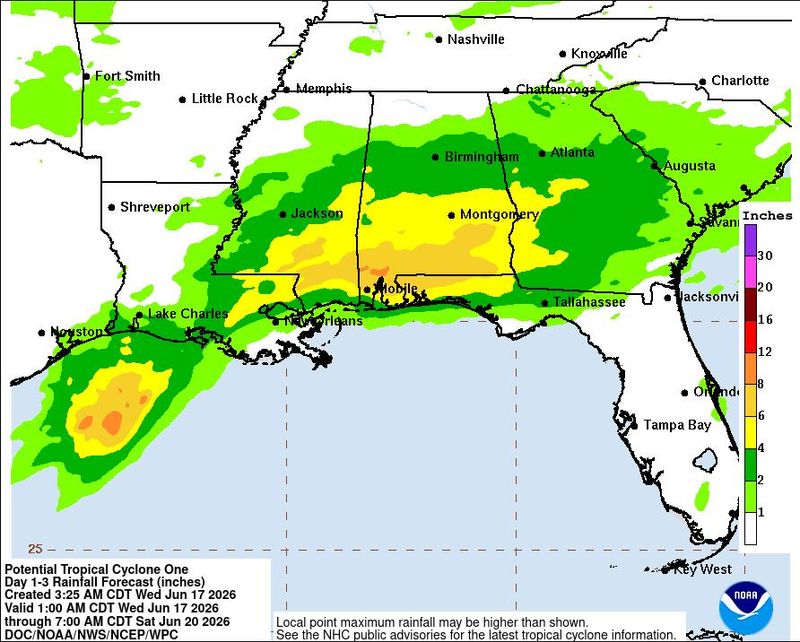
For Florida, the Panhandle from Apalachee Bay to Pensacola is forecast to get 7 to 10 inches of rain through June 24 with eastern Louisiana, Mississippi and Alabama in the heaviest areas for downpours.
Combined with rain that has already fallen this week, National Weather Service meteorologists in Tallahassee said that whatever PTC One or its remnants bring will increase the flash flooding potential for the Thursday to Friday time frame.
“Do not underestimate the impacts of what may be a short-lived system,” Yale Climate Connections meteorologists wrote in their Eye on the Storm blog.
The Weather Prediction Center has a “marginal” to “slight” risk of excessive rain leading to flash flooding into Saturday in the Panhandle. Marginal and slight are the lowest two severity levels on a four-tier scale.
“Despite the fact that there has been a drought, too much rain at one time is never a good thing,” said Andy Hazelton, a scientist at the University of Miami’s Cooperative Institute for Marine and Atmospheric Studies. “We could see a foot to more than a foot in some spots in east Texas and Louisiana.”
Freshwater flooding is one of the leading causes of death in tropical cyclones in the U.S.
While there were no landfalling hurricanes in 2025, Tropical Storm Chantal drowned six people in freshwater flooding in North Carolina after it made landfall July 6. Four people died when their cars were overtaken by floodwaters. Two men died while canoeing on a lake in heavy rainfall, according to the National Hurricane center’s postmortem report on the storm.
“Although it will only have a brief window to exist as a tropical cyclone over water on Wednesday, the primary threat from this system is not wind, it’s water,” said Brian McNoldy, a senior research associate at UM’s Rosenstiel School.
Meteorologists have watched the stirrings of the system for a week, initially giving the embryonic swirl a low chance of formation.
By Monday, it had jumped to an invest and then, on Tuesday, to Potential Tropical Cyclone One, a title that allows the hurricane center to initiate watches and warnings ahead of an official storm formation.
By Tuesday evening, it was trying to consolidate, and working to form a low-level center of circulation, which is a defining signature for a tropical cyclone.
Early Wednesday, the system had sustained winds of 30 mph and was about 35 miles southwest of Port O’Connor, Texas. It was moving northeast at 6 mph.
A tropical storm watch was in effect from Sargent, Texas to the border with Louisiana. A tropical storm warning was in effect from the border between Texas and Louisiana east to Morgan City, Louisiana.
Jeff Masters, co-founder of Weather Underground and a meteorologist with Yale Climate Connections, said the NHC initially lowballed the system’s ambitions.
“It’s in the Gulf of Mexico, it’s warm and there’s plenty of moisture. Things spin up regardless of what the models think,” Masters said.
But the capacity of the system to strengthen appears capped at a barely-there tropical storm. The NHC’s forecast says top sustained wind speeds will reach 40 mph on Wednesday before the system moves inland. Tropical storm-force winds are 39 mph to 74 mph.
A modicum of storm-shredding wind shear and some stifling dry air should keep the lid on the system.
“It may never make it to a tropical storm,” Masters said Tuesday afternoon.
Still, the storm that formed from the remnants of the Pacific’s Tropical Storm Cristina, which passed into the Bay of Campeche, is notable if it becomes the first named storm of the 2026 hurricane season and for gaining gusto from a diving jet stream that will quickly pick it up and carry it northeast.
On average, the first named storm of the season forms by June 20.
While there could be a deluge for parts of the Panhandle, the peninsula of Florida will see little from the system. Drought is still a feature in much of the state and NOAA estimates that North Florida south to the Keys need 18 to 22 inches of rain to get out of drought.
“A lot of the places that will get dumped on need the rain but, unfortunately, we’re not talking about the kind of rain needed to pull all of Florida out of drought,” Masters said.
Kimberly Miller is a journalist for the USA TODAY NETWORK FLORIDA. She covers weather, the environment and critters as the Embracing Florida reporter. If you have news tips, please send them to kmiller@pbpost.com. You can get all of Florida’s best content directly in your inbox each weekday by signing up for the free newsletter, Florida TODAY, at palmbeachpost.com/newsletters.
This article originally appeared on Palm Beach Post: Rain, not wind, biggest threat from would-be Arthur for Florida
Reporting by Kimberly Miller, USA TODAY NETWORK – Florida / Palm Beach Post
USA TODAY Network via Reuters Connect
By Kimberly Miller, USA TODAY NETWORK – Florida | USA TODAY Network
