*Editor’s note: This story is developing and will update.
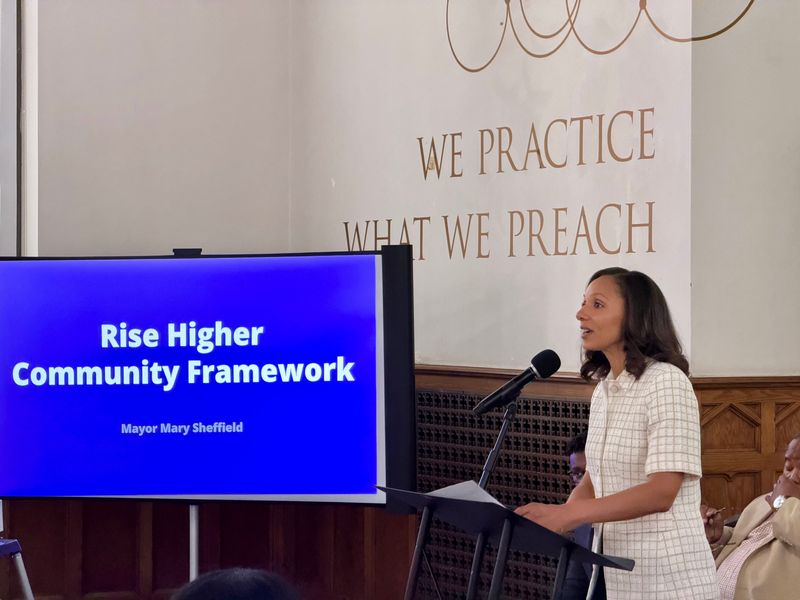
At the beginning of the year, Detroit Mayor Mary Sheffield asked residents to weigh in on their top quality of life concerns in the city. And now, six months later, she is releasing their feedback.

More than 8,000 residents responded to the Rise Higher Detroit survey — representing 39 of the city’s 46 zip codes — on boosting neighborhoods, reliable public transit and infrastructure, job opportunities and training, mental health resources and government services.
“We said from the beginning that this Administration would govern alongside the people of Detroit, and this framework is proof of that commitment,” Sheffield said in a statement. “We reached people all over the city, listened to what they said they needed most and turned those voices into a framework for action.
“This framework reflects the lived experiences, priorities and vision of the people who call this city home, and it will help guide the work ahead as we continue building a Detroit that rises higher for everyone.”
Detroit Action, Eastside Community Network and MI Poder, helped with door-to-door canvassing and at grocery stores, recreation centers, gas stations, churches and other community spaces. The survey was accessible digitally and on paper in English, Spanish, Arabic, Bengali and French.
“The data that came out is a critical asset for us moving forward. It will help us shift the narrative about who we are as a people. It will act as an essential guide that informs every policy and budget decision. It will help us figure out what we need to do better in order to help move the city forward,” said Donna Givens Davidson, president and CEO of Eastside Community Network.
More than 1,200 residents also joined community conversations across the city with high-ranking city officials to discuss challenges and weigh in on possible solutions.
Sheffield has gotten ahead with some initiatives and hires to tackle issues before fully gathering and releasing feedback.
Since taking office, she established the Department of Human, Homeless and Family Services to help residents with housing, homelessness prevention and other support services; launched a plan to install 3,000 new mid-block residential streetlights; launched the Rx Kids cash payment assistance program for pregnant moms and babies; expanded contributions to the city’s Affordable Housing Development and Preservation Trust fund for affordable housing investments; launching an senior affairs office to support Detroit’s elderly population; and launched a plan to speed up permitting to renovate homes and businesses.
Sheffield assured dozens of attendees, ranging from city and philanthropic officials, and community organizers and members that the report “will not just sit on the a shelf in our office:
“It represents the collective voice and vision of our city,” Sheffield said. “It is the cornerstone that this administration will turn to again and again as we shape policy decisions from the people of this great city.
Thriving neighborhoods
Some of the top concerns residents and stakeholders identified in the survey include, cost pressures of maintaining homes, leading to housing instability; uneven access to grocery stores, healthcare, childcare and community spaces; and vacant homes and poor neighborhood maintenance.
Residents urged the city to expand access to programs such as eviction prevention and emergency rental assistance, home repair grants, programs for first-time home buyers and seniors at risk of losing their homes.
Seniors over 75 years old also pushed for more mobile services to bring more resources to the neighborhoods.
Residents also expressed a desire to beautify their neighborhoods, such as reducing blight; fixing streetlights, potholes and sidewalks; and increasing enforcement against abandoned properties and illegal dumping.
Safe and communities
Expanding mental health resources, boosting youth education, as well as job and skills training for at-risk youth also were identified as important to respondents.
The top responses were to strengthen access to quality education for youth across the city, and expand legal representation for low-income residents. Those earning less than $25,000 a year want the city to boost anti-eviction laws and a right to shelter.
Other priority programs include school failure and suspension prevention programs, anti-bullying programs for elementary students, and support for youth experiencing grief, trauma and mental health challenges. Residents also expressed concern for those avoiding services due to fear of Immigration and Customs Enforcement.
Reliable transit and infrastructure
Residents expect a more modern transit system and protection from flooding and failing infrastructure. Several residents have dealt with with basement flooding, often from heavy rainfall, due to drainage failures.
Enhancing transit and bus stops have also been a concern, including missed buses, long wait times, a lack of lighting and shelter at stops, and maintenance of sidewalks, particularly in the winter. Pedestrians also face unsafe crossings, especially near schools, due to speeding and other factors.
Equitable economic and workforce development
Residents said there may be access to short-term and low-wage jobs, but they can be left without benefits orpaths for growth in the city.
Residents said they expect Sheffield to invest in job training, certification and apprenticeship programs, along with services such as transit, childcare, language assistance and housing support.
Others also suggest the mayor boosts access to low-interest loans, seed funding and grants, streamline the city permit and licensing process, and develop small business programs that provide assistance, training and business coaching.
Respondents also suggested growing the local tax base and bringing new businesses and industries to Detroit, however hundreds wrote in with a strong opposition of bringing in data centers.
Residents across all incomes were not supportive of a local sales tax and, instead, recommended “taxing large corporations and billionaire developers to ensure large businesses pay their fair share,” according to the report.
Education and youth opportunities
Residents say expanding affordable programs, such as childcare, and outside of school, having paid opportunities and improving mental health support for youth are a top priority.
To help prevent academic failure, suspensions, violence and bullying in school, respondents suggest identifying development programs for ages 12-19, “evidence-based” violence prevention programs that detect potentially violent situations and change high-risk behavior that supports violence; and online programs that help elementary school students understand ways to prevent bullying, cyberbullying, online dangers and forms of abuse.
Respondents also want to see more jobs and skills training and community-based mentorship programs for at-risk youth. Youth participants under 18 also want more aid toward the college application processes.
Angelique Power, president and CEO of the Skillman Foundation mentioned that many Detroiters said “they want a city that shows up for young people before a crisis…with love for young people that live here, with clear-eyed insight into youth and their power and their potential.”
She also highlighted the city’s boost in after-school program funding, with a goal of placing “a program within two miles of every single school in the city of Detroit…because Detroit has told us what happens outside of the classroom is just as important as what happens inside the classroom.”
Open and accessible government
Improving customer service, increasing transparency and ensuring the highest ethical standards from City government also were high priorities for survey respondents.
Residents say they want the city to improve customer service involving city government functions, along with bringing services to the neighborhoods so they don’t have to travel downtown.
Many said they were frustrated with not knowing who to contact for help in city government, and were open to implementing a single hotline to receive answers without being bounced around to multiple departments.
Dana Afana is the Detroit city hall reporter for the Free Press. Contact: dafana@freepress.com. Follow her: @DanaAfana.
This article originally appeared on Detroit Free Press: Sheffield releases 100+ page report on Detroiters quality of life issues
Reporting by Dana Afana, Detroit Free Press / Detroit Free Press
USA TODAY Network via Reuters Connect
By Dana Afana, Detroit Free Press | USA TODAY Network