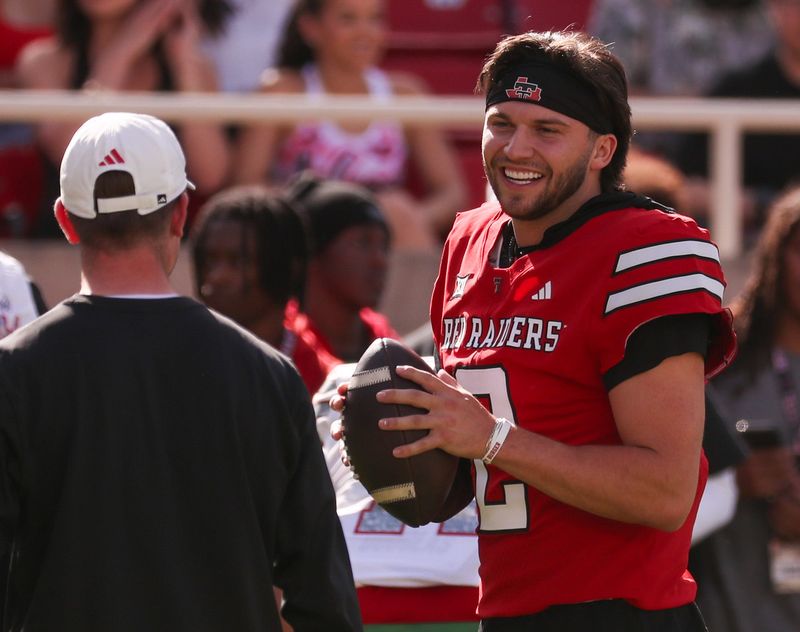
Brendan Sorsby must serve a two-game suspension but then can play for the Texas Tech football team in 2026 after a presiding judge in a Lubbock court granted the senior quarterback an injunction against the NCAA on Monday, June 8.
Sorsby’s legal team headed by New York attorney Jeffrey Kessler and the NCAA’s team led by Taylor Askew presented arguments in the case on June 1 in Lubbock’s 99th District Court.

“This court finds that the Applicant has demonstrated that he will suffer a probable, imminent and irreparable injury if this Court does not issue this temporary injunction,” Judge Ken Curry wrote in his ruling posted early Monday, “because he will be unable to participate as a member of Texas Tech University’s 2026 football team, including Texas Tech’s 2026 football season and:
∎ 1) Benefit from the elite coaching, training resources, camaraderie and regimen that only being a member of a Division I college football team can provide,
∎ 2) Build the skills necessary to maximize his own success during the college football season as well as that of Texas Tech’s football team and each of its players, and
∎ 3) Make an informed decision regarding whether to enter the 2026 NFL Supplemental Draft.
The NCAA had declared Sorsby permanently ineligible for acknowledged violations of its rules that prohibit gambling on college or professional sports in which it sponsors a championship. A May 29 court filing showed that Sorsby had made at least $90,000 in impermissible wagers since 2022 and that he did so at each of his three college stops: in 2022 and 2023 at Indiana, in 2024 and 2025 at Cincinnati and in 2026 at Texas Tech.
As conditions of his granting the injunction, Curry ordered Sorsby to continue clinical counseling individually, participate in peer support through Gamblers Anonymous or a comparable mutual aid community and commence and continue treatment for his diagnosed anxiety disorder.
Sorsby’s counsel must file monthly reports attesting to his compliance with the terms and detailing his activities the previous month.
The ruling drew swift backlash from the NCAA and its president, Charlie Baker.
In a statement to The Avalanche-Journal, the NCAA said it “strongly disagrees with the court’s ruling in this case and is deeply concerned about the damaging, far-reaching and broadly destabilizing ramifications of this outcome — which undermines and corrupts the integrity of sports. The NCAA is committed to supporting student-athlete mental health but must continue to aggressively defend against actions that defraud college athletics and threaten competitive integrity, such as betting on one’s own sport.”
Baker called out the ruling on social media.
“There is no better example of why targeted intervention from Congress is necessary,” he wrote on X. “When you have schools and deep-pocketed supporters willing to look the other way on the glaring integrity threat of betting on your own team — and judges whose rulings effectively strip away our ability to stop them — only Congress can equip the @NCAA to apply this common sense rule to everyone fairly and consistently. The Protect College Sports Act would empower the NCAA to enforce rules including the gambling restrictions — it’s needed now more than ever.”
The NCAA can appeal the injunction.
In an open letter to the university community on May 26, Tech President Lawrence Schovanec said Sorsby was being welcomed back to campus with a support structure in place to support an ongoing recovery with his gambling addiction. Schovanec specifically noted the Center for Students in Addiction Recovery was established in 1986 on the Texas Tech campus.
After Monday’s ruling, Tech released a statement from Kirby Hocutt in which the Tech athletics director said, “As we have said before, we do not believe that the circumstances of Brendan’s case warranted permanent ineligibility.
“As he returns to our football program, we remain committed to supporting Brendan’s recovery and ensuring his compliance with the court’s order. A comprehensive support structure, including clinical care, monitoring, and compliance checks, will remain fully in place for the duration of Brendan’s time as a student at Texas Tech.”
Sorsby was a high school athlete at Corinth Lake Dallas. He threw for 2,800 yards in each of the past two seasons at Cincinnati with 18 touchdown passes in 2024 and 27 touchdown passes last year. He transferred to Texas Tech in January and threw four touchdown passes in the Red Raiders’ spring game.
Tech announced on April 27 that Sorsby was taking leave from the team to enter a monthlong inpatient treatment program for gambling addiction. Simultaneously, news broke that the NCAA had started an investigation into Sorsby’s gambling, long a prohibited activity for players and college athletics employees.
Sorsby’s inpatient treatment took place in Goodyear, Arizona. He enlisted the services of Kessler, who filed a motion for an injunction on May 18. They sought to speed up the process, noting that, in the event Sorsby was barred from playing college football this season, he faced a June 22 deadline to apply for an NFL supplemental draft.
Later that day, Texas Tech announced that the NCAA, Sorsby and Tech had agreed upon a stipulation of facts in the case and planned to seek his reinstatement.
A Texas Tech request for Sorsby’s reinstatement, filed May 19, was denied by the NCAA on May 22. Texas Tech filed an appeal on May 29, and the NCAA denied the appeal on June 5.
Curry, a retired, visiting judge from Tarrant County, was assigned the case on May 21 after the 99th District Court’s Phillip Hays recused a day earlier.
This story has been updated with more information.
This article originally appeared on Lubbock Avalanche-Journal: Texas Tech football QB Brendan Sorsby gets injunction, 2-game suspension
Reporting by Don Williams, Lubbock Avalanche-Journal / Lubbock Avalanche-Journal
USA TODAY Network via Reuters Connect
By Don Williams, Lubbock Avalanche-Journal | USA TODAY Network