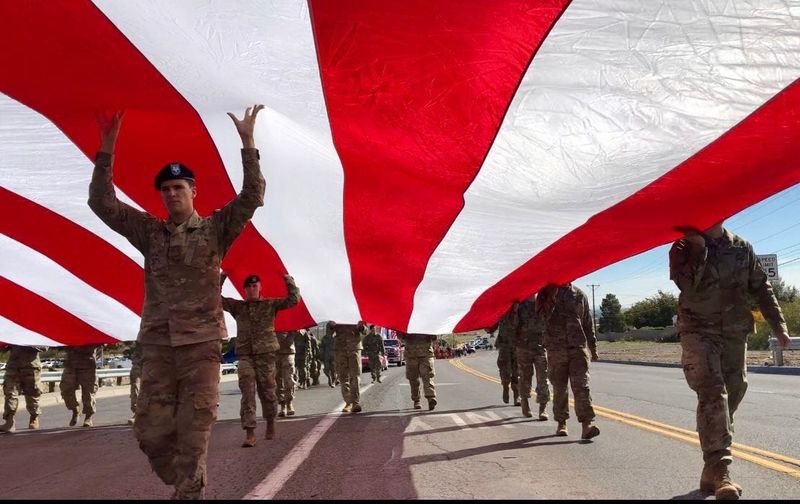
On Sunday, June 14, we will not only salute the Army’s birthday, but we will also celebrate the United States’ symbol of freedom: the American flag.
A flag resolution was adopted on June 14, 1777, that said, “Resolved: that the flag of the United States be made of 13 stripes, alternate red and white; that the union be 13 stars, white in a blue field, representing a new constellation.”

President Woodrow Wilson declared June 14 Flag Day in May 1916. Though it’s observed nationally, Flag Day is not a federal holiday.
Flag Day was first observed in 1877. President Harry Truman established Flag Day as a national holiday in 1949.
Following are some tips for properly displaying your U.S. flag:
America’s flag
The 50 stars and 13 stripes that make up the U.S. flag will celebrate its 66th birthday on July 4. Hawaii became the 50th state in 1959, and on July 4, 1960, the flag’s current design was officially adopted.
What do American flag’s colors represent?
The colors red, white and blue did not have meanings when the flag was adopted in 1777. However, when the Congress of the Confederation chose red, white and blue for the Great Seal of the United States in 1782, the meanings were listed as:
How to properly display U.S. flag
Flag etiquette ensures the flag is treated with respect. Congress established the U.S. Flag Code in 1942, which outlines standards for flag care and display.
The guidelines of flag etiquette are:• The position of honor: When displayed with other flags, the U.S. flag must always be to its own right (the observer’s left) and at the highest point. No other flag may be flown higher.• Never let it touch the ground: The flag should never touch anything beneath it, including the ground, floor, water or merchandise.• Respectful display: The flag should only be displayed from sunrise to sunset unless properly illuminated during darkness. It should be raised briskly and lowered ceremoniously.• No marks or modifications: The flag should never have any mark, insignia, letter, word, number, drawing placed on or attached to it.• Proper use in clothing and decor: The flag should never be used as wearing apparel, bedding or drapery. For decoration, use patriotic bunting with the blue stripe at the top.• Distress signal: The flag should never be displayed with the union (the blue field of stars) down, except as a signal of dire distress in instances of extreme danger to life or property.• Proper disposal: When a flag is torn, faded, or no longer fit for display, it should be destroyed in a dignified and respectful way, preferably through a ceremonial burning. Many local chapters of the American Legion or VFW offer official flag-retirement drop boxes and ceremonies.
When should flag be flown at half-staff?
The flag should fly at half-staff for 30 days at all federal buildings, grounds, and naval vessels throughout the United States and its territories and possessions after the death of the president or a former president. It is to fly 10 days at half-staff after the death of the vice president, the chief justice or a retired chief justice of the United States Supreme Court, or the speaker of the House of Representatives. For an associate justice of the Supreme Court, a member of the Cabinet, a former vice president, the president pro tempore of the Senate, the majority leader of the Senate, the minority leader of the Senate, the majority leader of the House of Representatives, or the minority leader of the House of Representatives the flag is to be displayed at half-staff from the day of death until interment.
The flag is to be flown at half-staff at all federal buildings, grounds and naval vessels in the Washington, D.C., area on the day and day after the death of a United States senator, representative, territorial delegate, or the resident commissioner from the Commonwealth of Puerto Rico. It should also be flown at half-staff on all federal facilities in the state, congressional district, territory, or commonwealth of these officials.
Upon the death of the governor of a state, territory or possession, the flag should be flown at half-staff on all federal facilities in that governor’s state, territory or possession from the day of death until interment.
The president may order the flag to be flown at half-staff to mark the death of other officials, former officials, or foreign dignitaries. In addition to these occasions, the president may order half-staff display of the flag after other tragic events.
Protocol of flying U.S. flag at half-staff
• Hoist: Briskly hoist the flag to the very top (the peak) of the pole for an instant.• Lower: Solemnly lower it to the halfway point. This point is exactly halfway between the top and bottom of the staff.• Retirement: At the end of the day, before bringing it down for the night, you must raise the flag back to the peak momentarily, then lower it ceremoniously.• Memorial Day rule: On Memorial Day, the flag is flown at half-staff only until noon, then raised to the top for the rest of the day.
Displaying multiple flags
• No flags above the U.S.: When the U.S. flag is flown alongside state, local, or institutional flags on the same halyard, it must always be at the peak.• Lowering together: If the U.S. flag is lowered to half-staff, any other flags flown with it must also be lowered to a position visibly below the U.S. flag.
Where to dispose of American flags
Several VFW and American Legion locations in El Paso accept flags for retirement
Unserviceable flags may also be dropped off at the Old Glory Memorial, located at 9500 North Gateway Blvd. and at the El Paso County Sheriff’s Headquarters, 3850 Justice Drive. They feature a 24/7 lobby drop box in partnership with the National Flag Foundation.
For the complete and official Federal Flag Code, consult the guidelines published by the U.S. Department of Veterans Affairs.
Trish Long may be reached at tlong@elpasotimes.com.
This article originally appeared on El Paso Times: Are you flying the American flag correctly?
Reporting by Trish Long, El Paso Times / El Paso Times
USA TODAY Network via Reuters Connect
By Trish Long, El Paso Times | USA TODAY Network