General Motors brands are on the cutting edge of hands-free driving. The General also has a feet-free success story to tell.
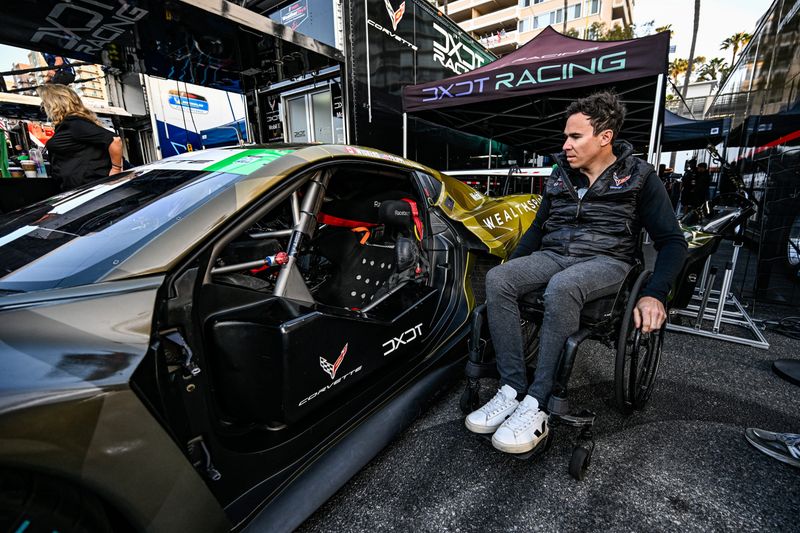
Using an innovative hand-control system, paraplegic Chevrolet Corvette race driver Robert Wickens is one of the fastest drivers in IMSA WeatherTech Sportscar GTD-class racing.

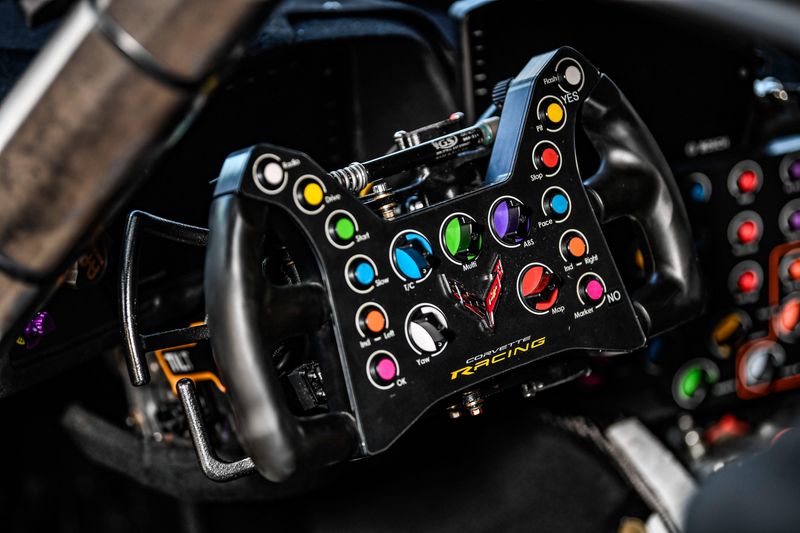
The so-called Bosch electronic braking system, developed in conjunction with GM and Corvette Racing team Pratt Miller in New Hudson, is an evolution of what Wickens has used since returning to motorsports in 2022 after a horrific IndyCar crash at Pocono Raceway in 2018. Wickens and his engineers — with physical assist from ex-Saginaw Valley State football standout Josh Gibbs — have developed a system that works seamlessly with teammates and offers potential for the broader consumer marketplace in an age when electronic systems make foot pedals redundant.
“It’s a full, brake-by-wire, closed-loop system designed by Bosch,” Wickens said in an interview after the Detroit Grand Prix, referring to the system that features parallel, pants-hangar-shaped brake (top) and throttle (bottom) paddles on the back of the steering wheel that work in tandem.
“The coolest part is I’m the only disabled driver in the IMSA WeatherTech SportsCar Championship,” he continued. “From a competitive standpoint, I share the car with up to four drivers (for a 24-hour race). So when I get out of the car, I turn my system off, and the normal throttle and brake become active again for my able-bodied teammates. No compromise.”
Wickens was the most famous driver not on the track at last weekend’s Chevrolet Detroit Grand Prix Presented by Lear. Given the tight, 1.7-mile downtown course’s configuration and limited paddock space, the IMSA limited the entry to 21 full-season team cars from the GTP prototype and production-based GTD Pro classes — eliminating smaller teams in the LMP2 prototype and GTD classes that compete at bigger venues like, say, the Long Beach Grand Prix in April.
At Long Beach, Wickens scored GTD pole position in DXDT Racing’s #36 Chevrolet Corvette Z06 GT3.R.
At the Detroit GP, he worked his other job — Andretti Global team driving coach — where he helped Will Power qualify on the front row and Kyle Kirkwood to finish on the podium in second.
Between driver sessions crunching data, he was a guest speaker at a Bosch forum that explored the topic of “Motorsport Validation: The vital role of motorsport as an extreme environment for validating and developing cutting-edge technologies.”
A gifted driver, Wickens, 37, earned pole position in his first IndyCar race in 2018. The Canadian native was running fourth at Pocono Raceway that year when a violent accident left him without the use of his legs. Inspired by the example of paraplegic Alex Zanardi — who lost his legs in a 2001 IndyCar wreck only to return to GT racing two years later — he recovered to continue his career.
“I had the privilege of talking with Alex about hand controls and his takeaways on what he would change,” said Wickens. “The first thing he told me was I needed to have the brake on the back of the steering wheel so I could have two hands on the wheel all the time.”
Like Zanardi, Wickens used mechanical controls — including a center console-based handbrake — when he returned to racing with the Hyundai racing team in the IMSA Michelin Pilot World Challenge in 2022. Picking up where he left off four years before, he scored a third-place podium finish at Daytona in his first race back at Daytona. The next year, he won the series.
The big technology breakthrough came in 2024 when Bosch developed the drive-by-wire, hand-control solution.
“It was really important to get the brake and the throttle on the steering wheel, so (I could) have more control of the car,” Wickens said. “That was always a main point of my design options because of grip strength. You can only squeeze a handle so much, right?”
When he signed with DXDT Racing for the 2025 season, GM and its racing team, Pratt Miller — which provides engineering support to Corvette teams around the world — joined the Wickens/Bosch partnership.
“Robert Wickens is a great racer. When this project came about, we wanted to be part of it and … create the system that works for him,” said GM Vice President for Performance and Motorsports Jim Campbell. “Rob and his team are in a real groove right now. When rotated out of the car (in Long Beach) — and the other driver rotated in — the fans went crazy because they saw the job that he did.”
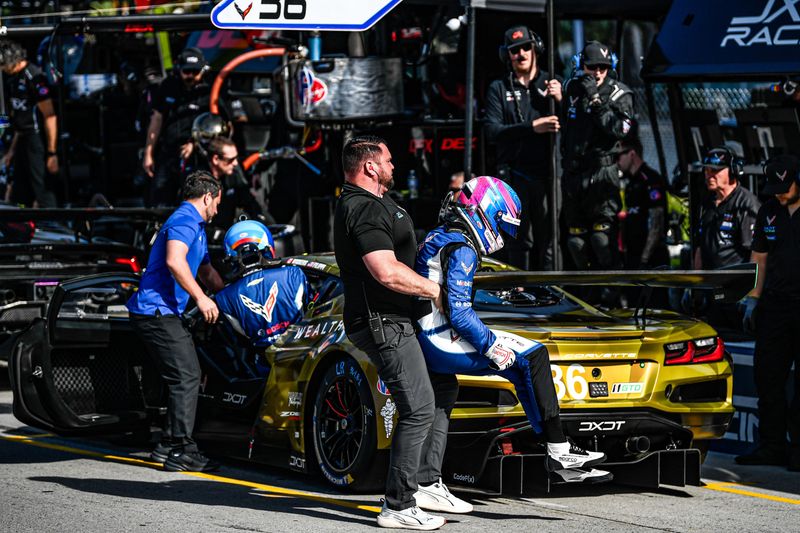
Wickens led every lap of his first stint. Then he handed the controls to his teammate, Mason Filippi.
It’s one thing to go fast on a hand-control system, but it’s another to integrate into a team. Wickens now competes in endurance racing, where driver switches can make or break a race.
“We had the fifth-fastest driver change of the entire race — something like 16 seconds,” Wickens said. “Long Beach is unique — like Detroit. Typically, you don’t change tires because of how short the race is, and you don’t need much fuel. So, you’re only taking on 18 seconds of fuel, and if you’re slower than that, the driver change will be the limiting factor, and so that was a huge focus for us.” (Fuel stops take 40 seconds in a 24-hour race like Daytona.)
With that goal in mind, Pratt Miller helped Bosch engineer the Corvette so Wickens and co-drivers could share the same wheel. A switch renders Wickens’ electronics moot, so his teammate can take over.
“Pratt Miller was massively helpful, obviously,” said Wickens. “Their knowledge of the Corvette Z06 GT3 is better than any. The amount of the attention to detail was honestly better than I ever could have imagined. The meetings, the rapid production prototypes, and making sure that the ergonomics worked was everything. It was really a very enjoyable project.”
For all of its state-of-the-art electronics, Wickens’ system also requires good ol’ fashioned muscle.
Leslie-based Gibbs, a former all-conference center for Saginaw Valley State University football and a fitness expert, has lifted Wickens in and out of race cars since 2022. Gibbs had experience helping paraplegic IMSA Michelin Pilot Challenge driver Michael Johnson prior to hooking up with Wickens.
“It’s crazy how effortlessly Josh can toss me around getting in and out of the car,” Wickens told ESPN in 2022.
The experience of Wickens, Zanardi, and Johnson indicates the potential for Bosch’s system to keep alive the racing hopes of disabled racers. But Wickens sees broader applications for a drive-by-wire wheel — whether to assist wheelchair-bound daily drivers like himself or even able-bodied drivers who want only hand controls.
“I think it’s about time that there’s a big advancement in that field,” said Wickens, whose daily driver is a BraunAbility vehicle that uses old-fashioned push-pull sticks for throttle and brake. “What I would love to have in the future — in addition to specing your new vehicle for paint color, upgrade packages, wheel size — is a hand-control option installed from the manufacturer. It will be ergonomically designed with cruise and radio controls … even gear selection.”
The future looks bright. But for now, Wickens is concentrating on winning an IMSA title for DXDT Racing. Next stop: Watkins Glen, June 25-28.
“It’s been a long road,” Wickens said. “But the big thing was the collaboration between Corvette Racing, Pratt Miller, and Bosch. Several cooks in the kitchen, but everyone just worked seamlessly.”
Henry Payne is auto critic for The Detroit News. Find him at hpayne@detroitnews.com or @HenryEPayne.
This article originally appeared on The Detroit News: How Corvette racer Wickens became the fastest paraplegic on Earth
Reporting by Henry Payne, The Detroit News / The Detroit News
USA TODAY Network via Reuters Connect
By Henry Payne, The Detroit News | USA TODAY Network