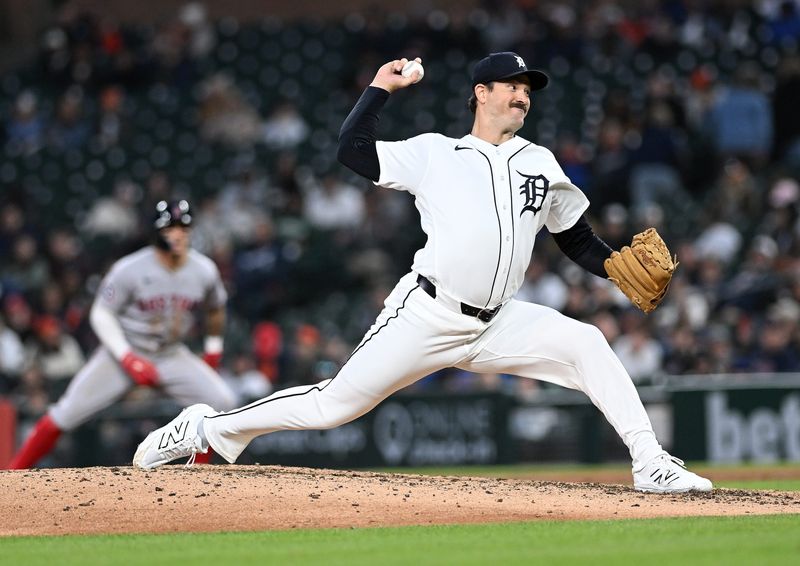
Detroit — Until Wednesday, Tigers’ right-hander Drew Anderson had to live with those two game-flipping pitches he made against the White Sox over the weekend.
But finally, five days after Miguel Vargas walked him and the Tigers off in the 10th inning and three days after he gave back the lead on a solo homer by Colton Montgomery in the seventh inning Sunday, he got to take the first step toward truly flushing those memories.

“Actually, that time in between was huge,” he said. “Just for the rest.”
Anderson pitched a clean, 12-pitch ninth against the Rays in Tampa, even earning a strikeout with the pitch that bedeviled him in Chicago.
“It still works,” he said, a little self-deprecatingly.
The kick-change, the pitch that changed the trajectory of his career and has made him arguably the most consistent swing-and-miss and strikeout pitcher in the Tigers’ bullpen, failed him last weekend, briefly, but with dire consequences.
The Vargas walk-off was especially vexing because the kick-change had been so sharp over his previous five outings when he didn’t allow an earned run over 14 innings with 16 strikeouts.
Even in the at-bat before Vargas, he’d struck out Sam Antonacci with a nasty kick-change. But he started leaving them up, almost immediately after that one. He got away with a hanger to former Tiger Derek Hill.
He got strike one on Vargas on a kick-change that also stayed up but darted to the inside edge. The next one, 90 mph, spun right over the heart of the plate.
It’s where he left another 90-mph kick-change to Montgomery two days later. A 90-mph changeup with no kick is just a bad fastball and the hitters reacted accordingly on both.
“For sure it was a mechanical thing,” said Anderson, who on the season is holding hitters to a .222 batting average (.161 expected batting average) and getting a 36.2% whiff rate and 34% strikeout rate with the pitch. “I was probably getting out front too much. On that walk-off, I was just trying to spin it and have it go where it wanted to and have that same action. It just didn’t.”
It looked like Anderson, one out away from locking down a huge win, rushed the 0-1 pitch.
“Maybe,” he said. “When you rush, everything gets out front and that’s when it gets flat. When I stay back on it and I’m able to my arms out in front of me, then I get the good movement.”
Anderson was a starter the two previous seasons in Korea and he was signed by the Tigers for $7 million initially to be in the rotation. He’s admitted that transitioning to a bullpen role, especially one as diverse as his, has been tough. Specifically tough to get into a proper routine.
“You don’t get those extra days to rest and there isn’t that one open day to work,” he said, referencing the between-starts bullpen session starting pitchers get when they pitch every fifth or sixth day. “I can do everything I need to do in catch play, but it’s not getting off the mound.”
The Tigers have tried to be cognizant of how Anderson bounces back after outings. He’s pitched on back-to-back days only once. He’s pitched five times with one day between, three times with two days between, six times with three days between and five times with four days between.
His outings have varied from one hitter to 4.2 innings.
Before the Chicago series, he’d thrown 189 pitches in four outings in 12 days. Fatigue might have been a factor in the way his kick-change flattened out against the White Sox.
“The same thing happened last year (in Korea),” he said. “I started to get a little bit tired and I think everything (arm angle, velocity) started to drop down a little. But that was when I was starting and it was the end of the season.”
Pitching in shorter, more intense bursts more frequently creates a different type of stress on a pitcher, as any seasoned reliever will tell you. It takes time to build your routines to handle it.
“That’s why those extra days were big,” he said. “I felt a lot fresher (on Sunday).
Kenley Jansen, the game’s active saves leader, is the only Tigers’ reliever with a higher strikeout rate (30.6%) than Anderson (28.5%). And with Jansen still on the injured list for at least another week, Anderson will likely remain an option for manager AJ Hinch late in close games, along with Will Vest and Kyle Finnegan.
He is better equipped, perhaps more calloused, for the role after taking those two punches from the White Sox.
“It’s something where I recognized what the issue was and I know how to deal with it,” he said. “It will be back to where it was.”
Mariners at Tigers
First pitch: 1:10 p.m. Saturday, Comerica Park, Detroit
TV/radio: Detroit Sports Net, 97.1/107.9 FM
Scouting report
RHP Bryce Miller (1-0, 1.71), Mariners: The start of his season was delayed by a left oblique strain, but he’s wasted no time getting back in a groove. In four games (three starts), he’s allowed four earned runs with 20 strikeouts and four walks in 21 innings, while holding hitters to a .200 average, .320 slug and a 25% hard-hit rate. His four-seam fastball has ticked up, from 94.8 mph on average last season to 96.7. He’s splitter is also 2 mph firmer. And in case that’s not enough, he mixes sliders, cutters, sweepers (to righties) and knuckle-curves (to lefties).
RHP Keider Montero (2-3, 3.69), Tigers: He’s coming off a gem against the White Sox (six, two-hit, shutout innings in 65 pitches). His improvement against left-handed hitters has taken his game up a level. In his career, lefties have a .449 slug and .771 OPS against him. This season, he’s neutralized them, .378 slug, .644 OPS. Lefties are 18 for 105 (.171) against his four-seam, changeup and slider combo.
Chris.McCosky@detroitnews.com
@cmccosky
This article originally appeared on The Detroit News: Tigers reliever Drew Anderson bruised, not broken after two haymakers
Reporting by Chris McCosky, The Detroit News / The Detroit News
USA TODAY Network via Reuters Connect
By Chris McCosky, The Detroit News | USA TODAY Network