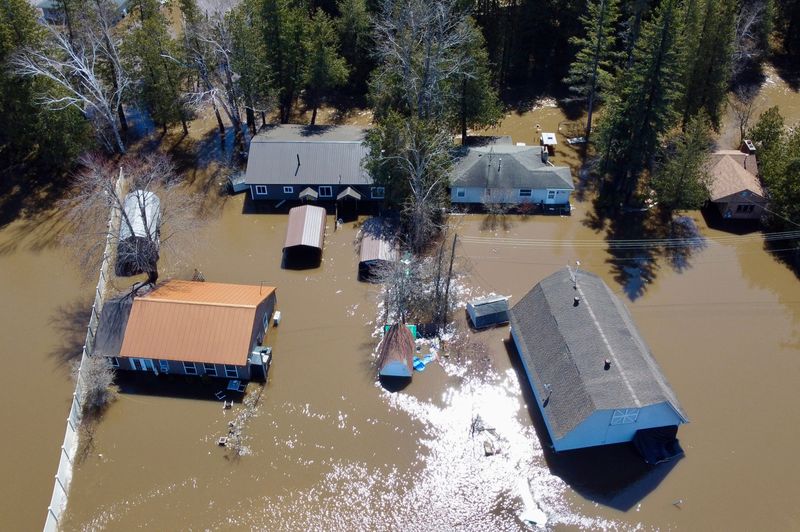
Gov. Gretchen Whitmer on Friday, June 5, asked President Donald Trump to issue a presidential disaster declaration for 43 Michigan counties that suffered several flooding in April, as well as nine confirmed tornadoes.
“The severe storms, flooding and tornadoes that struck Michigan in April left a devastating impact on communities across more than half of the state, destroying and damaging homes, businesses, and roads,” Gov. Whitmer said in the June 5 press release. “While recovery efforts are underway, many residents and local governments face difficult and costly challenges. This request for a major disaster declaration will help ensure affected families and communities have access to the resources they need to recover, rebuild and move forward.”

From April 10-21, severe weather produced tornadoes, damaging winds, large hail and heavy rain to cause flash floods. Multiple rounds of severe thunderstorms and heavy rainfall between April 13-18 produced tornadoes, damaging winds, large hail, flash flooding and major river flooding across much of Michigan.
Hundreds of residents were displaced or stranded by floodwaters, numerous roads were flooded or washed out, and several dams required close monitoring due to overtopping and failure concerns, the release said.
“The scale and severity of this disaster demanded an unprecedented damage assessment effort involving local, state and federal partners,” said Col. James F. Grady II, director of the Michigan State Police and state director of Emergency Management and Homeland Security. “Federal disaster assistance is vital for community recovery, enabling the restoration of essential services and the rebuilding of homes and infrastructure.”
“During April, the National Weather Service issued a record 13 flash flood warnings, 24 flood warnings and 25 flood advisories across Michigan,” according to the release.
Gov. Whitmer wrote to Trump asking that he initiate a presidential disaster declaration to help affected homeowners and renters, and reimburse local governments, certain nonprofit entities, and tribal agencies for response costs.
Ahead of the request, to evaluate its eligibility Michigan conducted its largest Joint Preliminary Damage Assessment (PDAs) to date with the Federal Emergency Management Agency, and the U.S. Small Business Administration (SBA). The survey determined that April’s weather damage met federal thresholds for a Major Disaster Declaration, Whitmer said in the release.
“Governor Whitmer’s request will be reviewed by FEMA which will advise President Trump on whether a disaster declaration is warranted,” the release said. “The final decision rests with the president.”
Here’s more on what a disaster declaration process:
What does a state of emergency, disaster mean?
The state of emergency declared by Whitmer during the flooding on means all state resources may be used to assist local authorities and first responders.
The declaration allows impacted residents to receive financial assistance to cover emergency response, and damaged infrastructure damaged costs.
A state of emergency is possible under the Michigan Emergency Management Act.
MSP Emergency Management and Homeland Security Division coordinates the state’s emergency response through the State Emergency Operations Center — a facility in Lansing where state, local and federal agencies plan a disaster response.
Where is Whitmer seeking aid?
Based on the results of damage surveys, the state has requested:
The governor has requested the activation of all the Federal Emergency Management Agency’s (FEMA) Individual Assistance programs for 37 counties, including Alcona, Allegan, Alpena, Antrim, Arenac, Barry, Benzie, Charlevoix, Cheboygan, Clare, Crawford, Emmet, Grand Traverse, Gratiot, Iosco, Kalamazoo, Kalkaska, Lake, Leelanau, Manistee, Mecosta, Missaukee, Montcalm, Montmorency, Muskegon, Newaygo, Oakland, Oceana, Ogemaw, Osceola, Oscoda, Presque Isle, Roscommon, Saginaw, Shiawassee, Washtenaw, and Wexford.
All categories of the Public Assistance (PA) program have been requested for 26 counties, including Alcona, Alpena, Benzie, Charlevoix, Cheboygan, Crawford, Eaton, Emmet, Grand Traverse, Gratiot, Iron, Kalkaska, Lake, Manistee, Marquette, Mecosta, Menominee, Missaukee, Montmorency, Newaygo, Ogemaw, Osceola, Oscoda, Presque Isle, Tuscola, and Wexford.
How is a disaster declared? What has to occur?
In the aftermath of a natural or human-made disaster, the scope of the response starts with local authorities, including police, fire or emergency medical services, according to the MSP’s Disaster Declaration Process webpage.
After their initial assessment, other local departments may step in, including the local Emergency Management Coordinator. The EMC may recommend local state of emergency.
If the disaster is too large for local authorities to handle, a state of emergency or state of disaster is requested from the governor.
Before the state steps in to help, it’s typical for the local emergency management programs to ensure that the local efforts were utilized to the maximum extent.
“State disaster assistance is used to supplement local efforts and resources, and to help relieve extraordinary burden,” according to the Disaster Declaration Process website. “It is not to be used for simple budgetary relief or to relieve hardship.”
An official document is signed by the governor to create the state of emergency.
What happens if state assistance is not enough?
If state and local efforts are falling short to provide full aid, then the governor may request assistance from the federal government through the U.S. Department of Homeland Security, Federal Emergency Management Agency and Region V Office.
After the request, FEMA surveys the damage called the Preliminary Damage Assessment.
“FEMA will review the request and make a recommendation to the President, who will make the final determination on any disaster aid to be provided to the state,” according to the Disaster Declaration Process. “The goal of disaster assistance is not to make individuals, businesses or government entities whole again, but to restore the community to a level that meets expected health and safety considerations.”
Contact Sarah Moore @ smoore@lsj.com
This article originally appeared on Lansing State Journal: Whitmer seeks disaster declaration for floods, tornadoes. What that means
Reporting by Sarah Moore, USA TODAY NETWORK / Lansing State Journal
USA TODAY Network via Reuters Connect
By Sarah Moore, USA TODAY NETWORK | USA TODAY Network