The high prices for new and used cars along with steep interest rates on vehicle loans, means many people are hanging onto their cars longer, putting the service lane front and center as a key profit center for most dealerships these days.
But the competition between dealerships and independent repair shops for customers is fierce, with car owners increasingly opting to go to the mom-and-pop shops rather than their dealerships on the perception that prices will be lower and it will be faster to get in and out the door.

Studies show those perceptions may be wrong, and pricing is varied. It’s partly for those reasons that Ford Motor Co. has launched a new nationwide marketing campaign to promote its dealerships as the best option for Ford car owners who need service work.
On June 1, Ford launched the “Real Parts. Real Pros. Real Easy.” campaign. Ford will run three, 30-second television spots and various social media ads of the campaign through the end of the year. It has been so long since Ford did a national marketing campaign touting dealership service work that Ford’s director of corporate service performance could not even remember the last one. But the time for this one is now, he said.
“We know there’s more competition in the marketplace for vehicle service and we know there’s perception out there,” said Todd Rabourn, Ford’s senior director of service performance. “We want to tell our story as to why Ford is the best place to get service and summertime is approaching, with people hitting the road more, so we think it’s the best time to tell that story.”
Losing customers early
According to S&P Global Mobility, the average age of vehicles in the United States reached 12.8 years in 2025, marking the second consecutive year of an increase in vehicle age by two months. The fact that people are holding onto their cars longer reflects broader changes in consumer buying trends amid a challenging economy, as well as the durability of modern vehicles.
For all automakers, not just Ford, it means dealerships’ fixed operations — or service and parts departments — are critical profit makers for servicing aging cars.
“We’re seeing an industry where consumers are handcuffed to their current vehicle because of the high interest rates on vehicles,” said Skyler Chadwick, director of product consulting at Cox Automotive. “Those consumers have no choice except to service their vehicle. So fixed ops is a huge opportunity for any automaker’s brand right now, because they have a good opportunity to make sure that they retain that customer in the ecosystem.”
The data shows that nearly three-fourths of customers who get their service work done at a dealership will buy their next car from that dealership, Chadwick said. Chadwick’s data is from the 2026 Fixed Operations and Ownership Study by Cox Automotive released in April. Cox Automotive said it fielded the study in the fourth quarter of 2025 and surveyed 500 dealership fixed-operations “decision makers” and 2,500 consumers who have had a service visit within the last 12 months.
The study showed that car owners are increasingly using the independent service shops more than dealerships. In 2018, there were about 266,000 independent auto repair shops in the United States. In 2025, that number jumped to about 300,000. At the same time, Chadwick said dealer share of service visits fell over the last eight years to 29% from 33%.
Also alarming, he said, is that more customers are leaving the dealership service lane for independent shops by their second year of ownership of the car — while still under warranty.
“Those trends are showing that dealerships are losing consumers earlier than what we thought,” Chadwick said. “It means that we’re not doing a great job at retaining customers in the ecosystem.”
Pricing misperception
Chadwick said part of the problem is communication and perception. There is a perception that independent shops offer cheaper prices, but Chadwick said the study found that average spend on general service at a dealership is $261 compared with $275 at an independent shop. General service includes such maintenance as oil changes, filter changes or tire rotations.
Chadwick said many dealerships often fail to be transparent about pricing on their websites and when people go to book service at a dealership, there may be a wait that runs into weeks. Both of those are turnoffs that drive away customers, he said.
Ford dealer Todd Szott said he’s frustrated by consumers believing they will get a better price at an independent mechanic, noting that most dealerships are competitive on prices and “perception isn’t reality.”
Szott is a dealer partner in Szott Auto Group that owns Szott Ford in Holly; Szott Jeep in White Lake; Szott M-59 Jeep in White Lake; Szott M-59 Chysler Dodge Ram in Highland; Szott I-96 Chrysler Dodge Jeep Ram in New Hudson, and Szott M-59 Toyota in Waterford. He said they provide customers with price estimates up front and offer a quick lane for oil changes as well as mobile service and pickup and delivery of a customer’s car to make it fast and convenient.
Ford’s Rabourn told the Detroit Free Press that the automaker has worked with its dealers to offer faster service along with value pricing.
“In terms of time to get in, we’ve seen that drop in the last year,” Rabourn said. “A customer can get in now in two to four days and the Quick Lane oil change means people can get in that same day. Many of our dealers have prices online and they display it at their service site. We worked closely with all of our dealers and our dealer council to address those issues.”
Both those issues are “an ongoing discussion” with Ford’s dealers, Rabourn said. Still, the automaker believes it is in “a great position today to tell our story about the convenience we have in our service network in partnership with our dealers.”
The messaging of Ford’s ad
Ford’s “Real Parts. Real Pros. Real Easy.” campaign is meant to show how Ford is modernizing the vehicle ownership experience for the long haul, Rabourn said.
First, the emphasis on “real parts” conveys Ford’s dedication to making sure customers get the reliable parts that are tailored to post-warranty vehicles and mixed commercial fleets, Rabourn said.
Also, Ford has “real pros” — advanced technicians — with “proprietary AI tools” for a combination of connected vehicle data and expert knowledge for the best diagnostics, Rabourn said.
But last fall, Ford CEO Jim Farley said on the “Office Hours: Business Edition” podcast, that Ford had 5,000 open mechanic positions across its dealership network that it hasn’t been able to fill even though a senior service technician could earn up to $120,000 a year. That’s nearly double the U.S. median salary, which according to the U.S. Bureau of Labor Statistics was $1,235 a week for full-time workers in the first quarter of 2026. According to Ford’s website, Ford has about 2,800 dealerships in the United States.
As for Ford’s dealers’ median salary to technicians, spokesman Said Deep said, “The key is this: Where you start in auto tech is not where you stay. In this market, the pay is mid-$40,000 to $50,000 to start, growing from there with skills and experience and specialization.”
The pay is also region dependent, Deep said, noting that Ford has a dealer in Alabama who starts technicians at $60,000.
Rabourn said Ford has been working to close the gap in the industry’s technician shortage at Ford by continuing to fund trade-school scholarships to train future techs. Deep said Ford’s dealers still need close to 5,000 mechanics but “we continue to work at it.”
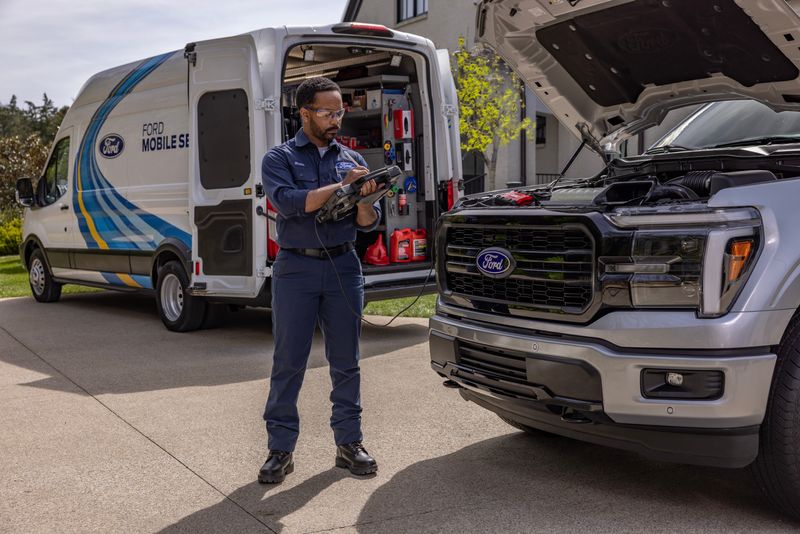
The third element of the campaign, the “real easy,” is about convenience. Roughly one in seven Ford service visits now happen at the customer’s home or office via the largest mobile service fleet in the country, Rabourn said. And in many cases, these visits can be easily booked through the Ford app at no extra cost.
Dealers say Ford is helping them compete
Szott said the new campaign will help Ford’s U.S. dealerships stand out in the market from general repair shops.
“Ford is trying to make their dealers be competitive and successful and service is a big part of our business,” Szott said. “We compete against independent shops. If we show customers that it is very convenient to come to a Ford dealership for Ford service, whether it be pickup and delivery or mobile service that comes to them, or they come to the store, we have the Ford parts.”
Village Ford in Dearborn has seen steady service business in recent months, said Jim Seavitt, owner. But he is glad Ford is touting the benefits of going to a dealership versus an independent shop.
“I like it that they are doing this and I hope they make sure it’s noted that it’s priced well. We want the guy who wants batteries, tires, wipers, filters …we want those guys,” Seavitt told the Detroit Free Press. “Service is very important, about 80% of my fixed costs are covered by parts and service and body shop.”
The Automotive Service Association, which represents the automotive repair industry, did not immediately provide a comment for this article.
Cost and trust determine who wins
Karl Brauer, executive analyst at car shopping site iSeeCars, said dealers make the bulk of their money on vehicle service, certainly more than they make on new or used cars sales.
“Ford running a compaign to encourage dealer service over independent shops is a very supportive move on the automaker’s part,” Brauer said. “But the cost issue will always be the most influential factor in where a consumer goes for service on an older vehicle.”
Brauer said there’s no clear, irrefutable evidence confirming the exact rates of a dealership’s service work versus an independent shop because there are so many variables. Most newer vehicles under warranty are primarily serviced at dealerships, he said, but the older, out-of-warranty used cars are a different story.
“My research suggests about two-thirds of cars on the road are serviced at independent or franchise shops, leaving about one-third for dealers,” Brauer said.
Franchise shops are the chains such as Jiffy Lube, Aamco, Midas and so on, Brauer said. He said he has a few older cars in his family’s fleet that he takes to independent mechanics because the cars are “too old to justify the higher costs that dealers charge. The cost savings can be substantial, which is why most car owners eventually switch from dealer service to independent or aftermarket shops once their vehicle hits a certain age.”
Beyond cost, there is the matter of trust, said Ivan Drury, director of Insights at Edmunds.
“If someone has been going to an independent shop for long enough to establish a relationship and even more specifically being on a first name basis with a mechanic, then there is no amount of marketing that will sway their decision,” Drury said. “On the flip side, dealerships have the upper hand when it comes to providing a positive initial impression due to the warranty period and free maintenance offers that some (automakers) provide.”
The perks that a dealership can provide, such as a luxury waiting room and snacks, go beyond what most independent shops can offer, Drury said. Also, trust could be invested in the dealership by a customer knowing that the more complex the vehicle, the more likely the dealership has seen the problem in it before and has the ability to repair it with specialty tools or diagnostic equipment.
But Drury said it makes sense for Ford to want to capture some consumers they might have lost to the independent shops, because not only is a dealership’s service lane highly profitable, it can also drive sales. In fact, Cox Automotive’s Chadwick said their study showed that most car owners stated if a repair topped $3,000, they would look to trade it in for a replacement vehicle.
“The vehicles often represent solid opportunities to acquire a trade-in that has been serviced in a timely manner and if the customer is in a good position with their loan or if the timing is just right to upgrade, it can be a win-win situation,” Drury said. “The real question is the size of the opportunity. The (Ford) ads might help to reinforce consumers under warranty to stay within the dealership ecosystem, but if someone has been outside the dealership for a few years, the chances of getting them back are pretty slim.”
Jamie L. LaReau is the senior autos writer for USA TODAY Co. who covers Ford Motor Co. for the Detroit Free Press. Contact Jamie at jlareau@freepress.com. Follow her on Twitter @jlareauan. To sign up for our autos newsletter. Become a subscriber.
This article originally appeared on Detroit Free Press: Why dealers are cheering Ford’s new repair service ad campaign
Reporting by Jamie L. LaReau, Detroit Free Press / Detroit Free Press
USA TODAY Network via Reuters Connect