It didn’t take long.
Less than a year after officially opening, the new Hudson’s Detroit office building in downtown — part of the city’s highest-profile new developments in decades — has filled nearly all of its office floors.

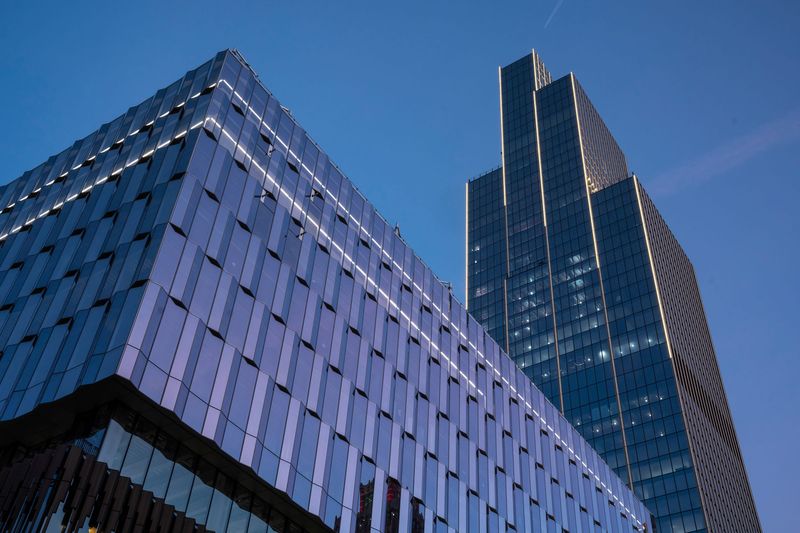
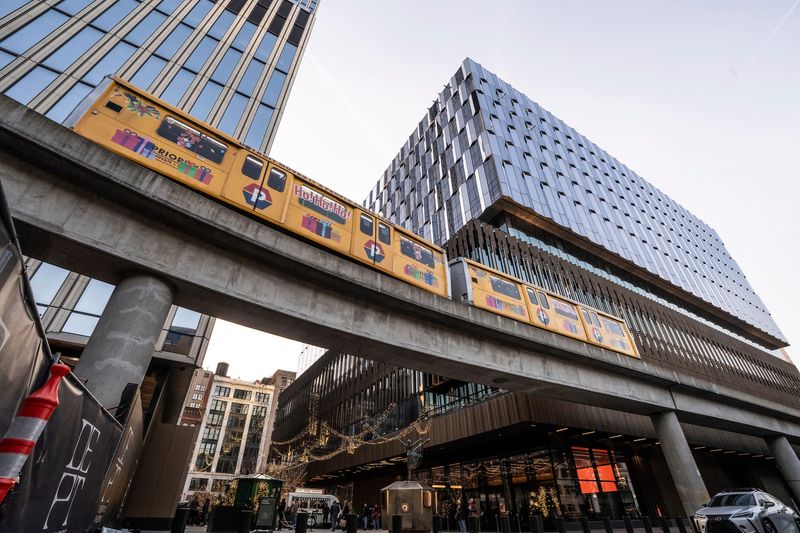
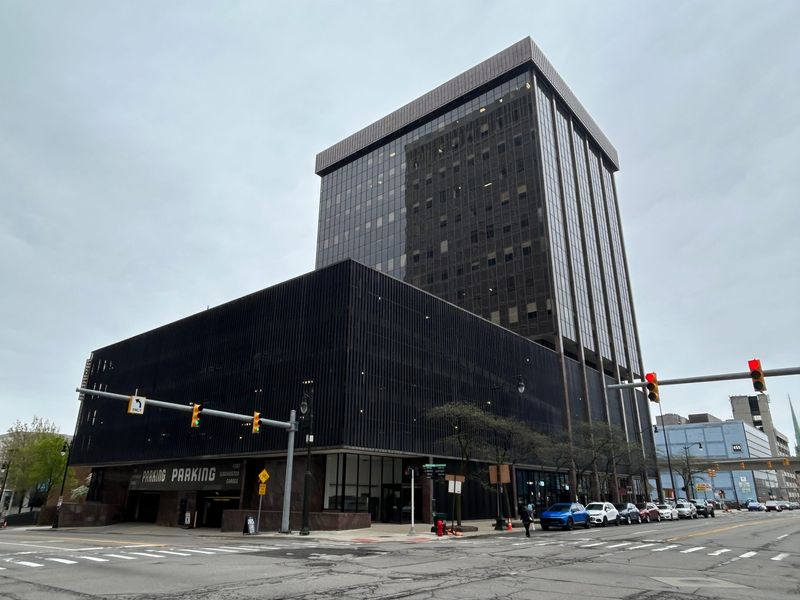
The 12-story glass-and-steel building at 1240 Woodward Ave. was 92% leased out of available office space earlier this year, including the floors occupied by its biggest tenant, General Motors, which moved its global headquarters there from the Renaissance Center.
After GM, which fills 53% of the space, the next biggest tenants are two Dan Gilbert firms — Rocket Companies and Rock Ventures — which together fill 27%, followed by prominent attorney Ven Johnson’s new law office (6%) and then JPMorgan Chase and the consulting firm Accenture.
Those and more new details about the $1.5 billion Hudson’s site development, as well as other Gilbert real estate projects, were recently disclosed in pitch documents for potential investors in a $110 million state-supported bond sale for Gilbert’s Bedrock real estate firm, which developed Hudson’s and will be responsible for paying back the bond proceeds over time.
At a time when the daily number of workers in downtown Detroit is reportedly still well below pre-pandemic levels and developers have been pitching to demolish some desolate office towers, the Hudson’s building has managed to attract a roster of highly desirable business tenants from older downtown buildings — filling most of its 404,000 square feet of new “Class A” office space relatively quickly.
Bedrock CEO Jared Fleisher said they are pleased with the speedy lease-up.
“Delivering the highest-quality office space in the state of Michigan is achieving its goal,” he said in a June 1 phone interview. “Certainly, in the case of General Motors, we are keeping one of the most important companies in the world, let along in our state and our region, headquartered in the city of Detroit — and that was not a forgone conclusion.”
Fleisher also addressed one point of criticism, which is that Hudson’s so far has only attracted office tenants who already were in downtown, rather than bringing new businesses to Detroit or accommodating big expansions. The project’s biggest development incentive, known as a “Transformational Brownfield,” was awarded back in 2018 on the premise that building Hudson’s would create many hundreds of new permanent jobs.
Fleisher said Hudson’s has been filling a need in the market for new and highly amenitized office space, space that downtown Detroit needs to avoid losing highly desired companies. (The building’s asking rents for office space haven’t been publicized.)
“When old space is less attractive, if we don’t deliver new space, there’s a very real risk we lose these critical businesses, we lose those jobs in our ecosystem,” he said. “There’s no inalienable right to have JPMorgan down here. If we don’t have the kind of office space that they need, they could go somewhere else.”
Aside from its office floors, Hudson’s is already over 75% occupied, primarily with retailers who weren’t in Detroit before, such as Alo Yoga and Tecovas. And a cocktail bar and tavern, known as Pine Hall, is expected to open soon on the building’s top floor.
Hudson’s is actually 2 buildings
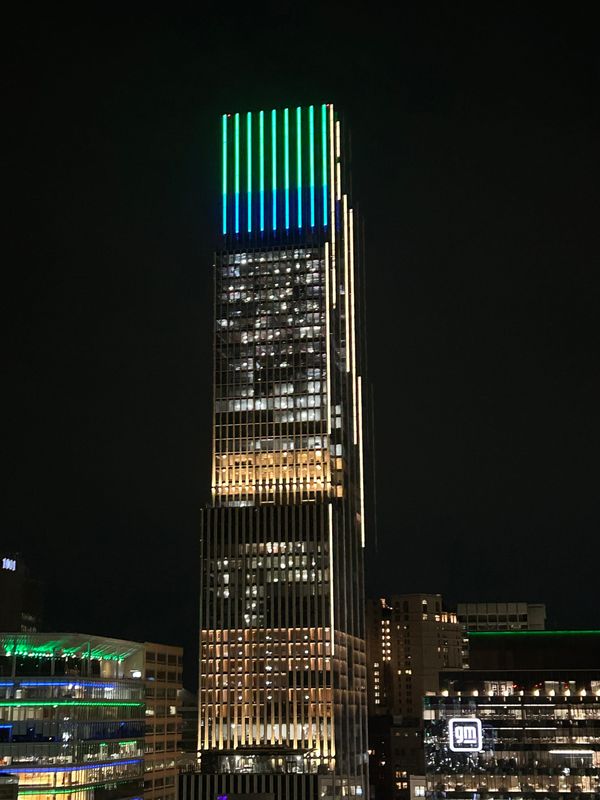
The new $662 million office building is one half of the overall $1.5 billion Hudson’s Detroit development. Next door is part two: a 45-story skyscraper that is still undergoing interior construction, but expected to open next year featuring a a 227-room luxury EDITION Hotel and 96 condos.
The bond sale disclosures didn’t reveal everything about the development, such as the closely held price list for the skyscraper’s condos, which are expected to fetch some of the highest-ever prices in downtown Detroit.
But in general, Bedrock has said the condos are expected to sell for $1,000 per square foot, and with the average size being 1,667 square feet, that puts $1 million-plus price tags on many of them.
The investor documents also show that Bedrock anticipates the skyscraper’s EDITION Hotel as being top of the market in downtown with average nightly rates of $415. (By comparison, the Shinola Hotel had an average daily rate of $360 in 2023 and the Westin Book Cadillac’s was $244, according to figures in the bond disclosure package.)
“For a healthy big city, you have the flagship hotels that command those kind of rates,” Fleisher said. “That means people are coming into our city and spending in our economy.”
One Campus Martius expanson
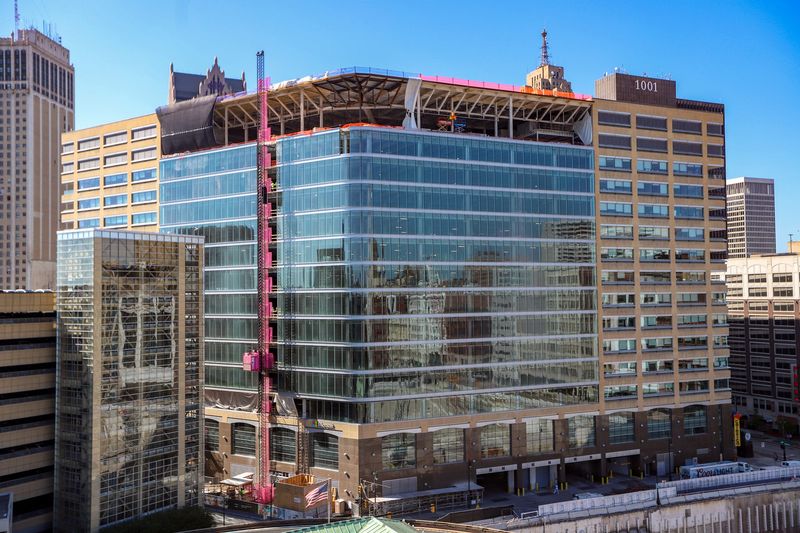
The documents also spill some details on a past Bedrock development that is near Hudson’s: the $119 million expansion to the back of the One Campus Martius building, which finished in early 2021.
That 320,000-square-foot-plus expansion wing was 82% leased up with office tenants at the start of the year — with 55% of it occupied by Gilbert’s Rocket Companies — the parent company for Rocket Mortgage — 18% by Gilbert’s Rock Ventures and 9% by Urban Science, which is an automotive consultancy and data firm that recently left the Renaissance Center to move into One Campus Martius.
The expansion’s 82% lease-up rate could be higher now, considering some very recent office relocations there, such as Fifth Third Bank moving from an older downtown building and the Consulate General of Japan arriving from one of the RenCen’s now-desolate office towers.
(The Free Press, with legal assistance from the Mackinac Center for Public Policy, filed a Freedom of Information Act lawsuit last year against the Michigan Department of Treasury seeking information regarding the occupancy of Bedrock developments that received development subsidies. The lawsuit is pending.)
Less crowded streets
Hudson’s Detroit was one of the first post-pandemic developments in Detroit, coming at a time when many downtown employers have permanently adopted “hybrid” in-office and remote work schedules, with bosses only requiring employees to come in three, two or even just a single day of the week.
Office building occupancy rates in Detroit, as well as how many workers are downtown, are still below their pre-pandemic peaks.
The average number of daily downtown workers was 34,900 in April compared with 55,628 workers in February 2020, which was just before the pandemic hit, according to the Downtown Detroit Partnership’s “Activity Dashboard” that uses anonymized mobile device data from the firm Placer.ai.
The office space vacancy rate downtown was 19.8% in the first quarter of this year, or about the same as a year ago, although up significantly from 12.6% in the fourth quarter of 2019, according to data from Newmark.
Commercial brokers say that downtown’s official vacancy rate appears to be stabilizing, in part because some large older buildings have discontinued leasing and were removed from the market’s inventory list.
Examples include the four original Renaissance Center office towers, of which two are slated to be demolished and another converted to housing as part of a joint $1.6 billion Bedrock and GM development project. The 16-story Fort Washington Plaza office building, 333 W. Fort St., also would be torn down to make way for a proposed 600-room hotel.
Bedrock previously scaled back its ambitious pre-pandemic plans to build more downtown office space, specifically on a site near Campus Martius that it is now developing as the COSM immersive entertainment venue.
“The theme of what we’re seeing is a shrinking of the marketplace from an overall supply standpoint,” said AJ Weiner, senior managing director at JLL. “We can’t say specifically that the demand is up, but we’re making the market smaller.”
Brendan George, a senior vice president with CBRE in Detroit, said downtown businesses are now signing longer-term office leases than they did in the immediate post-pandemic years, when some opted for one- or two-year commitments.
Although tenants are generally taking less space than they once did, there aren’t the massive downsizings that some predicted during the pandemic years.
“If a tenant historically leased 10,000 square feet, you don’t see them leasing 2,000 square feet,” George said. “The majority of companies are right-sizing, but it is not to an extreme.”
Contact JC Reindl: 313-378-5460 or jcreindl@freepress.com. Follow him on X @jcreindl
This article originally appeared on Detroit Free Press: How full is the first new Hudson’s building in downtown Detroit
Reporting by JC Reindl, Detroit Free Press / Detroit Free Press
USA TODAY Network via Reuters Connect