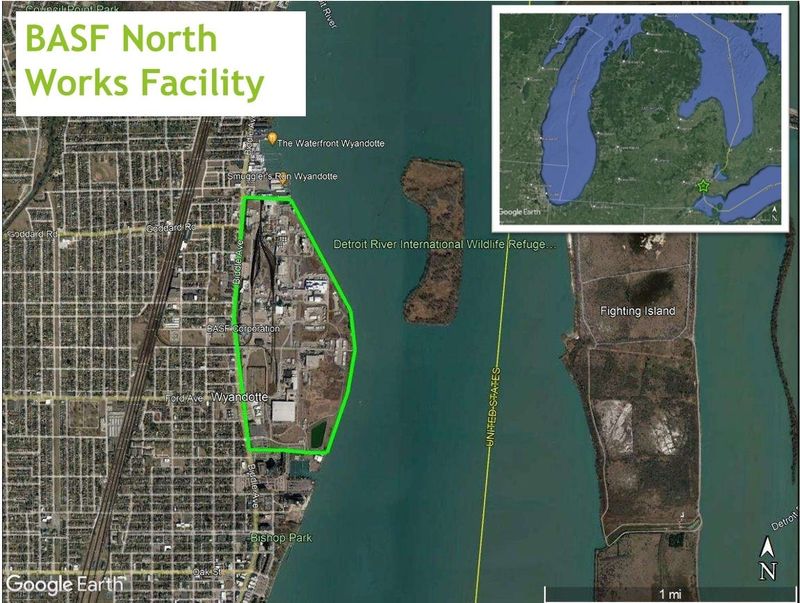
A group of downriver residents concerned over ongoing groundwater pollution from the BASF North Works Wyandotte chemical plant into the Detroit River − very near the City of Wyandotte’s drinking water intake pipe − has appealed to Wayne County Prosecutor Kym L. Worthy and Wyandotte officials to take action.

“Despite decades of oversight, the State confirmed in 2025 that BASF is failing to meet its legal obligations to prevent this contamination,” the June 1 letters to Worthy and Wyandotte City Attorney Tom Kuzmiak both state.
“Current State and Federal management timelines do not require BASF to meet any State or Federal Water Quality Criteria Standards at any point in the future, a delay that we believe is unacceptable given that this contamination has been documented since 1983.”
The letter is signed by downriver resident Ashley Satkowski, Wyandotte resident Brian Burgess, and Arthur Ostaszewski, a member of the environmental nonprofit Friends of the Detroit River. The group also organized an online petition that has received more than 3,100 signatures urging more urgent remediation actions at the BASF Wyandotte site.
Pollution venting into river for decades
A chemical plant has operated at the BASF North Works site in Wyandotte for over 140 years, dating to the 1880s, when chemical products like soda ash were first produced from local underground salt deposits. The plant, at 1609 Biddle Ave. in Wyandotte, is an American subsidiary of German chemical giant BASF.
Pollutants are venting off the plant property into groundwater and into the Detroit River − and have been on a continual basis for decades. That includes mercury, found venting in groundwater from portions of the BASF Wyandotte site at as high as 3,800 nanograms per liter in regulator testing in September 2006; up to 1,200 nanograms per liter in August 2012; and up to 1,800 nanograms per liter in June 2021. EPA and EGLE limit mercury in venting groundwater to 1.3 nanograms per liter — meaning the pollution is exceeding the standard to protect public health and the environment by well over a thousand times.
According to the EPA, exposure to some forms of mercury can lead to tremors, headaches, changes in nerve responses and disturbances in sensations, and poor performance on tests of mental function. Higher exposures can cause kidney damage, respiratory failure and death.
Other potentially health-harming contaminants of concern found in the pollution plumes are cyanide, arsenic, per- and polyfluoroalkyl substances, or PFAS, the nonstick “forever chemicals,” and volatile organic compounds.
The venting groundwater contamination is within 1,700 feet of the city of Wyandotte’s drinking water intake pipe in the Detroit River, and the pollution flows into a state-mandated Critical Assessment Zone around the intake, a highly sensitive, regulated area established around surface water intake points vulnerable to pollution. City officials, however, assert that repeated testing has shown the city’s drinking water is safe from the pollutants.
In 2025, state regulators told BASF that the company was violating the 1986 consent decree in failing to stop the groundwater pollution. The company responded and asserted it complies.
“BASF’s pollution is well documented for more than 40 years,” Satkowski told the Free Press. “There are three court orders where BASF agreed to halt the release to the river entirely, in 1980, 1985 and 1994. A 2026 plan was supposed to be submitted May 19, but neither EPA nor EGLE (the Michigan Department of Environment, Great Lakes and Energy) has released it to the public for review. The last three plans have not been enforced; why should we ever imagine that this fourth plan would be enforced?”
Messages left with BASF, EPA and EGLE on Monday were not immediately returned.
Construction on long-term fix not slated to start until 2027
BASF is working with the EPA on a long-term fix that would include a 1.7-mile barrier between the property’s edge and the river, and 300,000 gallons in an on-site storage tank capacity to better stop polluted groundwater from leaving the site. But construction on that project isn’t expected before 2027.
That frustrates some residents and environmental groups.
“Speed it up − 2028 is not good enough; 2027 is not fast enough,” said Burgess, a retired U.S. Army Staff Sergeant, in a Change.org petition that has received more than 3,100 signatures.
“This contamination has been flowing since before many of us were born. The EPA has the authority under the Resource Conservation and Recovery Act to require faster timelines. Use it.”
In their June 1 letters to Worthy and City of Wyandotte attorney Tom Kuzmiak, the residents tell both, “you have the authority to protect the health and safety of our citizens. We urge your office to investigate these violations and pursue all available legal remedies to ensure immediate remediation, a comprehensive independent audit of the groundwater interception system and monitoring, and full transparency for the affected Wayne County residents.”
Worthy’s office did not respond to messages left by the Free Press on Monday.
On a website developed by the citizens group, they outline a strategy of also appealing to nonprofit organizations and potentially filing a legal tort claim over the ongoing environmental contamination.
Satkowski has two young children at home.
“BASF is more than capable of properly processing their wastewater; they are choosing not to obviously, because of the money and because our government isn’t holding them accountable,” she said. “I’d love to see BASF’s operations halted immediately until reasonable solutions are implemented, not just promised.
“We live in Michigan with the greatest source of fresh water on the entire planet. This billion-dollar company is polluting it, and our government isn’t taking any reasonable action to protect us or act as stewards of this land. We deserve better. BASF’s profits are not more important than our health.”
Contact Keith Matheny: kmatheny@freepress.com.
This article originally appeared on Detroit Free Press: Wyandotte residents seek city, county help to stop BASF pollution plumes
Reporting by Keith Matheny, Detroit Free Press / Detroit Free Press
USA TODAY Network via Reuters Connect