Market conditions in China, regulatory changes there and its brands’ speedy vehicle development threaten to put the United States behind in developing autonomous driving technologies, experts say.
Direct comparisons are rare, given the lack of Chinese vehicles in the United States and data-sharing restrictions between the two nations. But that’s changing. Tesla Inc. last week said its Full Self-Driving Supervised is launching in China with an update coming shortly following years of delays. Google affiliate Waymo LLC is poised to compete against China’s Baidu Inc. in London. And Chinese brands are expanding into more markets globally — including North America.

“China is catching up fast, just how like a decade ago, they were not so great in battery technology, but then they were not just putting a lot of effort and investments into R&D, but also they tried to scale,” said Chris Liu, senior automotive analyst in Shanghai at technology research group Omdia. “So now it happens to this side as well.”
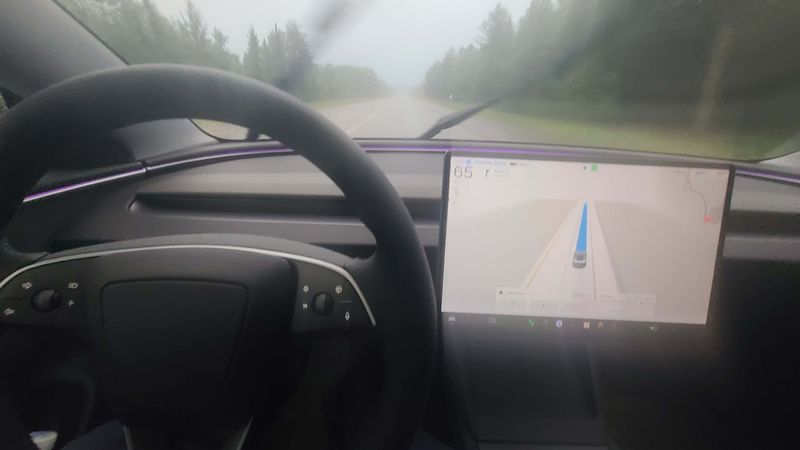
Experts point to hands-free Tesla FSD as a global leader in automated driving technology that uses artificial intelligence to learn to drive from video clips from the road instead of relying on preprogrammed rules. A less-advanced system has been available in China, but competitors like Xpeng and Xiaomi have moved forward with semi-autonomous driving features in the country. Tesla announced via Elon Musk-owned social media platform X that FSD was available in China after Musk joined President Donald Trump in a visit to Chinese leader Xi Jinping in Beijing. But approval for a fleet-wide push for the technology remains pending.
That would be a boon for Tesla in the world’s largest EV market. As hyper-competition in China known as “involution” has driven down vehicle prices there, companies have looked to features like advanced driver assistance systems to differentiate themselves in the market.
“If a Chinese EV wants to charge a subscription price, BYD undercuts them,” Tu Le, managing director of Sino Auto Insights, said about BYD Co. Ltd., China’s leading automaker.
The pressures have subsided a bit, Liu said, as the Chinese government has provided greater policy guidance on price and other specifications, benefitting margins. But there remain dozens of vehicle brands competing in the world’s largest vehicle market, and companies like BYD are making advanced driving technologies standard on many models. Liu highlighted a shift in market discourse in China from electric-vehicle driving range to intelligence and ADAS.
“It’s being adopted at an average selling price level for a lot of these, and more and more customers are having the fortune to be able to afford it,” Liu said.
China at the end of last year, however, introduced restrictions on long-term hands-off, eyes-on-the-road driving, which is known as Level 2 automated driving, over safety concerns and fatal crashes. If a vehicle detects hands are off the wheel for more than a minute, the system must issue warnings and slow down or pull over the vehicle. Such technology such as Tesla FSD, General Motors Co.’s Super Cruise and Ford Motor Co.’s BlueCruise is permitted in the United States.
“There is an element of wanting to be a little bit more careful in the deployment and the way it comes to market,” Jeremy Carlson, associate director of autonomy for S&P Global Mobility, said about China. “It’s ‘ask for permission, then forgiveness’ in China over the ‘do what you like and be prepared for the consequences’ in the U.S.”
Part of that could be concerns about international perception, Carlson said, but also sensitivity to consumer confidence about technologies that, along with EVs, China has poured hundreds of billions of dollars into.
“If consumers don’t choose to use them (autonomous vehicles), then it goes nowhere,” Carlson said.
Nonetheless, many vehicles in the country are capable of driving from a parking spot to the parking spot of a destination — for even around the price of roughly $30,000, Liu said. That accessibility offers Chinese brands scale of data, which helps to speed up the learnings from these technologies.
China also is advancing toward the launch of Level 3 eyes-off-the-road capability. Its Ministry of Industry and Information Technology recently started issuing production and testing permits. A few U.S. states like Nevada and California have allowed Level 3 driving on highways that certain vehicles, such as some from Mercedes-Benz, offer. Honda Motor Co. Ltd. was the first to sell the technology in Japan.
Nationally, Congress has pushed the National Highway Traffic Safety Administration to create a consistent policy for AVs to replace the state patchwork quilt of regulations.
General Motors Co. and Ford Motor Co. have said they plan to launch Level 3 automated driving in 2028 in the United States.
“GM is investing in AV, software and keeping our brands strong globally,” GM spokesperson Kellie Van Maele said in an email. “Leadership in autonomy will ultimately come from systems that are safe, validated, trusted, and ready to scale, and we have the experience, talent, and the technology to deliver it to our customers.”
A representative for Ford declined to comment, but Ford CEO Jim Farley has underscored the importance of the Dearborn automaker’s ability to compete globally while protecting the U.S. market.
“We leverage global partnerships and even IP (intellectual property) sharing, including with the Chinese OEs, to grow our business around the world,” Farley said. “But we are really fully committed to a level playing field here in the U.S. and also safeguarding our home market because of the importance of the auto industry in an industrial base.”
Meanwhile, Chrysler and Jeep maker Stellantis NV last week announced three new partnerships to advance driver assistance and software. With British autonomy firm Wayve Technologies Ltd., it plans to launch hands-free door-to-door supervised autonomous driving in North America in 2028. That’ll come after the launch of hands-free extended features launching in 2027.
“Stellantis’ autonomy strategy is pragmatic,” spokesperson Samuel Krahn said in a statement, “with investments focused on areas of differentiation, such as vehicle integration, motion control, and HMI, while partnering with technology leaders for perception and AI capabilities.”
Other companies like Rivian Automotive Inc. also are rolling out increasingly automated systems in the United States. That competition will help support innovation, too, Le said.
On the robotaxi front, Waymo is providing more than 500,000 trips per week across 11 major U.S. metro areas with its U.S.-developed system. It’s expanding to more cities across the United States, including Detroit, as well as internationally.
A spokesperson said in a statement that the company wants U.S. innovators to win the global contest in driving automation and lead the world in making transportation safer and more accessible.
The size of China’s engineering workforce and its tech-savvy consumer base also offer its brands advantages. Its strengths in EVs also are valuable for automated driving deployment and software, Liu said, as well as the size of its market.
“They sell so many more cars,” Le said. “Pre-AI, data was the key. Now there are other variables, but you still have to feed this monster algorithm a lot of data to train it.”
In addition, the rate at which Chinese companies develop vehicles is much faster than legacy automakers. So starting model development at the same time as a Chinese producer can put a traditional automaker two to three years behind, while the Chinese rival also is more likely to pivot in the middle of a vehicle generation cycle, Carlson said.
“A lot of the technology we’re talking about is pretty high investment,” he said. “Traditional global automakers feel pretty conservative when they are making some of these decisions. When they commit to it, it’s a long-term play. You need to scale. It’s not the way the Chinese are looking at it. They understand sometimes they need to revisit those plans and go a different direction.”
Limitations, however, exist. As China looks to grow its manufacturing scale overseas, data regulations such as in Europe also necessitate that it work with foreign suppliers for automated driving systems. This has resulted in polarized regions around ADAS, Liu noted.
Companies like GM also have partnered with Chinese suppliers like Momenta for advanced driving systems in China.
“The U.S. does have a lead,” Le said about automated driving. “But if Tesla can’t launch full FSD in China, and if the current state of play continues to hold in the United States, can we truly call these systems global?”
bnoble@detroitnews.com
@BreanaCNoble
This article originally appeared on The Detroit News: China catching up to U.S. on autonomous driving tech, experts warn
Reporting by Breana Noble, The Detroit News / The Detroit News
USA TODAY Network via Reuters Connect