EVANSVILLE — It’s probably not an issue that Evansville Vanderburgh School Corp. (EVSC) ever imagined would swoop across its radar.

Hawks — red-shouldered hawks who spend their time soaring over forests and hunting small mammals, amphibians and reptiles — were dive-bombing the grounds crew in Harrison High School’s football stadium. No one knew at first where they came from, what their mission was or even what kind of birds they were.
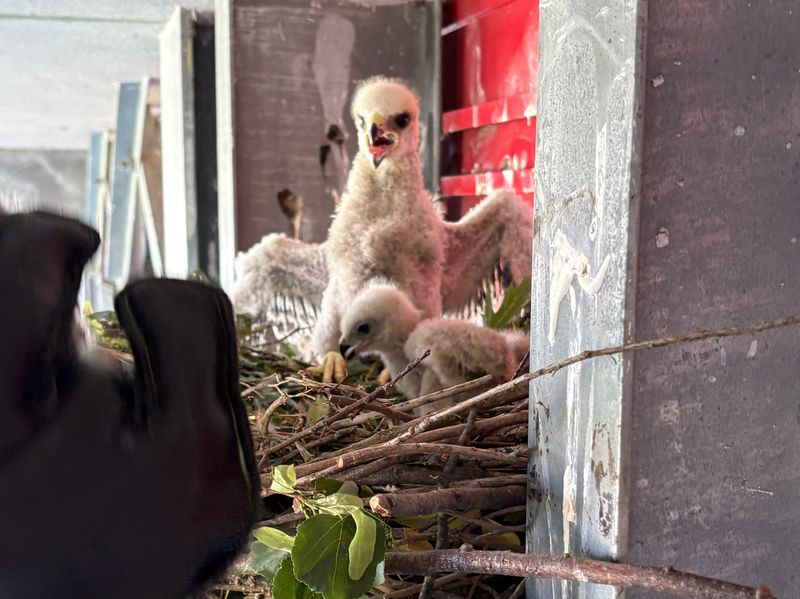
EVSC and Harrison leaders must have blinked when they learned the truth: that the hawks had built a nest up behind the bleachers on the home side of Romain Stadium, near the concessions stand and bathrooms. They were protecting their eggs.
Recognizing that dealing with protected wildlife species wasn’t their area of expertise, school corporation officials reached out to experts. EVSC called The Talon Trust, an Evansville-based nonprofit native raptor rescue and rehab operation.
The date was April 1. Harrison’s outdoor Commencement was set for May 20 in Romain Stadium. Nobody had to verbalize the horror of hawks dive-bombing the graduates and their families at one of the most important and joyous moments in their lives.
“We had no idea if there were actually eggs in there yet or what the situation was, so at Harrison they drilled a hole in the bleachers and put a camera through it to look at the nest,” said Lisa Snyder, a longtime Talon Trust rescue volunteer. “They were able to see that there were eggs in the nest.”
Snyder said she advised EVSC to contact the Indiana Department of Natural Resources (DNR). The school corporation needed permission to remove a nest to avoid what Snyder called “a very, very large fine.” DNR sent EVSC to the state agency’s Division of Fish & Wildlife.
Snyder said Fish & Wildlife told EVSC that since Harrison is located in a populated area, the school corporation could destroy the nest if they wanted to — but EVSC didn’t want to. The decision was made let the eggs hatch and send the chicks to a rehabilitation organization.
EVSC “cut a hole in the bleachers and ran a camera through to the hole to check on the eggs,” Snyder said. On April 3, Talon Trust and EVSC determined that four eggs had been laid.
Harrison teacher saw a teachable moment
The news was all over Harrison, of course. The area around the nest had been cordoned off for everyone’s safety and to avoid spooking the adult hawks into abandoning their nest.
But not everyone appreciated the precious value of life or the teachable moment as science unfolded right before their eyes. Some graduating seniors in particular would not brook any possible interference with their Commencement.
“Some people were like, we should just go up there and shoot them,'” said teacher Paul Fischer, who chairs Harrison’s science department. “Their first reaction is just to get rid of the birds because they want to treat it just like a sparrow, a house sparrow or some kind of other nuisance pest. That’s not what this was.”
Fischer relished the chance to teach students about empathy with all God’s creatures and their environmental responsibility as stewards of wildlife.
“It became kind of like this cultural moment in the classroom,” he said.
But still, a clock was ticking. Graduation was little more than a month away when, in mid-April, two of the four eggs hatched.
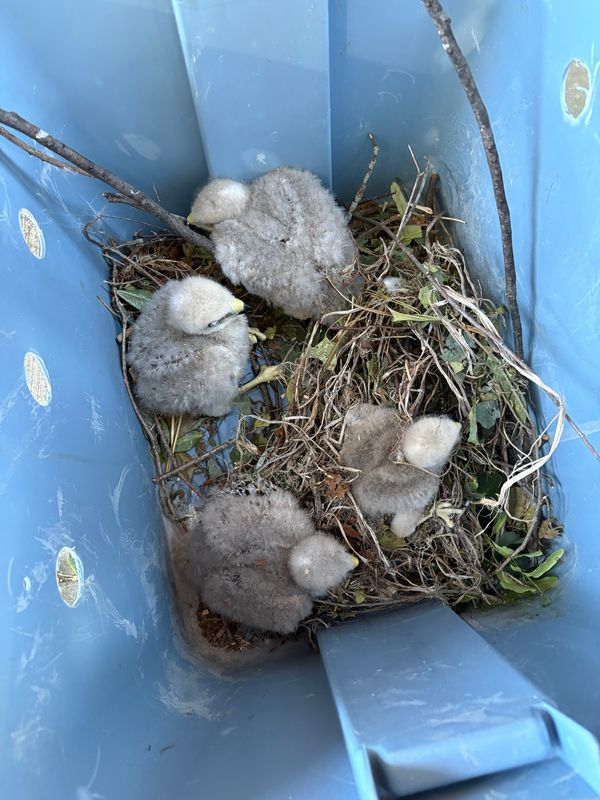
On May 1, Snyder and Talon Trust volunteer Mike Woods went up on a lift to rescue what were by then four surprisingly big chicks. They waited until the adult hawks were nowhere to be found, but Snyder wore a hardhat and carried an umbrella while Woods wore a motorcycle helmet.
Snyder said their audience — about a half-dozen EVSC employees and a third Talon Trust volunteer — might have helped keep the hawks away. But one of them did a “fly-by” as they were leaving, she said.
The plan going forward
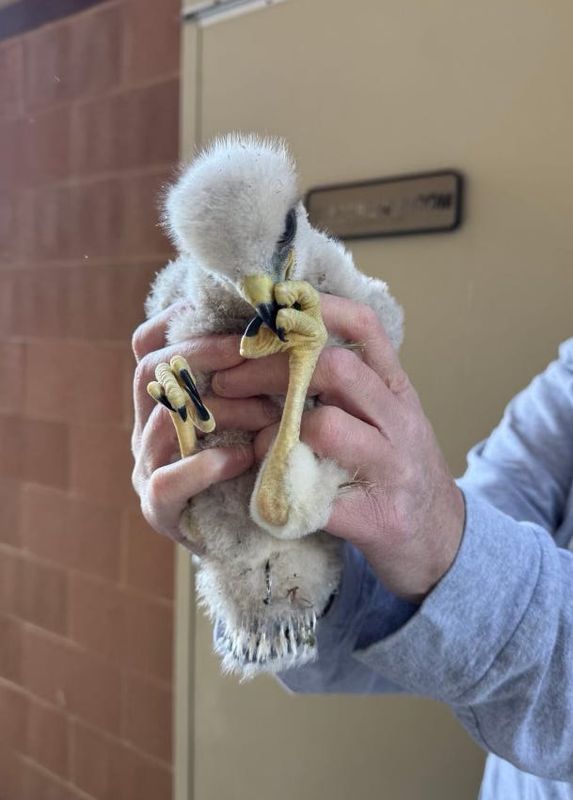
The chicks were transferred to Bedford, Indiana-based Raptors Rise Rehabilitation Center. The nest in Harrison’s bleacher was destroyed.
“We will finish raising the chicks with the help of a foster mother,” Raptors Rise stated in a subsequent Facebook post. “These chicks will be released back into the wild once they are ready.
“Yes, we all feel badly for the parents. We all feel sad for the chicks. There is no perfect solution for an imperfect situation. We all just do the best we can. However, we are grateful that (EVSC) allowed the chicks to be born and to be raised and released. Red Shoulder Hawks are important birds in our Indiana ecosystem! And like every other kind of bird, they are in decline.”
Snyder also lauded EVSC and Harrison for allowing the chicks to be born and cared for. Separating them from their parents was the right thing to do, she said.
“It’s a sad thing, but I commend the EVSC for letting them be born and grown-up enough to take the chicks,” Snyder said. “Because by law, they could have theoretically just destroyed the nest with the eggs in it.”
Once the chicks have learned bird communication skills and bird behaviors such as preening, Snyder said, Raptors Rise will give them back to The Talon Trust. They will be released in a place yet to be determined.
EVSC will monitor Harrison’s stadium for a while to make sure no other nests are built, Snyder said.
“This is a unique situation in that Fish & Wildlife allowed all of this to happen,” Snyder said. “Because just shortly before I got that call, I’d gotten a call from a resident, and they had hawks that had a nest in their backyard and they’re like, ‘Well, what do we do?’
“And basically, DNR says, get an umbrella. So if you were to have this situation in your backyard, you would just have to deal with it. Get an umbrella and try to avoid them at all costs.”
Hawks won’t come down to a chick on the ground to bring it back up to a nest, Snyder said, but they will come down to feed the baby.
“Say you find this chick on the ground and you look up and the nest is like 30 feet in the air,” she said. “What we have learned in the past and what we’ve learned from other rehabbers is, you just take some sort of basket, put some leaves and sticks in the bottom, put the bird in the basket and then tie the basket to the trunk of a tree as a makeshift nest.”
Reflections
Snyder won’t soon forget the weeks she spent working with EVSC to negotiate a solution to a delicate situation. She’s immeasurably grateful that it resolved itself well before graduation.
“You don’t get to have that many big adventures — and generally in the rescue business, you really don’t want it to be an adventure,” she said with a laugh.
Harrison’s Fischer had taken time before he spoke to the Courier & Press to fashion some pithy recollections.
“(The situation) nested its way into Harrison history, I could tell you that,” he quipped. “I’m just glad we weren’t just winging it.”
Fischer turned serious for a moment.
“We had guidance and we had help, and it was a whole community effort, honestly,” he said.
This article originally appeared on Evansville Courier & Press: How EVSC, bird experts saved baby hawks (and a graduation ceremony)
Reporting by Thomas B. Langhorne, Evansville Courier & Press / Evansville Courier & Press
USA TODAY Network via Reuters Connect