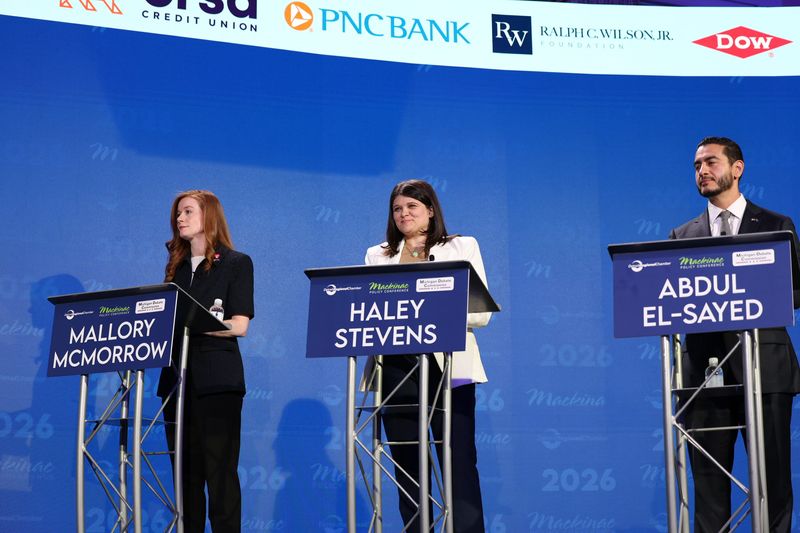
MACKINAC ISLAND — Robin Hood, an elephant hunter and a dodgeball player who knows her way around Washington spent an hour trying to convince some of Michigan’s most influential business, nonprofit and political leaders they are the best Democrat to retain the U.S. Senate seat being vacated by the retiring Gary Peters.
Those caricatures, like all caricatures, are less than perfect portrayals of Abdul El-Sayed, Mallory McMorrow and Haley Stevens, respectively. But they give you a sense of the lanes each candidate chose for their debate Thursday, May 28 at the Detroit Regional Chamber’s annual Policy Conference at the Grand Hotel.

El-Sayed repeatedly jabbed at the swells among the roughly 1,000 people who packed the magnificent landmark’s theater, defending his call to tax billionaires by pointing out that even after you take a chunk of their dough they’re still … billionaires.
McMorrow, glossing over the fact that she needs to win the Democratic nomination before taking on a Republican, repeatedly focused her fire on President Donald Trump and putative GOP U.S. Senate nominee Mike Rogers.
Stevens stressed her Michigan roots and experience in Washington as a congresswoman, and as a leader in the federal auto bailout that saved General Motors and Chrysler during the Bush and Obama administrations.
For a tight race that will be decided in a little over two months, the candidates spent surprisingly little time or effort trying to score points by taking shots at each other.
Each candidate also made at least one brow-raising claim as they answered questions from reporters representing five of Michigan’s leading news organizations, while moderators Nolan Finley of the Detroit News and Stephen Henderson of almost every news organization in the state, tried to keep them on time — and on point.
And two candidates delivered bona fide zingers, including one in which a candidate, in a refreshing change, was the target of his own barb.
One thing they all agreed on was an issue their archenemy, Trump, also supports: abolishing the filibuster in the U.S. Senate. The time-honored procedural gambit makes it easier for senators to prevent legislation from passing the upper chamber of Congress with a simple majority.
They also agreed, to varying degrees, that the Michigan Democratic Party has a problem with antisemitism, an issue that generated headlines last month when Stevens and another candidate were nearly drowned out during the state Democratic Party’s endorsement convention.
El-Sayed, a former Detroit and Wayne County health official, seemed to energize the audience more than his opponents — even though the crowd probably skewed more to the right and contained more people in the tax brackets he’s targeting than his typical crowd.
Stressing his disdain for corporate money, El-Sayed proclaimed: “If you’re on stage and have never taken a corporate (political action committee) check from Blue Cross Blue Shield, raise your hand.”
El-Sayed raised his hand. McMorrow and Stevens did not.
Blue Cross Blue Shield is a diamond sponsor of the conference, which, judging by the confab’s list of sponsors, is the highest sponsorship level.
El-Sayed also fired off one of the funniest — and most brow-raising — lines of the entire debate.
First, he said with a smirk: “You all know I’m a doctor, depending on who you read,” in an apparent reference to a May 12 article in Politico that began: “Michigan Democratic Senate candidate Abdul El-Sayed for years has publicly said he’s a physician — but there’s overwhelming evidence that he’s had no experience as a licensed medical doctor.”
The article continued: “There’s no doubt that El-Sayed has top-notch medical credentials. He attended the University of Michigan Medical School and ended up receiving his medical degree from Columbia University College of Physicians and Surgeons. He has a doctorate in public health from Oxford University and worked as an assistant professor of epidemiology at Columbia for a year before moving to Detroit to be executive director and health officer of the Detroit Health Department.”
El-Sayed — this time with a straight face — also said he aspired to be a doctor, not a politician. His decision to quit the Detroit Health Department to run for governor in 2018, as well as his current Senate candidacy, suggests otherwise.
McMorrow, a state senator from Royal Oak, emphasized affordability issues and her experience as the only candidate to beat an incumbent Republican. She knocked off state Sen. Marty Knollenberg in 2018.
She saved her darts for Rogers, who is running virtually unopposed for the Republican U.S. Senate nomination, and Trump.
“There’s a lot of agreement here on stage that we must end wars, not start them,” McMorrow said early in the debate. Near the end of the program, she added: “There are three Democrats on this stage. There’s more that unites us than divides us.”
In between those convivial comments, McMorrow generated laughs by taking a shot at Trump’s decision to appoint a former professional wrestling executive to essentially dismantle the federal Department of Education.
“Linda McMahon has quite literally body-slammed the Department of Education out of existence,” McMorrow said.
Stevens repeatedly stressed her Michigan roots, perhaps to underscore that McMorrow moved to Michigan 10 years ago or so, or maybe to brush off echoes from her first congressional campaign in 2018 that she only moved back to Michigan to run for office.
“Michigan fires me up,” Stevens gushed, before reciting a series of statistics showing off her knowledge of our state that sounded a bit like an entry from an almanac.
“Michigan deserves to be heard at the lawmaking table,” she added. “I love Michigan!”
Stevens criticized McMorrow earlier this month when CNN asked her to comment on old social media posts the news network uncovered in which McMorrow criticized the Midwest.
McMorrow — without prompting — referenced the report during the debate when she said: “I chose to live here. … You might have seen something about my Tweets online.” (McMorrow told me afterward that she wanted to address the social media posts “head-on” in front of the biggest crowd she has faced since the story broke. “This truly is the best place I’ve ever lived,” she added.)
Stevens repeatedly referenced her record in Congress and as a key player in the 2008 federal bailout of the U.S. auto industry.
“We have got to act for our state now,” she said. “I’m ready on Day One with legislation.”
Stevens dodged several questions, however, including one about the influence of AIPAC, which is shorthand for the American Israel Public Affairs Committee. AIPAC donates millions to politicians, including Stevens’ Senate campaign.
Stevens also didn’t say whether she supported restoring tax credits and other federal programs intended to support the growth of electric vehicles.
“I actually don’t care which kind of car you drive — as long as it’s Michigan-made and UAW-made,” Stevens said.
Stevens left some of us scratching our heads after she called for the abolition of the filibuster and said it would have been easier for Democrats to fight Trump’s so-called landmark “Big Beautiful Bill” if the filibuster didn’t exist. Henderson told Stevens those positions seemed contradictory, but in the time allotted for follow-up, Stevens wasn’t able to delve into whatever nuance she may have had in mind.
I hoped to ask Stevens for a more detailed explanation of her position after the debate, but, unlike McMorrow and El-Sayed, she did not stick around the media room to take questions.
Stevens adviser Caitlin Legacki, said Stevens left the media room after a couple minutes because no one asked her a question. Reporters told me Stevens left before they got the chance.
Legacki told us Stevens did 14 interviews the day prior, then went back to her room after no one tried to talk to her. Incredulous, I and other reporters asked Legacki and another aide to invite Stevens to return to the media room, where other reporters were busy quizzing McMorrow and El-Sayed.
Legacki and her colleague said they contacted Stevens, but said she told them she would not return.
M.L. Elrick is a Pulitzer Prize- and Emmy Award-winning investigative reporter, director of student investigative reporting program Eye On Michigan, and host of the ML’s Soul of Detroit podcast. Contact him at mlelrick@freepress.com or follow him on X at @elrick, Facebook at ML Elrick and Instagram at ml_elrick.
This article originally appeared on Detroit Free Press: Michigan U.S. Senate candidates pick lanes, not punches in debate
Reporting by M.L. Elrick, Detroit Free Press / Detroit Free Press
USA TODAY Network via Reuters Connect