Mike Duggan faced a dark reality 12 years ago when he was first elected mayor of Detroit: The city had hit rock bottom with the largest municipal bankruptcy in U.S. history, its population and services were floundering, and it had become a national symbol of mismanagement.

He began his term largely in the background as Emergency Manager Kevyn Orr guided Detroit through bankruptcy. And although his tenure began with a historic write-in campaign win, he was met with deep skepticism as a white mayor in a majority-Black city.
That shadow of criticism continues to lurk, as the new administration grapples with the fallout — financial and otherwise — of a federal investigation into contaminated backfill dirt used in Duggan’s signature demolition program. The investigation is ongoing and one of the contractors involved, Gayanga Co., has shuttered and is now suing the city for defamation.
Conversely, 13 years after taking office, Duggan also had a track record most any public official would be proud of: businesses came back, Detroit’s population grew for the first time in over six decades, the city removed or rehabilitated tens of thousands of abandoned properties. And, he ended his third, and last, term with city coffers showing a $105-million surplus.
It was a daunting undertaking that took strong political will, as well as a lot of help from people inside and outside of City Hall; business, nonprofits and community partners; engaged residents; and interests on both sides of the political aisle. Also, having had a largely friendly partner in Washington, with Democratic administrations in charge for most of his mayoral tenure, was a plus.
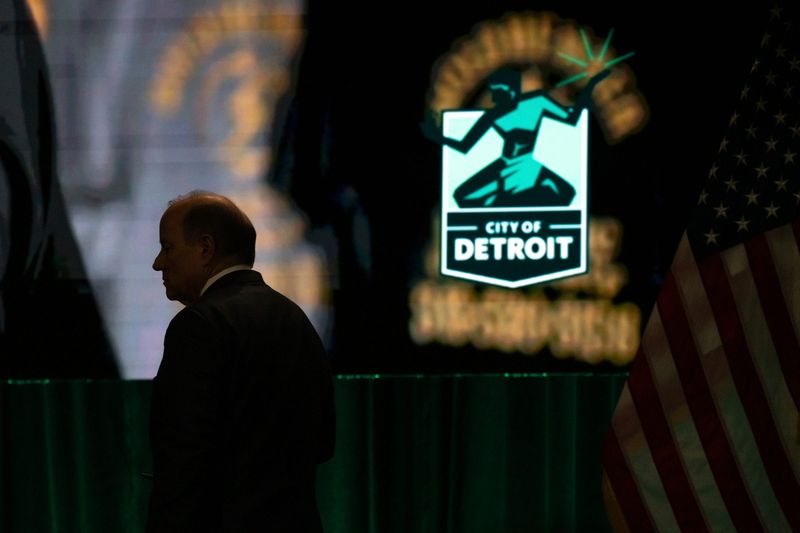
Ultimately, however, it was a track record that fell short of propelling him into Michigan’s governorship. In a major announcement Thursday, May 21, Duggan stood in the front of room 353 inside Huntington Place in downtown Detroit and announced that, seeing no winning path forward for his campaign, he was folding his independent campaign.
It was an announcement that made big headlines, but it wasn’t entirely unexpected, several political experts said, noting that independent campaigns rarely prove successful, mostly because of a lack of campaign funding. Still, many of those same experts gave Duggan credit for shaking up the status quo instead of standing pat as Detroit mayor — where he had been largely successful.
“A lot of people had written off Detroit. There was no hope, no vision. Corporate was trying to figure out a way to get the heck out of Detroit,” political analyst Mario Morrow said, adding that Duggan and his team managed to work closely with the City Council, the faith-based community and corporations to persuade companies to invest in the city, as well as bring in major events, such as the 2024 NFL draft.
“I think that what he did, when he became mayor, he gave people hope; he gave them direction; he gave them vision; and he substantiated that by showing signs of success,” Morrow continued. “He was the leader. And that, in itself, propelled him to have this vision to run for governor. He always talked about the infighting and bickering between the Republicans and Democrats…and he actually really thought that running as an independent would give people an opportunity to have somebody who was not betrothed to one party or the other.”
Morrow said he agreed that Duggan didn’t have a viable path forward based on polling and funding, but said he still expects Duggan to be a major player in the gubernatorial election. Despite being out of the race, people are seeking his opinion about which candidate to back with funding and support, Morrow said.
Former Detroit City Councilmember Sheila Cockrel said that while Duggan had assistance with handling post-bankruptcy plans, his administration — with help from former President Joe Biden and other experts — “did a masterful job” helping to stabilize Detroit’s finances, which still face challenges with reduced state revenue sharing and less money from the federal government.
Both Cockrel and Morrow said that Duggan’s campaign needed more national money to make real inroads, and that money was headed to the two major parties, not an independent campaign — even one run by a big-name politician with deep political roots.
Cockrel said: “It does say there’s a structural issue here if an authentic candidate, with a specific vision, and a specific history and track record, can’t find the tools that are needed to run a successful campaign — not even saying win it, just to run it — that says something about the sporadic nature of our political system. It should not be this impossible.”
Duggan may not be headed for statewide office, but his supporters don’t count him out for future high-profile business, academic or political positions.
A longtime force
For years, if Duggan wanted something, he made a call.
Unless, that is, he did it himself. Like the mayors of other big cities, he had security. But he also had a penchant for driving himself in his Jeep Grand Cherokee to most events and — before he began campaigning for governor — around Detroit’s neighborhoods to scope out recent improvements, or see where they were needed.
He walked into rooms in Detroit as the main character, in what some insiders called “Mike Mode,” booming about city successes: turning on streetlights, addressing 47,000 abandoned houses, reducing crime, removing blight, driving business development, beautifying streets and boosting emergency response times.
“You go around the city now, there’s smiles and hope. It’s hard to remember how scared and depressed people were 12 years ago when everybody was moving out and bankruptcy and pensions were being cut. It was kind of depressing just walking down the halls at City Hall,” Duggan said to the Free Press in November of his time in office. “And now, I think you see spirits are pretty good. So, I think the sense of optimism in the city is great.”
Business leaders, politicians and community members were always eager to shake the hand of one of the city’s longest-serving mayors. And some were eager to help his independent gubernatorial campaign, too. He raised more than $5 million in direct contributions, according to the most recent campaign finance disclosures filed in January. He also garnered endorsements from labor and business groups, including the Detroit Regional Chamber PAC and the statewide union Michigan Regional Council of Carpenters and Millwrights.
While in office, Duggan received praise from federal, state, local, philanthropic and private sector officials. He carried a level of influence in the Biden administration that paved his path to lobby for federally funded programs in Detroit, thanks to nearly $1 billion in grants.
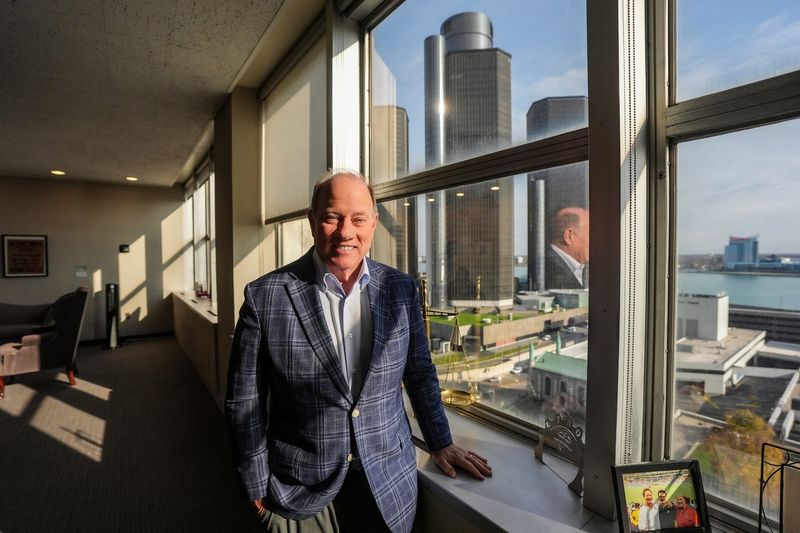
But the mayor always had interests outside of work, too. Duggan is a huge soccer fan, and gleams with excitement when conversations shift that way. He loves Detroit’s sports franchises, particularly the Lions. He’s an alum and avid University of Michigan sports fan. And he enjoys traveling with his wife, Dr. Sonia Hassan, and children — his mayoral office sported family photos and a handprint from his “right-hand man” and grandson.
But that office, on the 11th floor of City Hall and adorned with cherry wood, saw him through a lot of important work, too.
Best and worst days
Detroit’s longtime mayor had much to celebrate on the development front, particularly projects with historic significance: The reopening of Michigan Central station, the Ralph C. Wilson Centennial Park along the west riverfront and Hudson’s Detroit were a few that, he said, stuck out to him.
Duggan recalled that watching Motown superstar Diana Ross perform at the Michigan Central reopening, which was nationally televised, was one of his favorite memories, especially since the building once was a symbol of Detroit’s decay, yet evolved into a sign of revitalization.
Being a part of the Hudson’s Detroit opening downtown prompted him to “emotionally” react, he said, because as a kid, he would run up to the 12th floor to see Santa during the holidays, a core memory.
“This is really powerful, what we’re bringing back, the places of joy that are shared in the community,” he said.
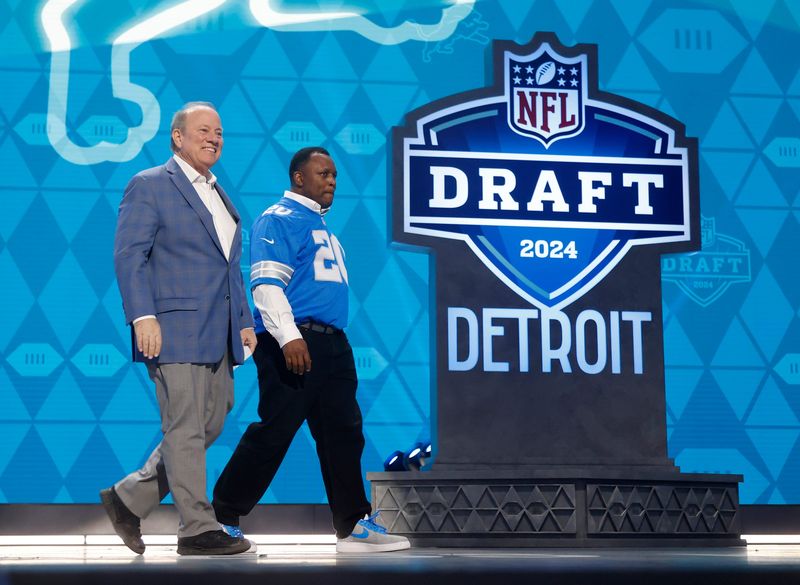
But one of his fondest memories as the city’s top leader, he said, was announcing one of the Detroit Lions’ picks during the 2024 NFL draft in Campus Martius alongside Hall of Fame running back Barry Sanders. Lions officials initially asked Duggan to announce their fifth-round pick, then offered him the third-round pick.
“I’m like, ‘Wow, I have arrived,’” Duggan told a Dec. 8 crowd during an exit interview talk at the Detroit Economic Club. A trade resulted in his announcing the second-round pick, instead.
City officials and the Detroit Police Department elaborately planned the NFL draft, with surveillance cameras wired to a real-time crime center. However, two hours before the event, the cameras were down, Duggan revealed, and attendees were already lining up. Construction crews working on The Residences Water Square apartment building, on the site of the former Joe Louis Arena, had hit a line.
Then-DPD Chief James White told Duggan he could not open the gates without functioning cameras, so Duggan did what Duggan does: he called AT&T Michigan President David Lewis to fix it and 45 minutes later, the cameras were activated and the event continued.
Duggan did not always have that level of control, however.
When he first took office, he was excluded from meetings involving plans for Detroit’s future during the bankruptcy process, he said.
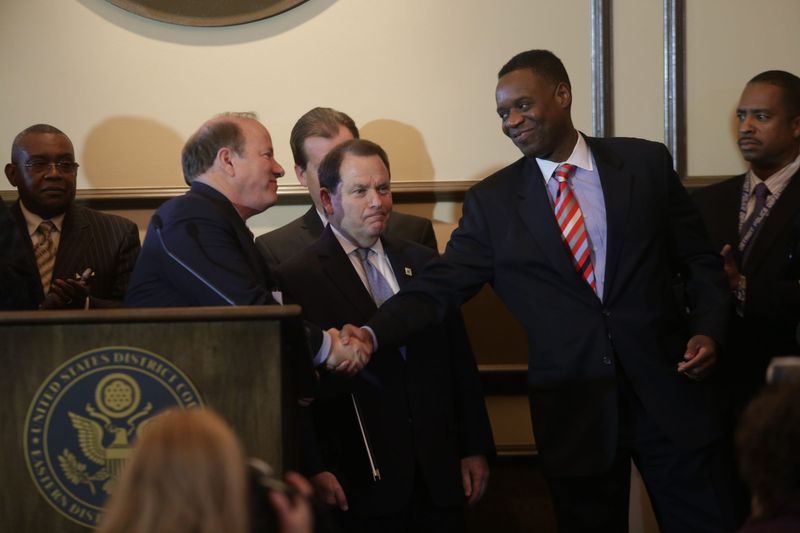
Kevyn Orr was appointed as the emergency manager before Duggan was elected, and early conversations were “extremely intense,” Duggan said at a Detroit Regional Chamber event with Rocket Mortgage Co-Founder Dan Gilbert.
Bankruptcy court required the city to have a 10-year plan to prove the city would be successful in restoring reliable city services, consistently balancing the city budget and covering pension obligations.
“Kevyn Orr excluded me from any of those things. I had no idea what was in his plans and assumptions until Judge Steven Rhodes, at the first hearing that he presented, says, ‘What does Mayor Duggan think?’” Duggan said at that Chamber event. “Rhodes said, ‘I’m not approving anything unless Mayor Duggan comes in and tells me he’s reviewed it.’ At that point, everything started to shift.”
Despite their differences, Duggan credited Orr with doing “a fine job.”
Once fully in charge of the city post-bankruptcy, Duggan moved to address major issues: water shut-offs, population loss and crime reduction.
Detroit’s controversial water shutoff program caught a lot of flak, even from the United Nations. But Duggan says he thinks his administration went about resolving it the right way.
“The emergency manager was shutting off the water. He would not let me … have control of the water department. Then, when all hell broke loose, literally, he walked in here and said, ‘Would you take the water department?,’ Duggan said
“Now, what was happening was the city had not, in years, raised any money for people who couldn’t pay. And so we immediately went out, raised $2- or $3-million in philanthropy, put people in payment programs, and ultimately put in a series of programs that, you know, now you have very few shut-offs,” Duggan said.
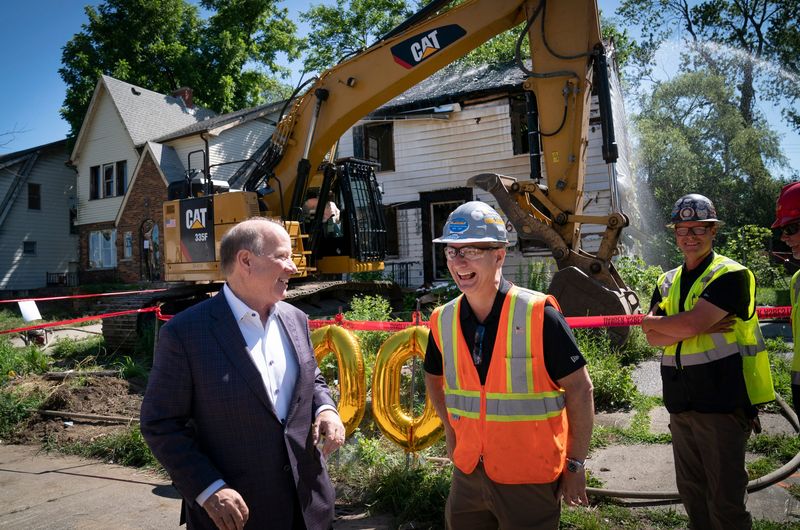
He faced criticism and federal scrutiny for the city’s aggressive demolition program — one of Duggan’s signature policies — which the government temporarily suspended for improper documentation and bidding. The mayor later tasked one of his executives to improve Detroit’s compliance with regulators.
Early in his tenure, Duggan staked his success on whether he could grow Detroit’s population after decades of decline. And he finally did — his last two years in office. That growth has now reached three years, with Mayor Mary Sheffield now in office.
Duggan said he saw ways to grow the states population, too, which factored into his gubernatorial run.
“We are not creating the opportunities in this state that young people want, and if we don’t reverse that, we’re going to keep going the way we’re going,” Duggan said.
His plan to grow the state relied on the same blueprint he used to help grow the city: build quality services and create appealing job opportunities and an environment where people want to live in Detroit. All of that included rebuilding the riverfront and Campus Martius, bringing the Detroit Pistons downtown — along with concerts and shows — and adding a lot of housing.
“Population in the state is growing in two places, Detroit and Grand Rapids, and both of them have created the range of job opportunities and quality of life young people want. We’ve got to do that in a whole lot of cities, and I think we can do it,” Duggan said.
The mayor also credited himself at the Economic Club’s event for paving the pathway to success for his department heads, especially police.
Detroit was known as “carjack city,” Duggan said. Police officers were paid about $15 an hour and leaving a city with high murder rates. While restoring general city services, he began with the Detroit Police Department.
When he got elected, he said, there were 750 carjackings a year in Detroit. He sat with DPD officials and provided them more money to address crime, which included cameras at gas stations, swifter follow-up on cases, and clearing cases.
By his last year in office, the city reached 76 carjackings. Duggan also advocated for police officer raises to retain them from flocking to suburbs, and issued police chiefs a contract where if they left during their contract period, they would owe two years of their salary to the city, to lock them in.
Housing, blight and neighborhoods
Demolishing and restabilizing the 47,000 abandoned houses that Duggan has so often referenced was a top priority for the mayor. As he prepared to leave office, the number was down to 1,300.
And he promised to end blight by 2025. He often touted his demolition program as a success in eliminating residential blight.
“We did exactly what we said we’re gonna do. We had 16,000 houses of the Land Bank. We said we’re going to knock down 8,000 and sell 8,000, and we’ve done it. The Land Bank is on the verge of being without homes,” Duggan said.
However, the city has since been plagued with testing and cleanup costs for hundreds of sites containing contaminated backfill dirt, and more recently an FBI investigation involving the program. Duggan said on May 21 that he is “confident Mayor Sheffield will handle it appropriately” and that he left money behind to help cover remediation efforts.
Part of the reason the city could absorb new residents was because crews were able to stabilize vacant houses for homeowners to buy. In the near future, Duggan said he expects the focus of the Land Bank to shift to managing vacant lots instead of homes, meaning “the next mayor is in a position where you think about how you reuse the land, as opposed to how you chase drug dealers out of a vacant house.”
He prides his administration for building about $1.7 billion in new affordable housing in the last six years. Though he also acknowledges criticisms over affordable housing not being affordable enough, and renters running into non-compliant rental homes.
“That’s all true,” Duggan said in a November meeting, though he pointed to a new affordable housing development next to the Brewster Wheeler Recreation Center, which has units for less than $450 a month.
“I hear from mayors all across this country who have got tent cities in their parks and on their streets, who want to know why there are no tents in Detroit. We are viewed as the national leader among other cities because of the way that we have built the affordable housing,” Duggan added.
City officials also managed to get the Fast Track PILOT ordinance passed, which offers developers property tax cuts based on rental costs — the more affordable the units, the deeper the tax reduction — a move that makes building affordable housing in Detroit easier than in any other part of the state, Duggan said. It’s something he talked about on the campaign trail.
“I keep telling the Traverse Cities, and the Marquettes and the Grand Rapids where there’s affordable housing problems in every place in this state, your local government has to let go of the regulations,” Duggan said. “You have to make the assistance programs easier to use. You got to make the zoning easier to use, and you can stay ahead of the curve. So I’m really proud of what we’ve done (in Detroit) on the housing side.” And he says he’s proud of the changes across Detroit’s neighborhoods, despite residents — for years — challenging him to develop more outside of the city’s core. He pointed to the percentage of votes he received in each election as proof of satisfaction: 55% in the first term; 72% in the second and 75% in the third. Furthermore, he pointed to a news poll that concluded his performance gained an 84% approval rating among voters.
“If I had another four years, I think I could have gotten it up to a 92% and had fewer people criticizing me. But that’s the nature of this business, and the next mayor will build on it and work on that other 16%,” he said. “This city declined over lost population, really, for 70 years, and we’ve started the reversal. And the reversal won’t be completed by the next mayor. May not be completed by the mayor after her. But I think I put it on a good path.”
And looking forward, he had praise for Mary Sheffield, who he hopes takes a hard look at property taxes — a key part of her vision for the city — and continues to focus on affordable housing.
“I think she’s going to be a real good, successful mayor,” he said.
With no path to governor, Duggan’s future uncertain
Duggan wants to be known as the mayor who eliminated political polarization.
“I really would like to be remembered as the mayor who took ‘us vs. them’ politics out of Detroit. I think that’s going to be the long-term change,” he said late last year, pointing to a united tone and landslide margins in the 2025 city elections.
It was a message he hammered on the statewide campaign trail, too, as he pitched himself as an independent alternative to a two-party system. And even though he wasn’t successful in his gubernatorial bid, he said he still believes in the independent path.
It’s not clear where Duggan goes after his gubernatorial run. He batted away speculation that he was dropping out to lead the University of Michigan, saying he hadn’t had a single conversation with the university about that — or anybody else for that matter, regarding a future job.
“What I’ve learned is this: there’s an enormous support for it. There’s not a national fundraising infrastructure for it. Somebody is going to break through…I think the first person who breaks through is going to be the person who self-funds,” Duggan said.
Dana Afana is the Detroit city hall reporter for the Free Press. Contact: dafana@freepress.com. Follow her: @DanaAfana.
This article originally appeared on Detroit Free Press: Mike Duggan ends statewide campaign, but left strong mark in Detroit
Reporting by Dana Afana, Detroit Free Press / Detroit Free Press
USA TODAY Network via Reuters Connect