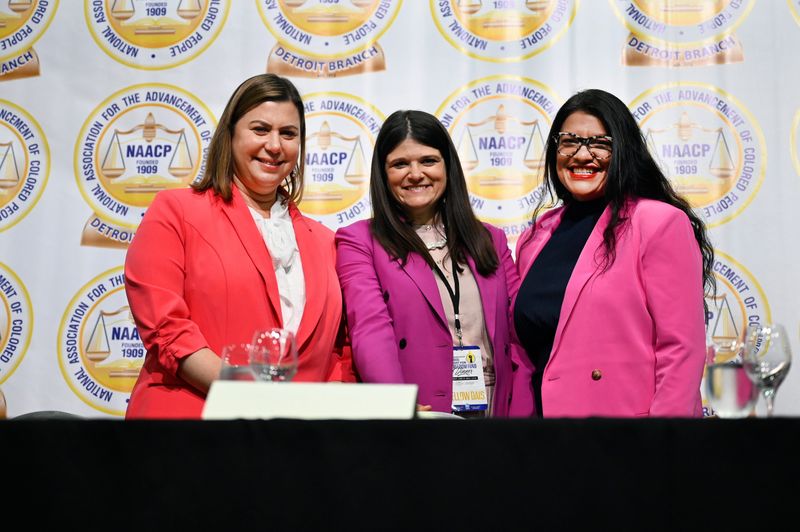
Washington — Democratic U.S. Sen. Elissa Slotkin and U.S. Rep. Haley Stevens announced a joint effort Wednesday to ban all entry of Chinese nameplate vehicles from Canada and Mexico into the United States, even for temporary visits to border cities in states like Michigan, California and Texas.
“It’s important to me, both as an economic security issue and as a national security issue, that we not allow these vehicles to come over our border,” Slotkin, of Holly, said in a phone interview.

The first-term senator has elevated broader concerns in recent weeks about the national security and economic implications of giving Chinese automakers access to the U.S. market. Slotkin introduced a bipartisan bill last month with U.S. Sen. Bernie Moreno, R-Ohio, meant to block Chinese automakers from accessing the U.S. market.
Her latest bill with Stevens — announced during a high-visibility week for both of them at the annual Mackinac Policy Conference — will seek to address the narrower issue of Mexican and Canadian residents temporarily driving vehicles manufactured by Chinese brands like BYD Co. or Chery Automobile Co. into or around Detroit and other border towns for brief visits.
The question of how U.S. border agents should treat Chinese vehicles coming into Michigan via Ontario has percolated in automotive and political circles in the Motor City since January, when Canada agreed to a trade deal with China that allowed the import and sale of up to 49,000 Chinese electric vehicles.
Residents of Mexico, where Chinese automakers have gained a significant foothold in the auto market, have long been able to drive Chinese nameplate vehicles into the United States on a temporary basis.
Reddit users in California and Texas frequently post photos of Chinese plug-in vehicles with Mexican license plates on American soil. One user reported seeing one BYD model as far north as New Jersey.
Slotkin and Stevens’ bill aims to cut off those vehicles’ access to U.S. roads, though it will include a provision allowing for exemptions under certain conditions.
“It basically just bans fully constructed Chinese vehicles — think about Geely (Auto) or BYD — from driving over in any capacity, even just for the day,” Slotkin said.
The senator continued: “I’ve called them surveillance packages on wheels. What’s to stop them from taking full-motion video, or LiDAR geolocation on our sensitive infrastructure sites, our military bases, and seeing the geolocation of individual leaders who are driving in these things?”
Slotkin said that she has not yet heard of or seen any Chinese vehicles near Michigan’s border with Canada but figures “it is just a matter of time.”
The senator also noted that she discussed the topic with Canadian Prime Minister Mark Carney during a recent visit to the country and told officials of her upcoming bill.
Slotkin and Stevens both called out the Trump administration for a worsening trade relationship between the United States and Canada, a factor they cited as a reason the U.S. ally reached an autos deal with China.
However, both also said additional steps are needed to look out for Michigan’s interests in the evolving industry and trade landscape.
Stevens, who is a candidate in an open race for Michigan’s other U.S. Senate seat, expressed similar security concerns to Slotkin and emphasized potential economic ramifications for the industrial Midwest if Chinese automakers are ever allowed to make and sell vehicles in the United States.
“We have to recognize that state-owned enterprises that exploit open, free-market capitalism and our industrial sector are a real danger to the United States and to Michigan’s manufacturing base,” Stevens said in a phone interview.
She added: “I’m not going to allow Michigan, as one of just a handful of states in the country whose central economic driver is manufacturing, to get steamrolled by bad trade practices. We’ve got to put Michigan first.”
Stevens has frequently worked on automotive and manufacturing issues during her four terms as a U.S. House member and previously served on former President Barack Obama’s auto industry task force before seeking elective office herself.
The lawmakers have not yet introduced the bills in their respective chambers but said they will do so in the coming weeks. In the meantime, the two plan to publicly promote their effort during Michigan’s 2026 Mackinac Policy Conference — an annual affair that brings together many of the state’s political leaders and spotlights key elections.
Slotkin demurred when asked if the joint bill was an indicator she would endorse Stevens in a competitive three-way Democratic Senate primary race.
“I am not getting involved in the Senate primary. That has not changed. I don’t get involved in Democratic primaries, as is our tradition in Michigan,” Slotkin said. But she did praise Stevens, who was first sworn into Congress on the same date as her in 2019.
“Rep. Stevens has been the leader in the House on auto manufacturing policy since we were both freshmen together. She knows it backwards and forwards, she knows the history, and importantly, she’s of a different generation that really understands the auto industry needs to be future-focused — not just looking backwards at how the auto industry used to be,” Slotkin said.
“It was a natural pick for me to have Haley lead it, because she’s truly the strongest member we have on auto policy coming out of the state of Michigan.”
gschwab@detroitnews.com
@GrantSchwab
This article originally appeared on The Detroit News: Slotkin, Stevens seek ban on Chinese vehicles, even for day trips
Reporting by Grant Schwab, The Detroit News / The Detroit News
USA TODAY Network via Reuters Connect