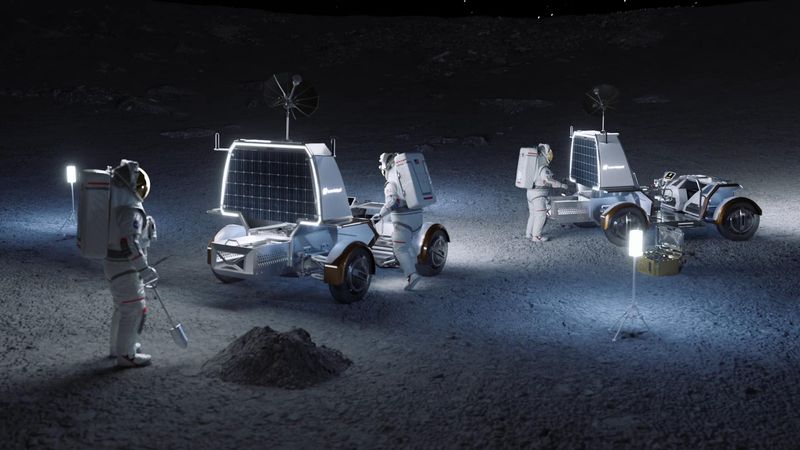
NASA has awarded General Motors a government contract that will propel the next lunar terrain vehicle designed to establish the first long-term human presence on the moon.
GM Defense, the automaker’s military-contracting subsidiary, will be a subcontractor in the development of the “Pegasus” Lunar Terrain Vehicle (LTV) to support NASA’s Artemis mission in 2029 alongside prime contractor Lunar Outpost, Goodyear Tire, MDA Space and Leidos.

The Detroit automaker confirmed to the Detroit Free Press on May 26 that it will provide battery-electric propulsion for a rover, called “Eagle,” intended for upcoming missions that will allow the United States to establish sustained operations in space. In a previous version of the contract, GM was also to provide the suspension, and autonomous vehicle hardware technology for the rover. Those functions will now be overseen by Lunar Outpost.
While the “Eagle” is not slated for the 2028 mission, the first contract is still on, according to Erica Mitchell, spokeswoman for GM Defense. The vehicle could possibly be used in 2030 if the next phase of the government decides to move forward with next steps.
According to NASA, Pegasus is “a lighter, mission‑ready evolution of its Eagle rover designed explicitly to meet NASA’s updated LTV requirements,” the agency said in a release.
“Operational for up to a year and capable of manual, autonomous, or teleoperated driving at speeds more than 9 mph, Pegasus incorporates Apollo‑heritage technologies and builds on prototype and flight experience to deliver human‑centered mobility essential for establishing a sustained Moon Base,” NASA said.
Qualities of moon cars
GM has worked for years to land the contract alongside partner Goodyear, continuing its decades long history in constructing technology that can withstand the harsh conditions of space.
Carlos García-Galán, program executive for the Moon Base, said during a press conference at NASA’s Headquarters in Washington that LTVs give astronauts the ability to further conduct scientific research around the moon.
The vehicles can be operated remotely from Earth and manually by the astronauts on the moon. Modern lunar vehicles also require fifth-level autonomous vehicle capabilities ― meaning they can drive capably without a human present ― because the vehicle is often deployed on the moon before astronauts can reach it.
Another element critical for long-term use on the moon is what NASA calls “survive the night” technology. In addition to dramatically higher range and battery capacity than the original rover, the new rover needs to remain functional during the 14-day long lunar night where temperatures may drop as low as -334 degrees Fahrenheit.
Pegasus is intended to withstand the particularly rough and hostile terrain of the Moon’s South Pole, so its battery must capable of withstanding extreme temperature swings, GM Defense said in a statement.
“GM’s electrification technology was built to perform in some of Earth’s toughest driving conditions, and adapting it for the Moon with space-rated batteries is an extraordinary technical challenge,” Stephen duMont, president of GM Defense, said in the statement. “Helping astronauts once again travel safely across the lunar surface will be a proud moment for our team and our country.”
In total, NASA awarded Lunar Outpost $220 million to build and deliver the first phase of LTVs. GM would not disclose what portion it would receive for its designs and technology.
GM put the first electric car on the moon nearly 50 years ago when it helped develop the electric Apollo Lunar Roving Vehicle (LRV), including the chassis and wheels for the LRV that was used on Apollo’s 15 through 17 missions.
Both GM and Goodyear have said the innovations discovered while working on the rovers will help them make better vehicles and tires for those used on Earth.
Staff reporter Jamie LaReau contributed to this report.
Jackie Charniga covers General Motors for the Detroit Free Press. Reach her at jcharniga@freepress.com.
This article originally appeared on Detroit Free Press: GM clinches NASA contract to build battery for moon-bound vehicle
Reporting by Jackie Charniga, Detroit Free Press / Detroit Free Press
USA TODAY Network via Reuters Connect