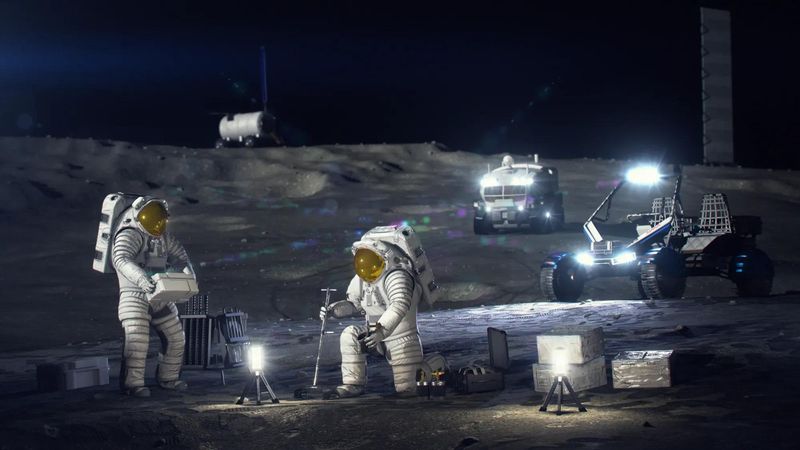
Blue Origin may launch an uncrewed lunar lander to touch down near the moon’s south pole as early as fall — kicking off initial robotic development of NASA’s future moon base.
Engineers with Jeff Bezos’ space company and NASA tested the Blue Moon Mark 1 lander, nicknamed Endurance, in a vacuum chamber in recent weeks at Johnson Space Center in Houston. The cargo lander will launch atop a New Glenn rocket from Launch Complex 36 at Cape Canaveral Space Force Station.

All told, the moon base’s first phase will encompass 25 launches, 21 landings and four metric tons of cargo by 2029, Carlos García-Galán, NASA’s Moon Base program executive, said during a news conference Monday, May 26.
NASA’s future goals: Establish an initial moon-base operating capacity from 2029 to 2032, leading to semi-permanent crew presence by 2032 and beyond. NASA Administrator Jared Isaacman described the lunar surface in terms of the “harsh and dangerous and unforgiving environment of space.”
“We are leveraging the NASA playbook from the 1960s, figuring out what works and what doesn’t in this epic science of survival. Because the moon base is as beautiful as it is hostile,” Isaacman told reporters.
“In sunlight, the surface can heat to over 250 degrees. In darkness, it can drop well below minus-200. In the permanently shadowed craters — areas of great interest that have been untouched by sunlight for millions, even billions of years — temperatures can fall well below minus-400 degrees,” Isaacman said.
“There is no atmosphere to moderate these extremes, no protection from radiation and solar particle events. And the surface is exposed to meteorite impacts, including the kind of light flashes the Artemis II crew observed from orbit,” he said.
The NASA news conference also highlighted a pair of uncrewed lunar landers that should launch by year’s end. The first is Astrobotic’s Griffin lander, which will deliver Astrolab’s FLIP rover among more than 1,100 pounds of cargo. That mission will launch on a SpaceX Falcon Heavy rocket from NASA’s Kennedy Space Center.
Trinity, Intuitive Machine’s Nova-C moon lander, is also slated to deliver science payloads from NASA, the European Space Agency and Korea Astronomy and Space Science Institute.
Isaacman said Blue Origin’s upcoming liftoff will enter the record books as history’s first privately funded lunar-lander mission.
Artemis III tracking for mid-2027 launch
On April 1, the four Artemis II astronauts lifted off in their mighty 322-foot Space Launch System rocket from pad 39B at Kennedy Space Center. Their ambitious 10-day lunar mission marked NASA’s first crewed voyage to the moon since Apollo 17 in 1972.
The four-person crew swung around the far side of the moon inside their Orion spacecraft and shattered the Apollo 13 record for the farthest distance any human has traveled from Earth.
Next, Isaacman said Artemis III is targeted for launch in mid-2027. This mission will test Orion rendezvous and docking with Blue Origin and/or SpaceX crewed moon landers in Earth orbit. Astronauts will also conduct integrated checkouts of life support, communications, propulsion and possibly spacesuits.
In late April, the enormous orange core stage of the Artemis III SLS rocket floated to KSC via barge from NASA’s Michoud Assembly Facility in New Orleans, Louisiana. That core stage is now tucked inside the Vehicle Assembly Building.
On May 7, NASA announced a full-scale mockup “training cabin” of a Blue Origin Blue Moon Mark 2 crewed lander is operational for training and testing at NASA’s Johnson Space Center in Houston. The actual crewed lander will stand 52 feet tall, and it could send astronauts to the moon’s surface during Artemis IV in 2028.
NASA announces agencywide realignment
On the personnel front, NASA announced an agencywide realignment on Friday, May 22, to “focus talent and resources on objectives including accelerating the Artemis program, establishing a Moon Base, developing a nuclear space reactor, igniting the orbital economy, and expanding missions of science and discovery.”
Brian Hughes was named director of Kennedy Space Center as part of the realignment strategy. He succeeds Janet Petro, who retired as KSC’s 11th director effective May 1.
Kelvin Manning served as KSC’s acting center director this month in the interim. His new job title is deputy associate administrator of NASA’s Human Spaceflight Mission Directorate.
Hughes previously worked as CEO and chief administrative officer of Jacksonville’s Downtown Investment Authority. A senior advisor to Trump’s 2024 presidential campaign and White House deputy national security adviser for strategic communications, he became NASA’s chief of staff last year.
Isaacman announced the realignment would not trigger workforce reductions, program cancellations or facility closures.
For the latest news from Cape Canaveral Space Force Station and NASA’s Kennedy Space Center, visit floridatoday.com/space. Another easy way: Click here to sign up for our weekly 321 Launch space newsletter.
Rick Neale is a Space Reporter at FLORIDA TODAY, where he has covered news since 2004. Contact Neale at Rneale@floridatoday.com. Twitter/X: @RickNeale1
Space is important to us, and that’s why we’re working to bring you top coverage of the industry and Florida launches. Journalism like this takes time and resources. Please support it with a subscription here.
This article originally appeared on Florida Today: Blue Origin lunar lander may launch this fall to help develop NASA moon base
Reporting by Rick Neale, Florida Today / Florida Today
USA TODAY Network via Reuters Connect