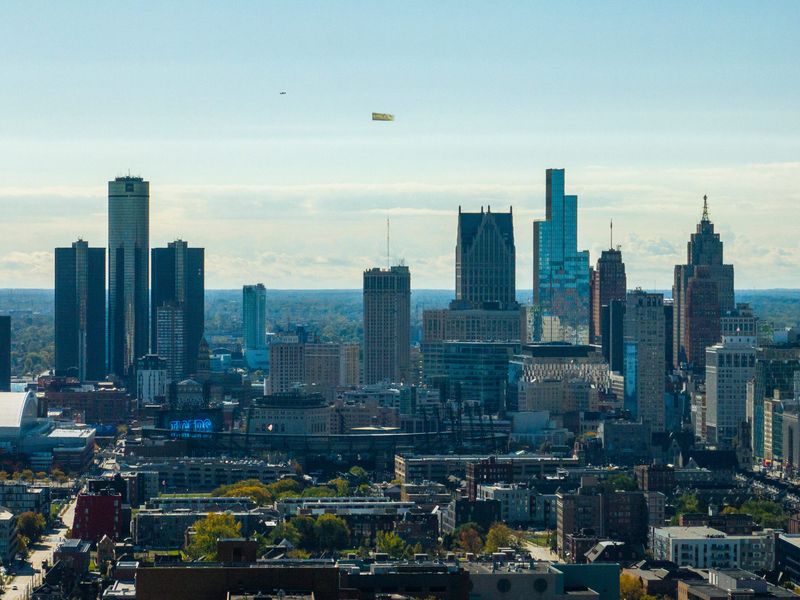
A slew of dire reports about Michigan’s economy suggest that Michigan’s leaders must get more honest and courageous about our future. In fact, it might be time to consider the dreaded “i-word” . . . immigration. Immigration issues have become political fodder for both the left and the right, but serious times require us to look beyond the rhetoric and the political gamesmanship. Immigration policy is economic policy, and few issues are as important to our future prosperity.
Since March, local doomsday stories include Detroit Regional Chamber President Sandy Baruah’s claim that “Michigan’s house is on fire” and a recent Detroit News headline that “Michigan’s population equation is upside down. Economists worried.” Business Leaders for Michigan’s latest strategy document, “Michigan in a New Era,” notes decades of slow population growth, talent outmigration and flat growth in high-wage professional service jobs. Yet, immigration as a solution to these warnings is virtually ignored by our state’s political leaders and pundits.

If our economic woes are indeed grave, it’s time we learn to talk about the “i-word.”
Let’s start with population growth. Immigration has been the most important driver of population growth across Michigan. Metro Detroit’s population grew 1.2%, or a little more than 50,000 residents, from 2010 to 2023. During that period, the U.S.-born population decreased by nearly 59,000, while the foreign-born population grew by over 109,000, accounting for all of the net population growth. The same pattern exists statewide, whether one looks back to 2000, 2010 or 2020. Talking about Michigan’s population growth without discussing immigration is like talking about Michigan’s economy without mentioning autos, agriculture or tourism.
Let’s explore high-skilled STEM talent. In 2024, the Michigan Economic Development Corporation’s Talent Action Team identified critical shortages for the state’s mobility industries. Electrical engineers and software developers topped the list. More than 70% of graduate students in these fields are international students. Michigan is home to some 40,000 international students who contribute $1.4 billion annually to the state economy. New research found that over 85,000 high-skilled STEM positions between 2013 and 2022 were filled by international students working on student visas after graduation, including over 50,000 engineering jobs. Continuing to fight a talent war without incorporating 70% of the future international talent pipeline is like competing in the Stanley Cup playoffs with half the team in the locker room.
Let’s talk inflation and housing. Immigrants comprise roughly half of all trucking business owners in Metro Detroit, helping keep the costs of moving goods and materials down through competition. There are over 5,000 immigrant business owners in Michigan’s construction industry. Nationally, immigrant construction workers comprise roughly half of all roofers, drywall installers and painters, and at least one-third of all carpenters, insulation installers and brick masons. If we want to build more affordable housing and keep the prices of goods and services down, we need more workers and construction business owners, not fewer.
Let’s talk business ownership and entrepreneurship. New research released in April found that while immigrants make up 10.7% of the Detroit region’s population and 12.5% of its workforce, they account for 18.4% of business owners and 23.8% of the owners of Main Street businesses essential to community vibrancy, like restaurants, grocery stores, dry cleaners, and car dealerships. If we want communities that attract and retain we need to support these business owners.
Ignoring immigrants’ economic contributions and their role in prosperity is a sad reality affecting leaders across the country. But not every state is drenched in headlines and benchmark studies documenting the state’s declining economy.
The good news is that Michigan has quietly developed the nation’s top immigrant economic development playbook. My organization, Global Detroit, was launched by the Detroit Regional Chamber, New Economy Initiative and Skillman Foundation with a bold vision to invest in immigration. Our strategies and programs are routinely cited as national best practices in international student retention, immigrant high-tech startup support and skilled immigrant integration. The Office of Global Michigan, launched by former Republican Gov. Rick Snyder and expanded by Democratic Gov. Gretchen Whitmer, represents one of the nation’s leading state offices on immigration. The Michigan Global Talent Initiative, a business-led strategy to add 125,000 college-educated immigrants to Michigan’s workforce, has become the model for other states.
For these strategies to truly help spark growth and prosperity, business and political leaders must actively embrace the economic benefits of immigration. That means building pro-growth, pro-immigrant measures into economic development, workforce, entrepreneurship, innovation and industry strategies to secure Michigan’s and America’s economic future. Ignoring the “i-word” leaves Michigan without one of its most powerful economic strategies.
Steve Tobocman is executive director of Global Detroit.
This article originally appeared on The Detroit News: If Michigan wants growth, it needs immigration | Opinion
Reporting by Steve Tobocman / The Detroit News
USA TODAY Network via Reuters Connect