The next astronauts to embark on a mission under NASA’s Artemis lunar program won’t be going anywhere near the moon. But that doesn’t make the undertaking any less critical.
In fact, Jeremy Parsons, a NASA deputy administrator, recently referred to a mission known as Artemis III as “one of the most highly complex missions NASA has undertaken.”

That’s because the mission launching from Florida to Earth orbit involves multiple rocket launches and multiple spacecraft that will have to find a way to link up in space. If all goes well, the mission targeted for 2027 would set the stage for a historic moon landing in 2028 – the first since NASA’s iconic Apollo era ended half-a-century ago.
“We’re integrating more partners and interrelated operations into this mission by design, which will help us learn how Orion, the crew, and ground teams all interact together with hardware and teams from both lander providers before we send astronauts to the moon’s surface and build a moon base there,” Parsons said in a statement.
Here’s everything we know so far about Artemis III.
What is the Artemis III mission?
Targeted for 2027, Artemis III will be the third mission under NASA’s new lunar program and the second with a crew.
Similar to Artemis II, which went off in April without a hitch, the mission will serve as a vital test flight before NASA attempts to land astronauts on the moon’s surface as early as 2028 for the first time since 1972.
Under its Artemis campaign, NASA plans to use a series of both uncrewed and human moon landings to construct a $20 billion moon base near the lunar south pole, where astronauts can live and work indefinitely. The missions would prepare for future ventures deeper into the solar system, including the first human expeditions to Mars.
NASA spacecraft to dock with Blue Origin, SpaceX lunar landers
The primary objective during the Artemis III mission is for astronauts aboard NASA’s Orion spacecraft to meet and dock in orbit with one or both commercial lunar landers being developed by SpaceX and Blue Origin.
Once in low-Earth orbit, which is a path around our planet relatively close to Earth’s atmosphere, the Orion capsule will rendezvous with at least one of the lunar landers: SpaceX’s Starship human landing system, and Blue Origin’s Blue Moon Mark 2 – both of which are still in development.
NASA has not yet decided whether any of the astronauts on the Artemis III crew would enter either lander after docking operations are successfully demonstrated, the agency said in a May 13 press release.
Who are Artemis III astronauts? Crew to spend more time in space than Artemis II
NASA, which in 2025 announced a new class of astronaut candidates, has not yet selected a crew for Artemis III.
Compared to the the Artemis II mission, which sent four astronauts a record 252,756 miles away from Earth, the Artemis III astronauts will be staying much closer to home.
But even though they won’t be leaving Earth orbit, the crew members will in fact spend more days in space than their predecessors did during a 10-day mission around the moon and back.
While NASA has not yet indicated just how long the mission would last, the astronauts would be tasked with not just docking with one or two lunar landers, but testing life support systems and potentially extravehicular spacesuits being developed by Houston-based space technology company Axiom Space.
The agency also plans to test an upgraded heat shield during Orion’s return through Earth’s atmosphere “to enable more flexible and robust reentry profiles for future missions,” NASA said.
NASA makes modifications to SLS rocket
To get the Artemis III astronauts into space, NASA will once again rely on the service of its towering Space Launch System (SLS) rocket.
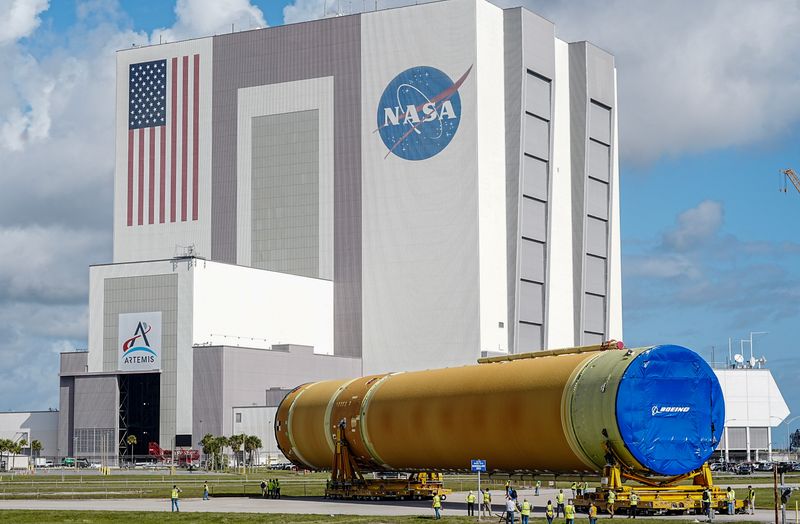
Standing at 322 feet tall, the SLS is the most powerful rocket the space agency has ever launched. NASA is already assembling the rocket at the Kennedy Space Center near Cape Canaveral, Florida in anticipation of Artemis III.
But when the SLS gets off the ground again potentially in 2027, it will look a little different from what launched the Artemis II mission.
On the first two Artemis missions, the SLS made use of a piece of hardware known as the interim cryogenic propulsion stage as the upper stage, which provided propulsion in space after other components of the rocket had separated. For Artemis III, though, NASA will instead use a spacer on the rocket that doesn’t have an engine.
Eric Lagatta is the Space Connect reporter for the USA TODAY Network. Reach him at elagatta@usatodayco.com. Subscribe to the free Florida TODAY newsletter.
This article originally appeared on Florida Today: NASA’s Artemis III won’t reach moon — but it’s critical to get there
Reporting by Eric Lagatta, USA TODAY NETWORK – Florida / Florida Today
USA TODAY Network via Reuters Connect