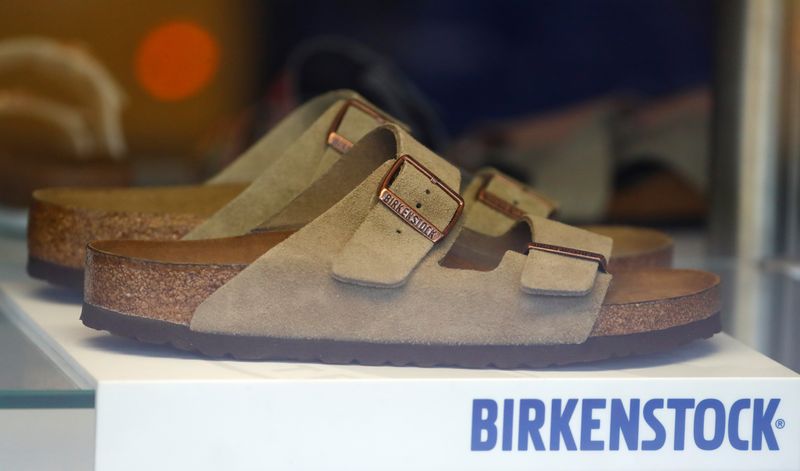
By Savyata Mishra and Danielle Kaye
May 18 (Reuters) – Birkenstock is falling out of favor with investors who are abandoning hope that the sandal maker can scale into a luxury powerhouse.

The company debuted its shares in 2023 in a richly valued initial public offering, where it pitched itself as a 250‑year‑old sandal maker reborn as a modern luxury brand. Three years on, a slump in Birkenstock’s market capitalization suggests that investors may be starting to see the company as a footwear brand with a small, loyal clientele and steady sales, but one unlikely to boast the broad appeal or margins of luxury powerhouses like LVMH, which partly owns the ergonomic shoe maker.
Doubts intensified last week after Birkenstock reported lower quarterly growth and failed to raise its annual sales outlook, blaming U.S. tariffs and the Middle East conflict. Its shares slumped more than 14% to a record low of $32.44, leaving it with a market capitalization nearly 38% smaller than the $9.3 billion at its initial public offering.
The selloff points to a growing disconnect between how the company was positioned and how it is now being judged. Birkenstock sits between luxury and mass market, more premium than most footwear brands in how it controls distribution and limits discounting, but without the scale or product range of global luxury names.
“Investor expectations likely became inflated once the brand was valued more like a luxury fashion company than a footwear company,” said Keith Fraley, an assistant professor at the Fashion Institute of Technology in New York. The challenge now, Fraley said, was maintaining exclusivity while growing globally.
VALUATION IS BEING RESET TO REFLECT MORE MID-MARKET BRAND
That tension runs through Birkenstock’s business. Birkenstock produces the vast majority of its shoes in Germany, reinforcing its premium image but leaving it exposed to higher costs than rivals that produce in Asia.
At the same time, demand is showing signs of strain. Birkenstock has pushed through price increases, supported by wealthier customers, but more price-sensitive shoppers are pulling back as higher living costs weigh on discretionary spending.
Those pressures were evident in the latest quarter, with margins falling as the dollar weakened against the euro and its tariff burden doubled to 20%, hitting profitability in its largest market, the United States. Birkenstock’s adjusted EBITDA margin declined 270 basis points in the latest quarter and the company said those pressures would continue to weigh on margins this year.
Birkenstock’s contoured cork footbed sandals – central to its identity – are essentially a summer shoe, analysts and brand experts said, and broad growth has remained elusive even as it pushes into clogs, boots and sneakers. Despite Birkenstock’s ambitions, investors are recalibrating expectations from high-growth luxury contender to a solid, but more constrained, consumer brand.
“Fashion markets eventually ask the same question: is this timeless or did everyone who wanted in buy enough?” said Michael Ashley Schulman, a partner at Cerity Partners.
That shift in sentiment is also showing up in valuation. The company’s shares now trade near 13 times forward earnings, close to the industry average, a sharp comedown from the premium it once commanded when the stock peaked at 123.17.
By contrast, Crocs, Birkenstock’s closest rival, has avoided a similar selloff in part because it already trades at mass‑market footwear multiples – 7 times its next 12-month earnings – and delivers margins above 20%.
“If (Birkenstock) chases volume by opening too many wholesale doors or relying on promotions, they will lose the luxury premium they’ve spent decades building,” said Eric Tsytsylin, a brand strategy partner at Lippincott, a global brand consultancy.
($1 = 0.8601 euros)
(Reporting by Savyata Mishra in Bengaluru and Danielle Kaye in New York; Editing by Sayantani Ghosh)