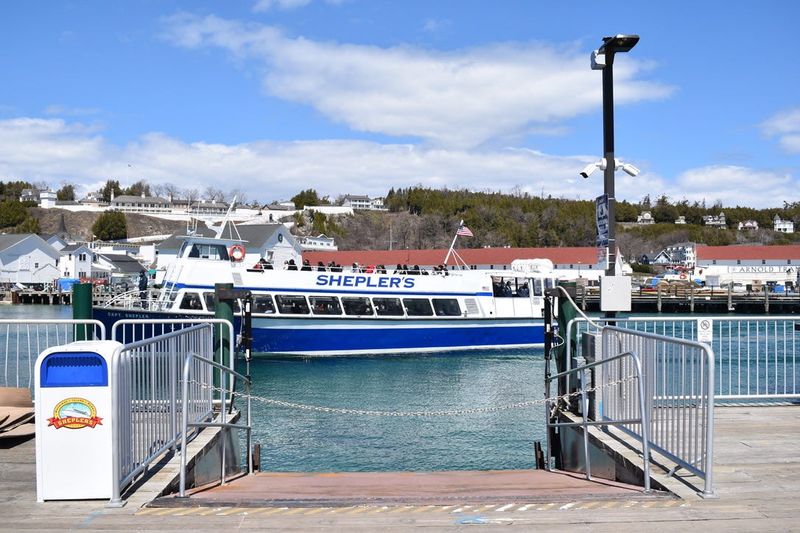
A legal dispute threatening to halt ferry service to Mackinac Island next year is casting a shadow over the coming summer season, prompting travelers to express concerns and state lawmakers to consider empowering local officials to regulate fares and other fees.
Legislation being considered by the Michigan House Government Operations Committee would allow Mackinac Island to oversee all aspects of ferry service, including fees charged for services like parking, priority boarding and baggage. The measure passed 30-6 in the Senate last year, but it remains stuck in the House panel — with just a week to go to the unofficial start to another summer.

“We were hoping to have it done by summer, because this is a problem, but no it’s just stuck there,” said Sen. John Damoose, who sponsored Senate Bill 304. “This is exactly what everybody’s afraid of, that a whole community and a whole island could be held hostage by one company.”
He said the bill is intended to clarify the city’s authority over ferry operations after both ferry lines came under common ownership. The measure has remained in the House Government Operations committee since July, with no recent action.
The operator of the two ferry lines that carry visitors to and from one of Michigan’s most popular tourist destinations says the city is refusing to negotiate a new contract and warns that it could pull Shepler’s Mackinac Island Ferry and Arnold Transit Co. boats from service in 2027 without one. The City of Mackinac Island accuses Hoffmann Marine, which sued the city last year, of using a de facto monopoly to set exorbitant rates.
Caught in the middle: Tourists and the inns, restaurants, fudge shops and souvenir sellers who depend on the visitors for their livelihoods.
John Sellek, spokesperson for the Mackinac Island Convention and Visitors Bureau, acknowledges the legal fight is starting to affect business despite the fact that ferry service is operating as normal this year.
“People planning visits this year and next are excited but want to know more about the situation,” he said. “While most reservations are still set because everyone is hopeful for a compromise, we are seeing some cancellations.”
Tourism leaders and business owners emphasize that ferry service is unaffected this spring and summer by the legal fight.
“The important thing right now is that no matter what people see in the headlines about this debate over affordable ferry service, Mackinac Island is open for business this year,” Sellek said. “We welcome everyone to visit the island and our small businesses.”
More than 1 million tourists visit the island each summer, according to officials, with most visitors using ferry service to get there. Sellek said workers at hotel front desks, restaurant tables and retail counters are hearing traveler concerns.
“This situation exposes our biggest fears about what monopoly power could do to the economy of Mackinac Island,” he said. “For a single entity to have bought all ferry companies and the city franchise agreements that came with them and then ignore those regulatory agreements, which are meant to protect tourists and residents, is a major concern to all of us.”
The dispute stems from ongoing negotiations between the city of Mackinac Island and Hoffmann Marine over pricing and operating terms. Both ferry lines are owned by parent Hoffmann Family of Companies, which purchased them in recent years.
The city has argued that these acquisitions eliminated competition in ferry transportation and long-term parking, while the ferry services allege the city has overstepped its authority. The matter is in federal court via a suit and countersuit.
Shepler’s Mackinac Island Ferry and Arnold Transit Co. each said in late April that they “reserve the right to cease operations for the 2027 season” if a new agreement is not reached, citing stalled negotiations with the city. Mark Magyar, an attorney for the ferry companies, said the city interpreted the letters as a threat, but that is not the case.
“Contrary to the City’s characterizations of this letter, it was neither a threat nor an intention to cease services,” he wrote in an email. “But a contract extension is necessary to ensure certainty and continuity of service to Island residents and visitors.”
As for this year, ferry ticket sales are up, said Jenny Gezella of Hoffmann Marine.
“Despite a later start to the season due to challenging weather, early ticket sales are already outpacing last year,” Gezella said in a statement. “It’s encouraging to see such strong early demand, and both teams are excited to welcome visitors back to Mackinac Island aboard our safe, clean, reliable fleets — delivering the first-class service our guests expect.”
While officials say ferry service is operating normally this season, the larger concern may be how the dispute is perceived by those considering future visits. The island’s economy benefits from advance bookings for peak-season travel, weddings and large conferences.
Tim Nash, vice president emeritus and director of the McNair Center at Northwood University, cautioned the dispute could become more significant heading into 2027 when the current agreement expires. Nash pointed to a federal judge’s comments in April, urging the city and ferry services to find a solution, noting their interdependency on each other.
“Mackinac Island is a wonderful place, and both sides are benefiting immensely,” Nash said. The dispute may be more confusing for travelers outside of Michigan who are less familiar with the matter.
“The further you travel from Michigan, the more this dispute is confusing and adds more lack of confidence to the decision people will make,” he said.
Michigan Attorney General Dana Nessel has encouraged the City of Mackinac Island and Hoffmann Marine to enter facilitative mediation with a mutually selected mediator to resolve ongoing disputes.
“Mackinac Island is vital to our state’s tourism industry,” Nessel wrote. “With more than one million visitors each year, the continued vitality of the Island and access to natural wonders depend on a collaborative relationship between the City and the owner of the ferries that serve as the primary gateway to its shores.”
Sellek said Mackinac Island’s small businesses support the city because local leaders are fighting for affordability and accessibility, the most pressing issues facing Michigan families who visit the island each year.
“If prices increase at an alarming or unethical rate, Michigan’s crown jewel and one of Michigan’s most prestigious state parks will suffer,” he said. “For next year, we are optimistic a compromise will be found.
“But in case that remains out of reach, we fully support the Michigan Legislature acting to make affordability, transparency, and local control a priority in this debate between a monopolistic ferry system owned by an out-of-state company and the families of Michigan.”
cwilliams@detroitnews.com
This article originally appeared on The Detroit News: Ferry fight puts Mackinac Island tourism in choppy waters
Reporting by Candice Williams, The Detroit News / The Detroit News
USA TODAY Network via Reuters Connect