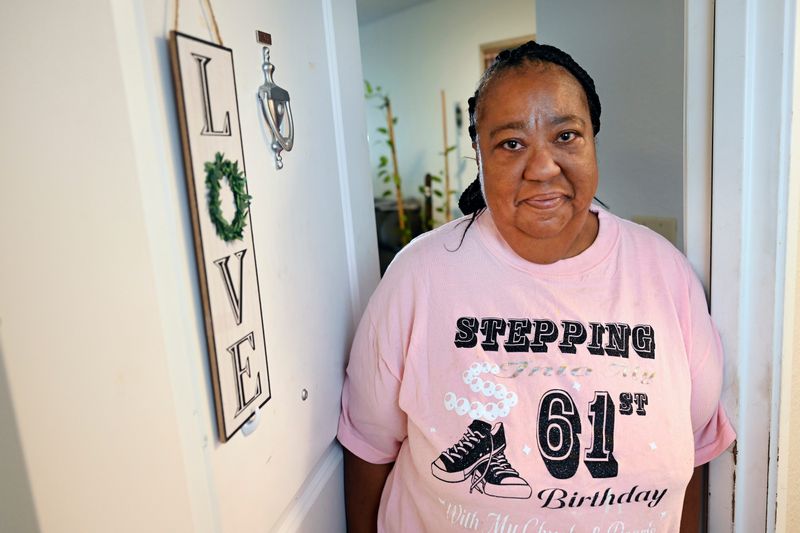
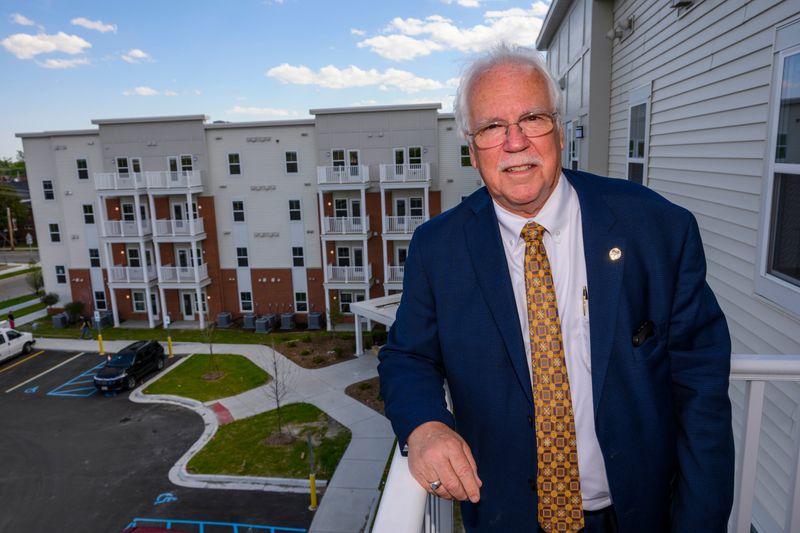
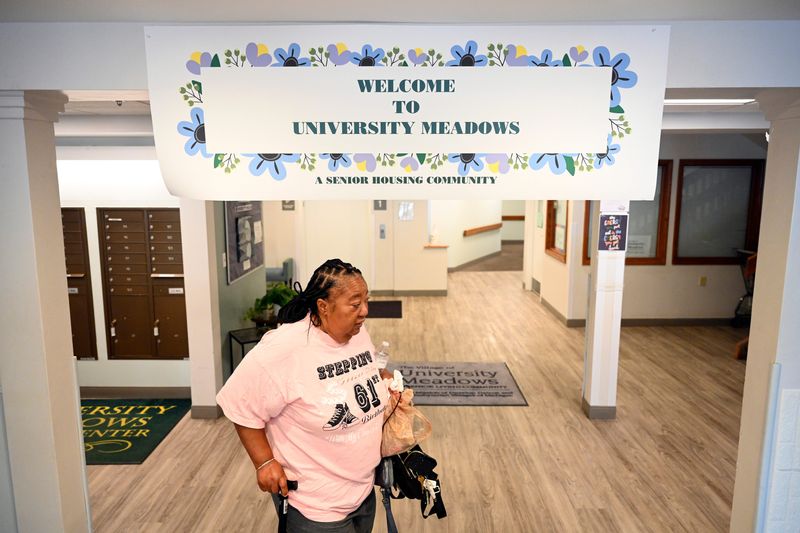
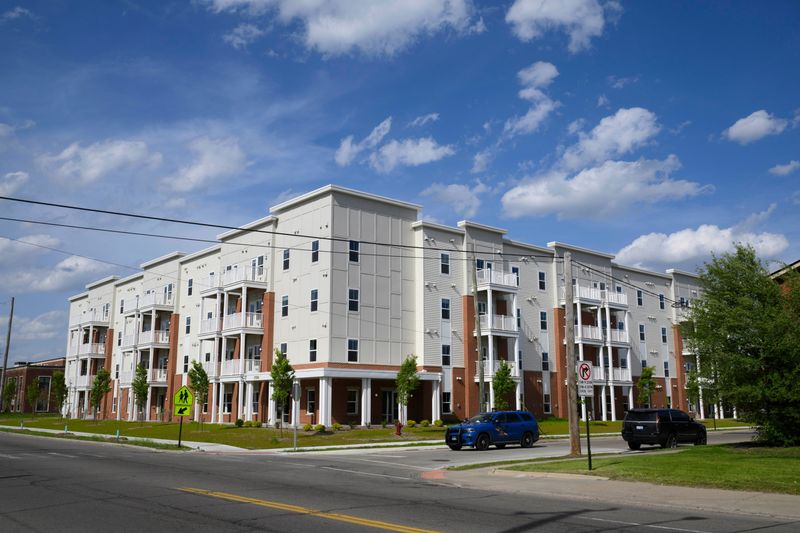
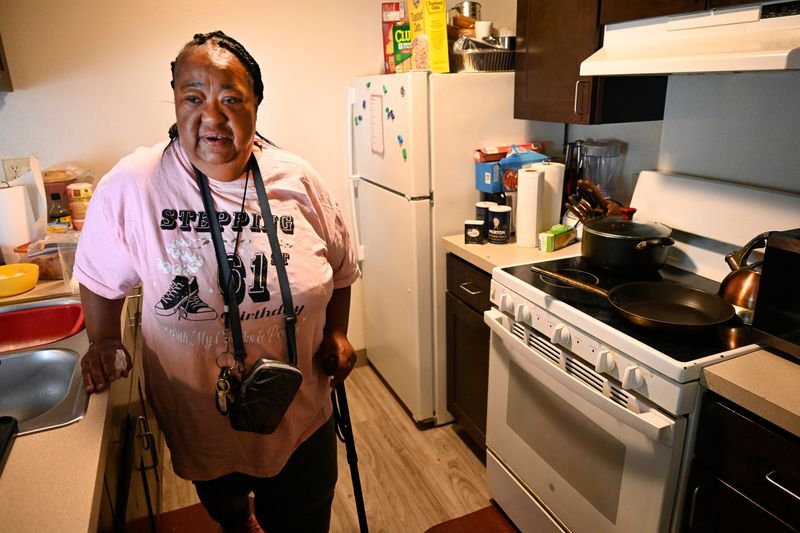
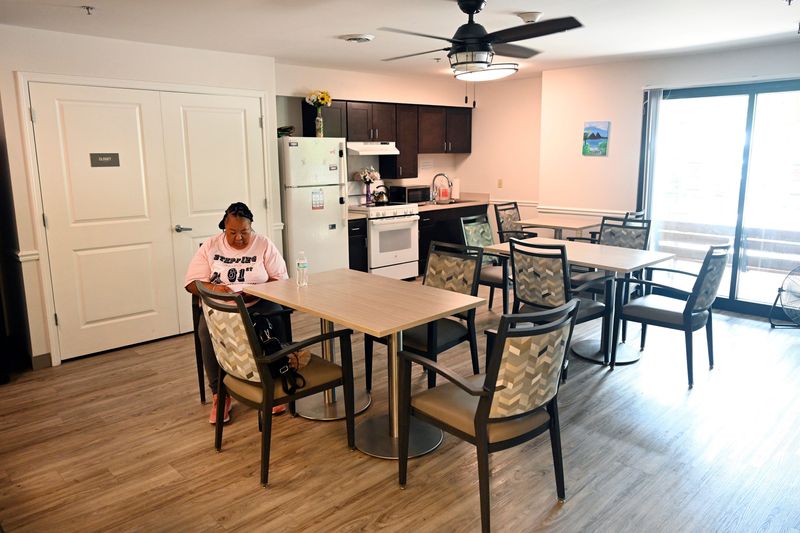
Detroit ― Harriett Whiting said she was “very excited” when she found out her application to rent an apartment at The Village of University Meadows in Detroit was accepted in 2022.
She had been homeless for over two months after an electrical fire had ravaged her previous apartment’s bathroom. She first stayed at a hotel and then boarded at a friend’s place.

She was thrilled when she found out she and her boyfriend could move into a two-bedroom apartment at University Meadows, an affordable senior living community.
“When I came there, it just looked like it was the place for me … like it was home when I walked in the door,” she said of her experience touring the community.
Whiting, 62, said she loves living in the apartment complex in Detroit’s Woodbridge neighborhood. She said the manager is responsible, the maintenance team keeps up the property, and the community is “like family.” Her rent is also suitable for her and her boyfriend’s income level.
Across Metro Detroit, communities are working to expand housing options for older adults like Whiting. The region’s population 65 years and older is forecasted to grow by nearly 148,000 from 2020 to 2030, or 22%, while the region’s population as a whole is only projected to increase by 1% over that period, according to the Southeast Michigan Council of Governments.
That creates a “tremendous need” for affordable senior housing, said Michael Karson, the president and CEO of AgeWays, which is the area agency on aging for Livingston, Macomb, Monroe, Oakland, St. Clair and Washtenaw counties.
“People are not able to find housing that they can afford, obviously,” he said, “and there’s not a lot of housing being built to take care of the number of people or the population, to meet the need.”
Roger Myers, president and CEO of Presbyterian Villages of Michigan, said the current senior housing crisis will only magnify in five to 10 years. Baby boomers are in their early 60s to upper 70s. In several years, some of the population will be looking to move from single-family homes to multi-family housing.
“The majority of that population is going to end up on very fixed incomes,” Myers said of the baby boomer population, “and if they are at a point where they need housing, there just is not enough.”
Local governments are trying to meet the need by renovating low-income senior apartments or encouraging the building of new senior housing. Some have updated their master plans or zoning codes to promote senior housing, including by allowing accessory dwelling units, which are small, independent living units on the same lot as a detached single-family home that can help seniors age near their family. Some nonprofits and cities are also funding repairs or accessibility upgrades to seniors’ homes, helping them to age in place.
For-profit developers, meanwhile, have been building senior condos and apartments, though their prices often are above market rate. Michele Chirco, general counsel for home builder MJC Companies, said new construction rentals tend to be more expensive than existing ones.
The challenge of ‘aging in place’
Myers said that if you ask “pretty much any group of older people” where they want to live, most will say they want to live “where they are right now.” They would like to live in their own home, condo or apartment.
“And as nice as the nicest senior living community would be ― retirement community ― that wouldn’t be, for most people, their first choice,” he said.
But there’s an increasing number of people who realize that keeping their own home is, for many, not the best option, he said.
Myers said some local communities and nonprofits are taking steps to help people stay in their homes longer. PACE Southeast Michigan, which is owned by Henry Ford Health and Presbyterian Villages of Michigan, provides lower-income people aged 55 and older with medical care, social work services, physical therapy, speech therapy and other services.
“The aim of that is to enable frail, older people to stay in the community as long as possible and to really avoid needing to move to a nursing home or another ‘institutional’ setting,” he said of PACE, which serves about 2,500 individuals in Wayne, Oakland and Macomb counties.
Myers said he doesn’t think there are enough senior living communities in Metro Detroit, particularly on the more affordable side.
He said baby boomers generally weren’t “good savers,” and most don’t have pensions. Employers also used to provide health care for their retirees, but generally no longer do. He said if you have one or two bad health episodes, “your money goes quick.”
Presbyterian Villages of Michigan runs senior living communities across the state, most of which are independent living communities, with a few assisted living or memory care facilities. The vast majority of the independent living communities offer subsidized apartments; in those units, a tenant’s income level dictates how much rent they pay.
Myers said the majority, but not all, of Presbyterian Villages of Michigan’s affordable communities have very long waiting lists. He said statewide, affordable communities have an occupancy rate of 95-99%, while the communities that are at or above market rate have occupancies of about 85-95%.
Karson said that seniors need “true affordable housing,” and different providers need to be able to come into their homes to support their independence.
“So it’s not just having the apartment, it’s really having the services within the building to make sure that there’s meal plans or meals can be brought in, whether it’s home-delivered meals, the Meals on Wheels program, or there’s a kitchen that’s supplying the services within,” he said.
Karson said aides need to be able to come into seniors’ homes to help them with activities of daily living, such as meal prep and housekeeping. Home visits from physical therapists, nurses and physicians also may be needed.
“If you put someone into affordable housing and they’re aging in place, at some point their needs are going to increase, and then the question becomes, ‘Are they appropriate?’ And people should be able to get the services they need, so that’s not a question,” he said.
Seniors living on their own
Whiting, the Detroit resident who moved into the Village of University Meadows in 2022, has settled into her home. A LOVE sign hung on her door, and her living room is furnished with a gray, plush couch and a play yard for her grandson when he visits. A photo of her friend and neighbor, Ivory, who passed away in 2024 at the age of 83, sits on a table.
Whiting, a native of Alabama, said she loves meeting different seniors in the community, which is owned by Presbyterian Villages of Michigan, and talking with them. She learns from their wisdom.
“I never knew my grandparents,” she said, as they died when she was young.
Whiting loves her new kitchen and occasionally cooks meals for the University Meadows community, including a Thanksgiving meal in 2023 that included dressing, greens, sweet potato pie, pound cake, turkey, ham and potato salad. She is also part of the community’s fundraising committee, and she sometimes fries fish that they can sell.
Affordability is a priority for Whiting when it comes to her housing. Being able to afford her rent feels good: “You got some type of security over you.”
Whiting and her boyfriend pay a total of $516 for rent. They qualify for an apartment for households at 30% of the area’s median income. Their apartment is a project-based voucher unit administered by the Detroit Housing Commission through U.S. Department of Housing and Urban Development funding.
Whiting receives supplemental security income (SSI), monthly payments to people with disabilities and older adults who have little or no income or resources. Her boyfriend receives SSI and Social Security.
Louise Rush, 87, has lived in The Village of Our Saviour’s Manor, a Presbyterian Villages of Michigan community in Westland, for nearly 15 years. She moved back to Michigan from Georgia in 2012 because her granddaughter had a young son, and she wanted to help raise the child.
She applied to live in The Village of Our Saviour’s Manor because it is close to her daughter in Romulus. She was interested in staying in a senior living community because she wanted to live independently and be around her peers ― other seniors.
“And I love it … because this way, I see someone every day ― every day ― and I like that,” Rush said.
She said she and other residents of The Village of Our Saviour’s Manor do activities to help other people, including distributing buckets of toiletries and snacks to homeless individuals.
Cities expand senior housing opportunities
Some cities and townships in Metro Detroit have plans to expand or change senior housing as the population ages.
Dylan Clark, senior management analyst for the Troy city manager’s office, said Troy’s master plan lays out the need for an “aging in place” strategy in the city.
“It is important that structures have ‘universal design’ and ‘visitability’ to ensure they can be used by the widest range of possible users and are easily convertible to full-accessibility,” he said in an email. “The plan also embraces the traditional age-restricted multiple-unit senior housing developments as well as assisted living and nursing home care centers.”
He said the need for “missing middle” housing ― housing such as duplexes, triplexes, townhomes and bungalows ― is apparent.
“Smaller, more affordable housing is not only great for families without children or young adults, but for seniors who want to downsize but remain in Troy,” he said.
An increasing number of communities, including Ferndale and Eastpointe, have changed their zoning codes to allow accessory dwelling units (ADUs). Some examples of ADUs include a small building that shares a lot with a single-family home, a garage that has been converted into a home, and an apartment above a garage, according to buildinganadu.com.
“Among other things, ADUs can be used to support a multi-generational approach for those looking to add space for aging family members, while still offering autonomy,” Ferndale City Manager Colleen O’Toole told The News in an email.
John Roach, a spokesperson for the mayor of Detroit, said former Mayor Mike Duggan made “a huge push” for affordable housing in the city. Since 2018, the city has preserved 13,250 units of affordable housing, 58% of which serve the elderly population, said Alison DeRees, a spokesperson for the city’s Housing and Revitalization Department. Over that time period, 2,413 affordable units have been built in the city, 12% of which serve the elderly population.
Former Detroit Deputy Mayor Melia Howard said the Detroit Housing Commission is updating and remodeling some of its low-income properties. The commission recently approved, for example, an estimated $160 million project to renovate Sheridan Place I and II, apartment buildings for people 50 years and older on East Jefferson Avenue, according to the commission.
In January, new Detroit Mayor Mary Sheffield announced that the city would bring 65 senior citizen and disabled living apartment complexes up to code by the end of August as part of a new plan to eliminate safety issues. Many senior apartment complexes in the city have dealt with elevator outages, insufficient inspections and poor maintenance accountability, the mayor said, while building management often fails to report the issues.
For-profit sector recognizes need
Meanwhile, for-profit developers are recognizing the need for more senior housing.
Chirco, the general counsel for Macomb Township-based home builder MJC Companies, said people may have to pay more for their housing when they downsize, as their mortgage rate may be higher or their property taxes may increase, but many seniors move “based on need.” Their bedroom might be upstairs, or they might not be able to manage the yard anymore, for example.
He said MJC Companies’ ranch-style homes across southeast Michigan are popular among seniors, as they don’t have a second level. He said for-sale duplexes are also popular for seniors who are downsizing.
“Because they’re moving into communities that kind of more resemble a single-family community,” he said. “They still have a lot of their same privacy. There’s often maybe just one shared wall with a neighbor, maybe sometimes one or two, but it’s not neighbors above or below you.”
He said both independent living housing ― which is what his company builds ― and assisted living housing have grown in Michigan.
He said MJC Companies opened Walden Park, its first age-restricted community, in Macomb Township in 2024. He said some downsizing seniors have “quite a bit of equity built up.” Some put their equity into another property, while others choose to rent in places like Walden Park. Renting frees up some of their equity for their life in retirement, as they don’t need to make a down payment.
But Chirco said there are affordability concerns for senior rentals.
“These are brand new units,” he said, “so I would say they’re above market rents, just by virtue of new construction … costing more now and needing that to be reflected in rental rates.”
Walden Park charges $2,600 a month in rent on average for its two-bedroom apartments, which are about 1,400 square feet and have outdoor, covered patios.
Chirco said the need to build more senior housing faces “the same constraints as the need for housing generally in the market.” Builders have to deal with a scarcity of land, affordability concerns, “regulatory hoops” and financing rates.
New Haven Village President Brian Meissen said Ohio-based Redwood Living is developing a 120-unit rental community in the Macomb County village. The developer is targeting young professionals as well as empty nesters who “don’t want all the maintenance and the upkeep on the outside and just want a simpler lifestyle,” he said.
New Haven, a village of over 6,000 people, is projected to see its population 65 years and older rise by 68.4% between 2020 and 2030, which is the fastest increase of all of Metro Detroit’s municipalities, according to Southeast Michigan Council of Governments data.
Brighton-based Build Senior Living plans to build Hampton Manor, an assisted living facility with memory care, in New Haven, but the project will need to be approved by the village again after a change to the building’s footprint.
Shahid Imran, managing director and CEO of Build Senior Living, said earlier this year that the company hadn’t determined the pricing for the facility yet, but their existing facilities in Metro Detroit have rents starting at around $3,600 a month for studios and at $4,100 to $4,200 for one-bedrooms.
Imran said those rents are market rate for assisted living facilities. He noted that the communities have nursing care and amenities such as a movie theater, a beauty salon and a library.
Meissen said the community needs more of these facilities.
“I know that the baby boomers are getting to that retirement age and needing the next stage of housing for them,” he said. “So these options definitely are good to have in the community.”
asnabes@detroitnews.com
This article originally appeared on The Detroit News: Amid ‘tremendous need’ for affordable senior housing, Detroit area nonprofits and cities step up
Reporting by Anne Snabes, The Detroit News / The Detroit News
USA TODAY Network via Reuters Connect