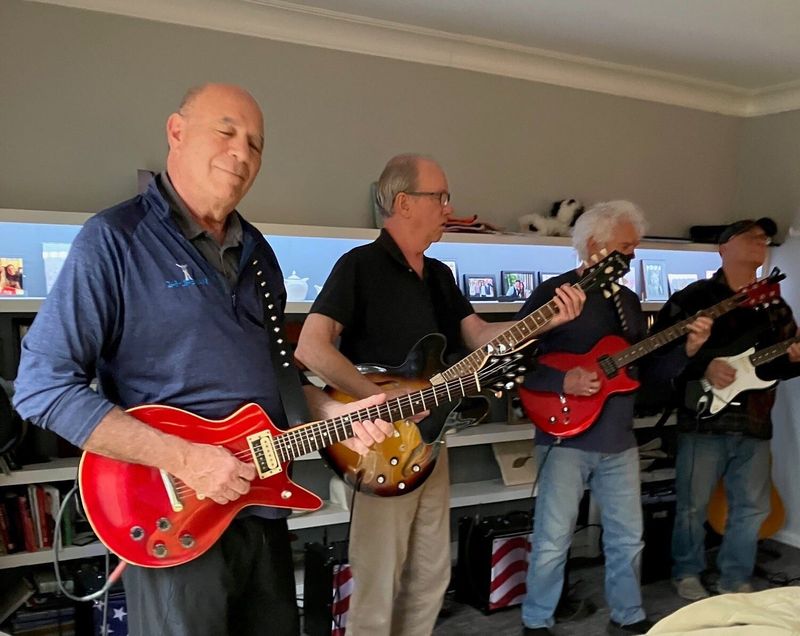
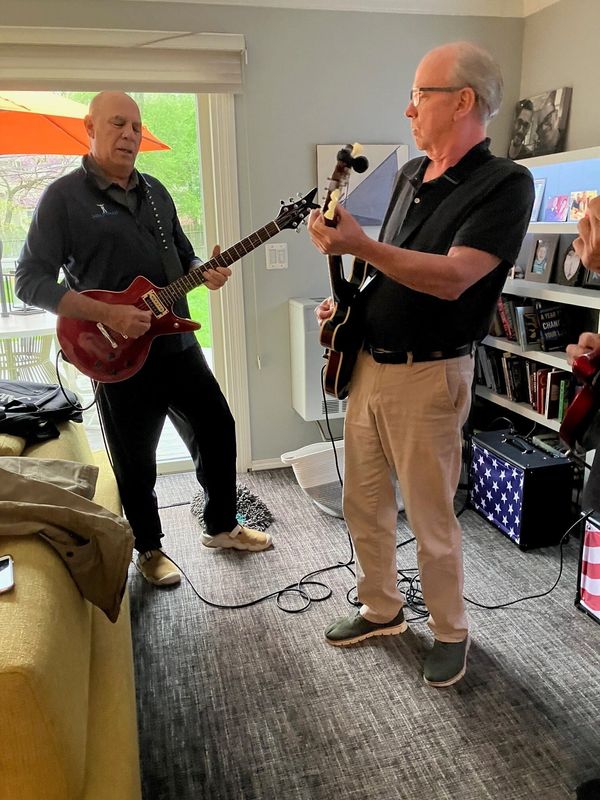
The four guys holding electric guitars were, in combination, older than the United States. They had assembled at Gary Rosenberg’s house in Huntington Woods to play one song.
The song was “The Star-Spangled Banner.” Four guitars, no vocals, 90 seconds. Unless they decide to rehearse again before June 6, the next time they play it will be at a Detroit Tigers game.

“One of the things Gary said when we started this was that his goal was to play Comerica Park,” said the group’s other Gary, Gary Sussman, 72. “We all said, ‘Yeah, sure.’ “
Yet that’s where they’ll be, eight short years later: Detroit vs. the Seattle Mariners, 1 p.m. And here they were on a Tuesday night in early May, standing between a sectional and a bookcase, with their guitars hooked to low amplifiers with stars-and-stripes-fronted cabinets.
“It’s downhill from here,” Rosenberg said. “Back to playing sixth grade basketball games.”
Guitars & Stripes, as the foursome is known, has appropriately hit its target just in time for our nation’s 250th birthday, or semiquincentennial for short. Not to overstate things, but G&S is the Medicare-eligible embodiment of all that’s right about America, or at least a good chunk of it:
Hope, hard work, teamwork, ingenuity and garage bands.
Long careers, short rehearsals
In these fractious times, the Guitars & Stripers come from across the political spectrum — and they don’t linger. Rehearsals last half an hour.
“We’re all grown-ups,” Rosenberg said. “It’s one song.” And while this is everyone’s major league baseball debut, it’s nobody’s first rodeo.
Sussman, of Berkley, has been in some manner of band since 1966, when he and a few other kids in his neighborhood found musical instruments beneath their Christmas trees.
Rosenberg spent most of the 1970s with the Stratton Nelson Band, a mainstay at places like the Peanut Barrel in East Lansing and the Wagon Wheel in Troy. They were successful enough to have paid vacations and an actual bank account.
“Then John Lennon got murdered,” Rosenberg said, “and I thought, ‘why do I want to be famous?’ ” He started selling insurance instead, and he’s still doing it.
White-haired Ted Strunck, 77, of Royal Oak, Rosenberg’s brother-in-law, taught middle school for decades and wrote an original musical for the kids to perform every other year. Duane Harlick, 63, also of Royal Oak — and OK, he’s two years shy of Medicare — retired from an IT job and plays in a rock band, a yacht rock band and a Journey cover band, and flies to Florida every now and again to sit in with a Jimmy Buffett-adjacent band called Jim Asbell and the Tropiholics.
“They’re all more accomplished than I am,” Rosenberg said, but he still gets to play lead.
Ernie Harwell’s contribution
Rosenberg traces the idea for an anthem-specific band to the fifth game of the 1968 World Series. That’s the one where Ernie Harwell invited Jose Feliciano to sing “The Star-Spangled Banner” at Tiger Stadium, and his slow, soulful, splendid, Latin-jazz interpretation made a fair-sized portion of the populace furious.
In the left field stands, Rosenberg was enthralled. “It was meaningful enough to him,” he said, “that he developed his own personal way to do it.”
Fast-forward half a century, and Rosenberg started pondering a version in four-part guitar harmony. Nothing extemporaneous, or Jimi Hendrix-infused; just single notes, not chords, as though a saxophone quartet had taken on the project.
He approached Sussman with the concept, and Sussman wrote an arrangement. Two friends signed on, Rosenberg cold-called for a booking at a high school basketball game, and the group was off and strumming.
There’s been some turnover across the years — one guitarist moved overseas, one accepted a professorship in Indiana, one died — but the invitations have trickled in.
A bike race at the Detroit velodrome. More basketball at Oakland University, Detroit Mercy and Wayne State. The Berkley Cub Scouts’ Pinewood Derby wooden car race, going on four years, once in a tent with a sagging roof in a rainstorm.
Then: Ford Field, for a Michigan Panthers game in the United Football League — not much of a crowd, size-wise, but a heck of a building. In March, a Pistons game at Little Caesars Arena. Next, a video landed on the right desk with the Tigers.
They’ve kept hustling, kept practicing, kept tweaking. Rosenberg floated the idea at the rehearsal of an extra-long pause after the “land of the free” passage, but Sussman talked him out of it. They all agreed to get quieter in a middle section to make the rest of it explode.
“What matters is, we want to deliver a thrill for our audience,” Rosenberg said. “We want people to say, ‘That was bleepin’ cool.’ “
Then comes the second-best part, after the sheer joy of playing.
It’s the national anthem. When it stops, everyone cheers for what’s coming next, and nobody’s in the spotlight yet except Guitars & Stripes. And is anyone sitting down?
Heck, no. For four guys who’ve played for raucous rooms but also drunks and empty tables, it’s a standing ovation, guaranteed, courtesy of inspiration and perspiration and Francis Scott Key.
Neal Rubin always sings along to the anthem, but unfortunately, not well. Reach him at NARubin@freepress.com.
This article originally appeared on Detroit Free Press: From school gyms to Comerica Park, Guitars & Stripes scores a big gig
Reporting by Neal Rubin, Detroit Free Press / Detroit Free Press
USA TODAY Network via Reuters Connect