

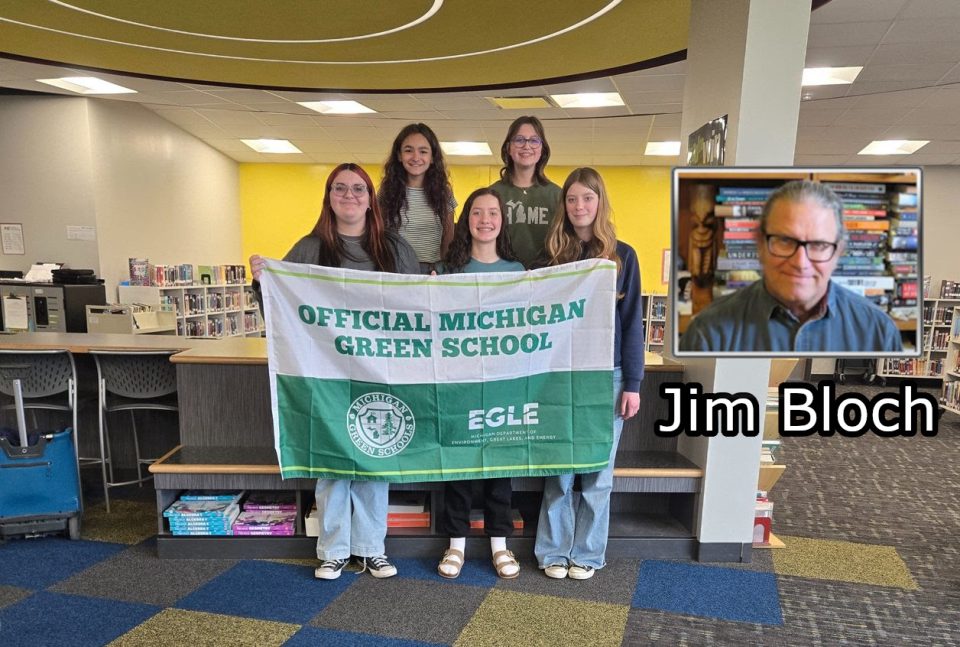
By Jim Bloch

Fort Gratiot Middle School, which serves students in grades six through eight, has become the first school in St. Clair County to be recognized as a Michigan Green School, a program relaunched by Michigan Department of Environment, Great Lakes and Energy in the 2021-2022 school year.
Under the old program, administered by a nonprofit organization, at least eight St. Clair County schools had qualified as green schools.

“Michigan Green Schools was created to celebrate schools that commit to environmental stewardship through hands-on learning and stewardship activities,” according to EGLE on its website.
The program is open to public and private schools.
To become certified as a green school, students must complete 10 to 14 activities chosen from four general areas: Reduce/reuse/recycle; energy; environmental protection; and miscellaneous.
Schools may also be certified at green-plus levels. Students who complete 15 to 19 activities earn an Emerald classification for their school; 20 or more activities qualify as Evergreen schools.
“Common activities that schools complete include recycling, composting, improving energy efficiency, school food gardening, native plantings, Great Lakes watershed education, and learning from environmental-based guest speakers and field trips,” said EGLE.
The FGMS Green Team’s plans for the 2025-2026 school included implementing a recycling program for paper and returnables; adopting an endangered animal; building bird houses and a bird feeding station; establishing a Monarch butterfly habitat; and creating art projects out of old magazines, scrap paper and reused items. Founding the Green Team itself to implement the school’s environmental goals was the first order of business.
“The Michigan Green Schools program continues its steady upward momentum with 419 certified schools in 2026, the highest participation level since EGLE began administering
the program in the 2021–2022 school year,” said Samantha Lichtenwald, Michigan Green Schools Coordinator, in her story about the program on the EGLE website.
There were 358 certified schools in 2025; 343 in 2024; 302 in 2023; and 197 in 2022.
Of the 419 schools, 128 were certified as green, 93 as emerald and 198 as evergreen.
“Two school districts achieved full participation in 2026, with every school building earning Michigan Green School certification — Haslett Public Schools and Traverse City Area Public Schools,” said Lichtenwald. “Several other districts are close to reaching this milestone, and EGLE looks forward to celebrating even more fully certified districts in future program years.”
The FGMS Green Team’s mission “is to make our school a cleaner, greener place. We work together to protect the environment by recycling, saving energy, reducing waste, and encouraging others to make eco-friendly choices. Through teamwork and action, we aim to help our school and community care more about the planet—now and for the future.”
History
Michigan Green Schools began in Hartland County in 2005 when the program was granted nonprofit status with the goal of protecting the air, land, water and animals of Michigan, “along with world outreach through good ecological practices and the teaching of educational stewardship of students pre-kindergarten through senior high school.”
The Green School program received the endorsement of the state in 2006 when Gov. Jennifer Granholm signed Public Act 146, officially granting green status to any school engaging in 10 of 20 sanctioned environmental activities. Public Act 301 of 2010 updated the law, establishing multiple levels of green certification and allowing schools more creativity in the environmental activities they choose.
Eighteen schools participated in program in 2005. By 2012, 508 schools had been certified as green.
In 2012, St. Clair County participants included Gearing Elementary in St. Clair (green); St. Mary McCormick Catholic School in Port Huron (emerald); Pine River Elementary in China Township (emerald); Gardens Elementary in Marysville (evergreen); Woodlands Developmental School in Marysville (green); Eddy Elementary in St. Clair (green); St. Edwards on the Lake in Lakeport (green); and Immaculate Conception in Ira Township (green).
EGLE took over the program from the nonprofit organization to offer a more centralized, consistent approach to the environmental initiatives at the schools. The state could provide more resources and tracking tools for schools.
“From recycling and wildlife habitat to Great Lakes education, FGMS students are turning everyday learning into real-world impact,” said Friends of the St. Clair River on its website May 8. “We’re happy to be supporting them on their journey.”
Jim Bloch is a freelance writer based in St. Clair, Michigan. Contact him at bloch.jim@gmail.com.
