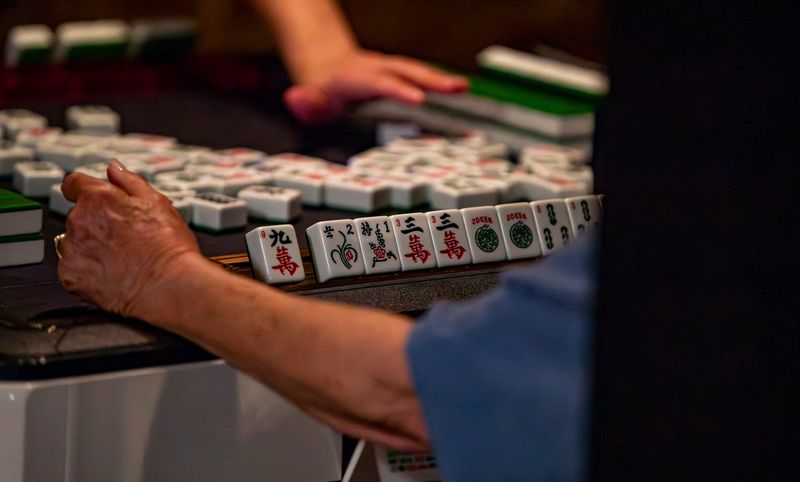
Have you heard of Mahjong?
The new Hallmark romantic comedy All’s Fair in Love & Mahjong premieres Saturday, May 9, at 8 p.m. on the Hallmark Channel, putting the classic tile game front and center.

Blending cozy storytelling, friendly competition, and a touch of romance, the film taps into the growing popularity of Mahjong among American audiences.
For those new to the game, or simply looking to learn more, here’s a guide to Mahjong’s origins, how it’s played, its many variations, and how it evolved into a cherished social tradition across the United States.
What is Mahjong?
Mahjong is a fast-moving, tile-based game that began in 19th-century China. It blends strategy, memory, and a bit of luck, and is usually played with four people around a table.
Think of it like a mix of cards and puzzles: players take turns drawing and discarding from a set of 144 tiles. The tiles feature suits like dots, bamboo, and characters, along with winds, dragons, and sometimes flowers. As you play, you’re trying to build a complete hand by forming specific sets (like runs or matching tiles) and one pair.
The goal is simple: be the first to complete a winning hand of 14 tiles and call “Mahjong!” But getting there requires sharp observation, quick decisions, and a little intuition about what everyone else is holding.
What’s ‘All’s Fair in Love & Mahjong’ Hallmark movie about?
All’s Fair in Love & Mahjong is a light romance about Ronni, a school nurse adjusting to life as an empty-nester. As she faces big changes, she discovers a love for teaching Mahjong, builds a supportive community, and sparks a romance with Ben, a contractor helping fix up her home.
Where can you watch ‘All’s Fair in Love & Mahjong’?
You can watch it on Hallmark Channel and its streaming platforms. It premieres Saturday, May 9, at 8 p.m.
Who is in the ‘All’s Fair in Love & Mahjong’ cast?
The film stars Fiona Gubelmann, Paul Campbell, Yan-Kay Crystal Lowe, Tamera Mowry-Housley and Melissa Peterman.
How do you play? Watch this video on how to play Mahjong in 2.5 minutes
Where is Mahjong from? Are there different versions of the game?
Mahjong originated in 19th-century China. Over time, it spread around the world and developed into several distinct versions, including Chinese Classical Mahjong, Japanese Mahjong (Riichi), and American Mah Jongg.
A look back in history. Why and when was Mahjong banned in China?
Mahjong, which originated in China, faced periods of restriction in the mid-20th century because of its strong association with gambling and excess.
After the Chinese Communist Revolution, the new government sought to reshape society and discourage activities seen as wasteful or tied to the past. Mahjong, often linked to betting and leisure culture, came under scrutiny.
The crackdown intensified during the Cultural Revolution, when many traditional practices were labeled as “old culture” or capitalist habits. During this time, Mahjong was restricted or banned in an effort to promote stricter social values and limit gambling.
Although these bans weren’t permanent, they reflect how a simple game became caught up in broader political and cultural shifts.
How is American Mah Jongg different from Chinese MahJong?
American Mah Jongg is quite different from traditional Chinese Mahjong and the biggest difference is that it’s basically a “new puzzle every year.”
In American Mah Jongg, players don’t freely build any winning hand they want. Instead, they must match one of the specific winning patterns listed on an official card published each year by the National Mah Jongg League. That means strategy starts before you even play, you’re constantly scanning the card, deciding which hand to aim for, and adjusting as tiles come in.
Traditional Chinese Mahjong, such as Chinese Classical Mahjong, works differently. There’s no yearly card. Instead, you build a winning hand more flexibly (usually four sets and a pair), while adapting your strategy dynamically throughout the game.
A few other key differences make the American version stand out:
In short: Chinese Mahjong is about improvising your way to victory, while American Mah Jongg is about decoding a constantly changing menu of winning hands and committing to the right one at the right time.
Is Mahjong Jewish?
No, Mahjong is not originally a Jewish game. It was created in 19th-century China. However, it became closely associated with Jewish communities in the United States during the early to mid-20th century, especially among women.
Here’s a timeline of how the Jewish adaptation happened:
Why do so many Jewish women play Mah Jongg?
The game gained popularity in the U.S. during a 1920s craze and gradually became a lasting social tradition. By the 1950s, many Jewish American women who lived particularly in suburban areas had embraced Mahjong as a regular activity. It served as more than just entertainment: it was a space for socializing, building friendships, and staying mentally engaged. Over time, it helped connect generations and became a meaningful part of cultural and community life.
Doris Alvarez is a Breaking and Trending Reporter for The Florida Times-Union. You can get all of Jacksonville’s best content directly in your inbox each weekday by signing up for the free Daily Briefing and News Alerts newsletters at jacksonville.com/newsletters.
This article originally appeared on Florida Times-Union: ‘All’s Fair in Love & Mahjong’ Hallmark movie debuts. What is Mahjong?
Reporting by Doris Alvarez Cea, Jacksonville Florida Times-Union / Florida Times-Union
USA TODAY Network via Reuters Connect