Lansing — Michigan’s internet casino gaming revenue has blown past previous projections for the five-year-old market, launching the state past $3 billion in gross receipts in 2025 and landing it in the top three states nationally in 2024, according to state and national industry records.
The state’s internet sports betting industry has been growing almost every year, albeit on a smaller scale, topping $671.3 million in gross receipts in 2025, according to state records.

Michigan’s building surge in internet gambling — online casino games were legalized in the state in 2019 and officially launched statewide in 2021 — can be attributed largely to the fact that it is one of only eight states in the nation, as of 2024, to allow some form of iGaming and the only one in the Midwest, experts said.
State fiscal analysts didn’t expect this extent of online casino gaming growth when forecasting new tax revenues. Last year, tax revenue from online casinos alone (not including sports bets) was nearly 16 times what was modeled seven years ago.
A House Fiscal Agency analysis in 2019 — while listing a variety of dynamics that made projections extremely difficult — used a mature, five-year internet gaming market model of about $300 million in adjusted gross receipts, similar to New Jersey’s market at the time, to estimate about $31.3 million in tax revenue for the state.
In 2025, five years into legalization, the state’s iGaming adjusted gross receipts stood at $2.9 billion — nearly 10 times what fiscal experts projected in 2019 — and generated more than $500 million in state revenue, according to reports from the Michigan Gaming Control Board.
That surge in popularity has occurred while brick-and-mortar casino aggregate revenue at the three Detroit casinos has largely remained steady from 2021 through 2025, according to state data.
“I always knew that the market growth would be significantly larger than the legislative fiscal forecasts put forth by the state,” said former state Rep. Brandt Iden, a Republican who led the effort to legalize online sports betting and iGaming in 2019. “They greatly underestimated the market and, thanks to my persistence, the state and its education system have realized hundreds of millions of dollars in new revenues.”
Iden, who is now vice president of government affairs for Fanatics Betting and Gaming, and others in the gambling industry have argued that the initial, rapid growth in online gaming is proof that it was occurring illegally in Michigan prior to the then Republican-led Legislature and Democratic Gov. Gretchen Whitmer acting to legalize it in 2019.
Over the past five years, Michigan’s skill in managing the regulated market has helped to increase consumer confidence and industry growth, said Joe Maloney, president of the Sports Betting Alliance.
“To the extent that we’re seeing consistent growth in the state of Michigan, it’s really a reflection of overall increasing consumer trust and, generally, acceptance of gambling as a form of entertainment that’s acceptable,” Maloney told The Detroit News.
Online gambling still has detractors in Lansing
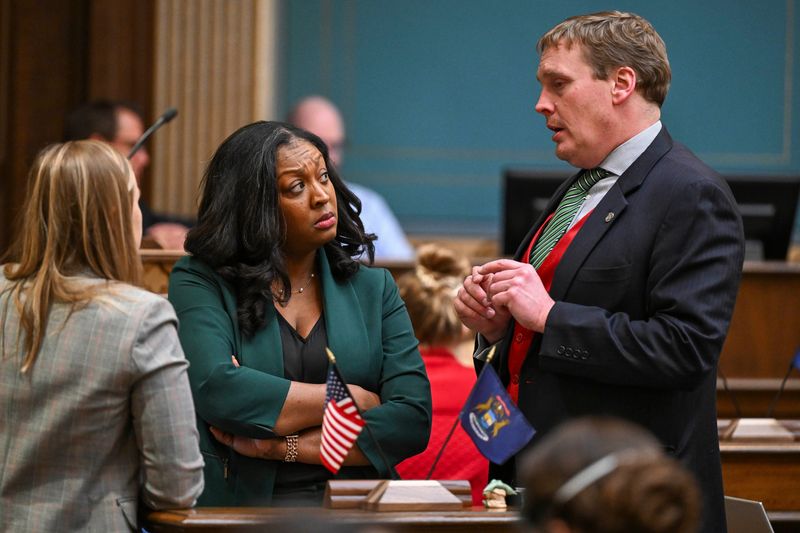
But several lawmakers who opposed legalization in 2019 and who still walk the Capitol halls in Lansing expressed reservations about the rapid expansion of the gambling industry.
The “revenue” being touted is really just “customer losses and fees,” said state Sen. Thomas Albert, a Lowell Republican who voted against the 2019 legalization as a state representative.
“Normally, growth in business is seen as a good thing, but in this case, money is being taken out of people’s pockets when they might not be able to afford it — money that could otherwise support families and encourage economic growth in our communities,” Albert said.
State Sen. Ed McBroom, a Vulcan Republican who voted no on the legislation in 2019, said he was unsurprised by the growth but concerned all the same.
“I don’t support legislation that increases vices,” McBroom said.
Problem gambling experts expressed some concern over the rapid growth, but acknowledged it is difficult to know the full extent of who is participating and who might be exhibiting problematic behaviors because so little data is collected in Michigan.
The state is doing significant work to address problem gambling, but the need for more data to understand what is being missed is desperate, said Marlene Warner, interim executive director for the Michigan Association on Problem Gambling.
“It is hard to make a decision … around where to deliver resources and where to direct programming when you don’t have a map of what is really out there and who is at risk and who is currently suffering with the problem,” Warner said.
The Michigan Department of Health and Human Services is in the midst of commissioning a gambling and gaming prevalence study through Wayne State University. The last similar study was conducted in 2013.
Legalization brings flood of online gaming, sports betting
In 2019, Michigan lawmakers voted across party lines to legalize and regulate online sports betting and internet gaming. The effort was spearheaded by Iden, who left the Legislature in 2021 to work in the industry and is a registered lobbyist in Michigan for Fanatics, the mega sports apparel retailer that has branched out into betting.
Under the 2019 statute, the state’s existing casino operators — Detroit’s three casinos and 12 tribal operators — could partner with online sports betting platforms and internet casino gaming providers. Those activities were taxed at various levels to produce revenue for the state and local governments where they were located.
Implementation of the laws was initially slowed by the COVID-19 pandemic, which kept casinos closed for months, but the online system was officially launched on Jan. 22, 2021.
The options almost immediately generated money, according to the data compiled by the Michigan Gaming Control Board, whose most recent data on 2025 gambling revenue was published in mid-April.
Gross receipts for internet gaming started at $1.1 billion in 2021 and rose each year to $1.58 billion in 2022, $1.9 billion in 2023, $2.4 billion in 2024 and $3.09 billion in 2025, according to the board reports. The adjusted gross receipts for internet gaming, which reflect receipts minus free play, came in slightly lower, at $1 billion in 2021, $1.4 billion in 2022, $1.7 billion in 2023, $2.2 billion in 2024 and $2.9 billion in 2025.
Gross receipts for internet sports betting began at $292.2 million in 2021 and then increased to $399.58 million in 2022, $420.4 million in 2023, $460.5 million in 2024 and $671.3 million in 2025, according to the annual regulatory reports.
The receipts for online gaming and internet sports betting rose even as the aggregate revenue from gambling stayed steady at Detroit’s brick and mortar casinos — hovering at around $1.2 billion from 2021 through 2025, MGCB reports show. State tax revenue from Michigan’s tribal casinos also remained relatively steady during that period, ranging from $30.3 million to $31.5 million from 2021 to 2025.
The rapid uptake of internet sports betting and online gaming, the Sports Betting Alliance’s Maloney argued, is proof that the activity already was happening through illegal channels. The state, in that sense, helped to bring the activity into a regulated, legal market, he contended.
Michigan is a success story in “choosing to regulate it, put some guardrails around it, tax it and then hold licensed operators accountable,” Maloney said.
Michigan gambling revenue ranks high nationally
For the past several years, Michigan has ranked among the top states for online betting activity.
Its $4.19 billion in gambling revenue in 2024 ranked the fifth highest in the nation, following Nevada ($15.6 billion), Pennsylvania ($6.87 billion), New Jersey ($6.29 billion) and New York ($5.17 billion), according to the American Gaming Association’s State of the States 2025 report.
Detroit ranked eighth in a list of the top 20 U.S. commercial casino markets in 2024 in the same report.
Michigan’s iGaming market in 2024 ranked in the top three, alongside Pennsylvania and New Jersey, according to the American Gaming Association rankings.
The record gambling has resulted in a healthy payout to the state’s coffers, giving lawmakers a new source of tax revenue to spend.
State tax revenue from iGaming contributed $201.7 million to the state treasury in 2021, $289.2 million in 2022, $354 million in 2023, $451.4 million in 2024 and $597.5 million in 2025, according to Michigan Gaming Control Board reports.
Online sports betting, by contrast, brought in $7.3 million in state payments in 2021, $13.7 million in 2022, $15.8 million in 2023, $14.7 million in 2024 and $27.1 million in 2025, according to board reports.
The Michigan Gaming Control Board, which would only respond to emailed questions for this article, is being led by former state Sen. Jim Ananich, a Flint Democrat who voted in favor of the 2019 online betting laws and is now the board chairman.
When asked for Ananich’s thoughts on implementation, a board spokesperson said the former state senator supported the 2019 legislation to modernize the state’s gaming framework, create a legal regulated market, generate new state and local revenue, and establish consumer protections.
“As with any major policy, implementation continues to be evaluated through market performance, regulatory oversight, and responsible gaming data,” said Lisa Keith, a spokeswoman for the Michigan Gaming Control Board.
The problem with Michigan’s problem gamblers data
In the years preceding the legalization of online sports betting and iGaming, the state of Michigan maintained a “disassociated persons” list to which individuals could voluntarily add their names, thereby banning themselves from the Detroit casinos.
The lifetime bans were changed in 2020 to allow individuals the option of having their name removed after five years, a move some problem gambling experts supported because it was a more manageable commitment for problem gamblers to make. The list included 4,252 people at the end of 2025, according to state records.
When lawmakers legalized iGaming and online sports betting in 2019, they created a new database to which problem gamers could add themselves, called the Responsible Gaming Database.
Those lists have grown progressively over the years alongside the markets.
The Responsible Gaming Database stood at 78 participants who self-excluded from iGaming in 2021, 343 total at the end of 2022, 691 at the end of 2023, 1,156 in December 2024 and 1,644 at the end of 2025, according to the Gaming Control Board reports.
The database recorded 74 people who had excluded themselves from online sports betting by the end of 2021, 311 total on the list in December 2022, 644 in late 2023, 1,093 as of December 2024 and 1,550 as of late 2025. Individuals can also self-exclude directly through the online gaming and sports betting platforms, according to the state.
But the self-exclusion numbers don’t fully represent the universe of individuals who have problematic habits, nor do they shed much light on who is participating in gambling across the state, Warner said.
Warner, who is working as the interim executive director of the Michigan Association of Problem Gambling, is based in Massachusetts, where she serves as the CEO of the Massachusetts Council on Gaming and Health. The Bay State, she noted, has much more detailed data on who is gambling, what they’re gambling on, where they’re gambling and which forms of gambling are connected to problems.
In Michigan, the lack of data leaves many questions unanswered, she said: Are there higher rates of gambling problems in rural or urban areas? Among young people or the elderly? Among those with more money or with less?
“We’re just kind of feeling things out in the dark here, and we really want to turn a light on this issue,” Warner said.
There’s funding and good efforts in Michigan to address problem gambling, Warner said, but they’re generally siloed, when there should, ideally, be a more comprehensive approach to the issue. Some of Michigan’s measures include a problem gambling hotline, connections to counseling services, its “Don’t Regret the Bet” education campaign, self-exclusion policies and some research.
Researcher Michelle Malkin agreed that Michigan is making a good effort at attempting to tackle problem gambling issues they’re able to identify. But more data and more money are needed to make a real difference, said Malkin, director and lead research scholar of the Gambling Research and Policy Initiative at East Carolina University.
“Michigan has the opportunity to make a big difference for people there,” Malkin said. “There’s a lot of legalized gambling in the state, and they’re using that money to fill in monetary areas that they are needing to fill in, and not enough of it is going to the resources that are necessary.
“But they’re at least having the conversation,” she added. “Some states are not.”
In March, the Citizens Research Council of Michigan issued a report on policy recommendations that could help to “hedge” problem gambling in the state’s 5-year-old online betting options. The report by research associate Karley Abramson included recommendations for caps or prohibitions on prop bets, a prohibition on the use of credit cards to place bets, limitations on artificial intelligence or algorithms that recommend bets, or limitations on how often money can be added to an account in a given time period.
All of those options, Abramson said, could help problem gamblers by curbing an “endless loop of betting.”
“All these things together make it so that that small percentage of people who are going to struggle with it are going to be even more vulnerable,” Abramson said. “Lots of people have an account. Most people engage in it very responsibly. But, for that group of people, it is becoming particularly problematic.”
Staff writer Ben Warren contributed.
eleblanc@detroitnews.com
This article originally appeared on The Detroit News: Michigan’s internet gaming market blows past expectations
Reporting by Beth LeBlanc, The Detroit News / The Detroit News
USA TODAY Network via Reuters Connect