

By Jim Bloch

“Big win for SC4 and our waterways!” said St. Clair County Community College in an April 7 Facebook post.
The college announced that geography instructor Dr. Cadey Korson had been awarded a grant from the National Geographic Society to develop a stream bank restoration plan along the Belle River in Columbus County Park. Korson and her students will work with the St. Clair County Parks and Recreation Commission and Friends of the St. Clair River to implement the plan.

“Over the course of the 2-year grant anywhere from 175-550 SC4 students might be involved in the project, primarily from Earth Science and Human Geography courses,” Korson said via email.
The banks of the Belle River are occasionally hard to pinpoint.
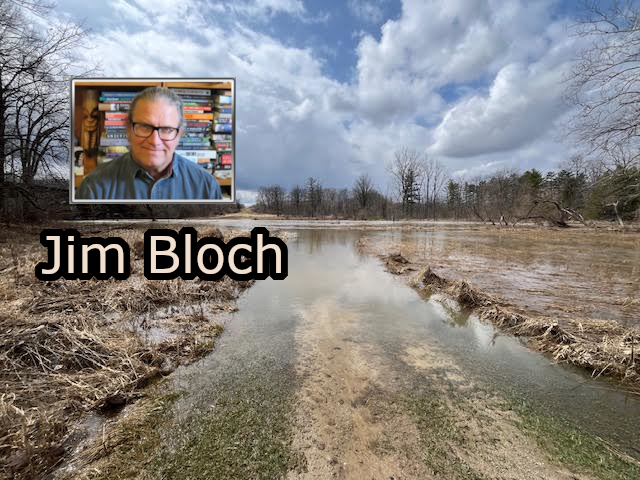
Four days before the college’s announcement, with rainfall of up to 2.5 inches on the night of April 3, there were no traditional stream banks visible on the Belle River as it curved through Columbus County Park. The high water overrode the river’s banks, lifting several wood-backed rubberized tees for disc golf from their frames and depositing them downstream among clusters of tree trunks. The trail along the river between the Grand Trunk Railroad bridge, on the southeast edge of the park, and the base of the sledding hill was underwater. The flood plain northwest of the park lodge turned from plain to flood. Picnic tables and benches barely cleared the high water.
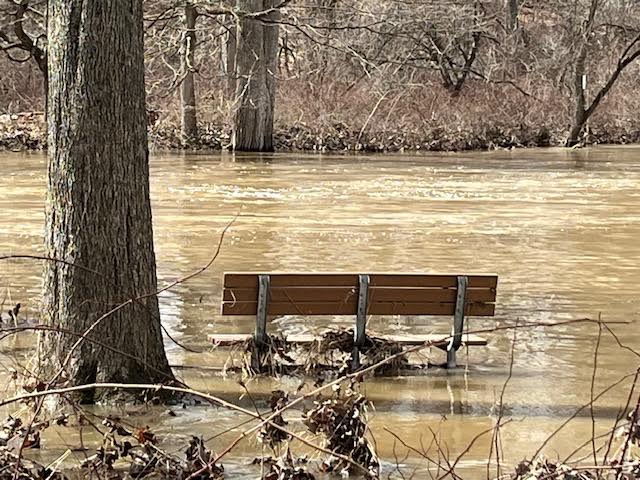
A bench protrudes from the Belle River in Columbus County Park.
Improving the water quality of the rivers and streams is critical to the Great Lakes watershed. The waterways are not in great shape.
“In 2022, 96% of sampled rivers and streams in Michigan were too polluted to safely consume fish,” Korson said.
The Great Lakes watershed is “in peril,” she said, and it’s too important to ignore.
“The Great Lakes provide drinking water for more than 40 million people in the US and Canada, are home to 3,500 plant and animal species, and generate $52 billion from recreational activities,” Korson said.
The headwaters of the Belle are in Lapeer County, north of the city of Lapeer. It flows southeast into St. Clair County, cutting across the northeast corner of Macomb County, and running back into St. Clair County through Columbus County Park in Columbus Township and meandering into Marine City, where it feeds the St. Clair River after a 74-mile run. The Belle is home to more than 50 species of fish and 25 species of freshwater mussels.
“Together with the Saint Clair County Parks and Recreation Commission and Friends of Saint Clair River, SC4 students will study and monitor riparian areas along the Belle River in Columbus County Park to improve maintenance and land use practices to better protect and restore habitat while ensuring safe access and enjoyable outdoor experiences for the public,” said Korson. “Industry-standard mapping technologies will be used to record and visualize collected data about water quality/quantity, erosion, sedimentation, and biodiversity.”
Through hands-on work with conservation experts and local environmental groups, the students will gain experience that will help them prepare for careers in environmental sustainability.
“Student research will be used to propose and implement an integrated riparian restoration plan that enhances stream biodiversity and protects endangered freshwater mussel habitat,” Korson said. “Mussels are a keystone species in freshwater ecosystems: filtering out pollutants and sediment from rivers, stabilizing sediments, and contributing to the food web.”
Korson will use an Esri StoryMap, a web-based tool for mapmaking that is interactive, integrating text, multimedia and 3-D components to “showcase students’ findings, track implementation and monitoring, and serve as a community outreach tool.”
Korson could not share the amount of the National Geographic grant.
SC4 has high hopes for the work.
“This is more than just a project,” the college said in its announcement. “It’s an opportunity for our students to leave a lasting mark on their community and gain critical experience in the field of conservation.”
Jim Bloch is a freelance writer based in St. Clair, Michigan. Contact him at bloch.jim@gmail.com.
