If Michigan’s football team lost to Ohio State year after year, there would be hell to pay. And you can bet there would be changes at the top. After all, you don’t pay a coach $6 million a year to fall on his face against his team’s biggest rival.
It would be even worse if the team dropped to No. 32 in the rankings.

Sad to say, but that’s exactly how the state of Michigan is performing when it comes to its economic competitiveness.
The news comes from an annual report called Rich States, Poor States, which ranks every state’s ability to compete and grow based on 15 policies, including tax rates, minimum wage and whether a state is Right to Work. This year, Michigan plummeted from 19 to 32 — the biggest drop of any state.
What drove Michigan’s catastrophic year-over-year decline?
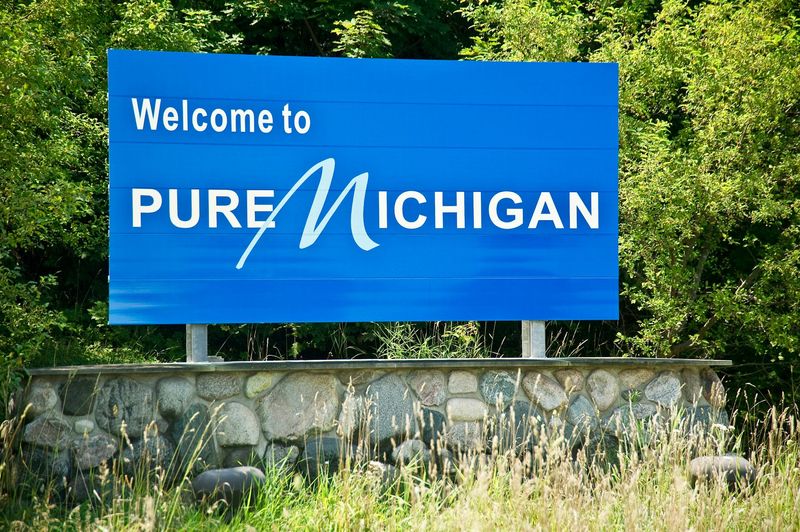
Send a thank you note to the leaders in Lansing who repealed Right to Work and hiked the minimum wage, while also refusing to follow the lead of competitive states that cut income taxes, which would open the door to investment. Michigan’s legislators may as well have replaced the “Welcome to Pure Michigan” road sign on northbound I-75 with a “Sorry Folks, Closed for Business” billboard, instead.
“All of a sudden it’s a kind of a crisis moment for Michigan competitiveness, vis-à-vis the Great Lakes states,” explained Jonathan Williams, president and chief economist of the American Legislative Exchange Council, which publishes the annual report.
Ohio and Indiana are Michigan’s geographic competitors, and both have chosen a different path when it comes to enacting policies that will allow their states to thrive.
In Columbus, legislators enacted a 2.75% flat income tax on individuals and small businesses. That helped propel Ohio to 15th place on the Rich States, Poor States list, making it the state with the biggest improvement on the list this year. Compare that to Michigan, which imposes a 4.25% income tax rate, on top of additional income taxes assessed by cities like Albion, Detroit, Grayling, Lansing, and Port Huron, among many others.
Meanwhile, Indiana has been a Top 10 state for years, thanks to consistent free-market, low-tax policies. And last year, Mississippi and Oklahoma voted to phase out their personal income tax altogether. Michigan, though, is standing still — and increased its annual budget by $24 billion in recent years (not exactly a path to tax relief).
It’s not just about winning a Rich State trophy, though. Michigan’s bad policies are resulting in terrible outcomes. As the Detroit Regional Chamber of Commerce recently reported, Michigan ranks among the bottom 10 states in per capita income, job growth and educational attainment. When it comes to population, the Saginaw Bay region is in particularly dire straits. The region’s eight counties lost about 20,000 people from 2021 to 2024, including many young adults.
Williams says that Michigan’s decision to increase the minimum wage — which went into effect this year — has a harmful effect on job growth, particularly for young people. “That’s a huge driver of problems with employment, especially for young workers that don’t have any experience yet in the workforce, like high school and college recent graduates,” Williams said. With no jobs at home, they must head for states with more opportunities.
Just as talented people are leaving, new people aren’t coming. Companies are looking elsewhere, too. Though there’s not one single reason, Williams notes that Right to Work — the law that gives workers the choice whether or not to join a union — is a big driver. Michigan became a Right to Work state in 2013. But when Democrats took control of state government, they repealed the law in 2024. That’s had a serious impact on the state. “Many of the businesses that we talked to as we travel the states say they won’t even consider investing in a state with a new economic development project unless it’s a Right to Work state,” Williams noted. It’s gotten so bad in Michigan that even when the state tries to lure companies with billions of dollars in taxpayer-funded incentives, they just say no.
For a college football team, one bad season can be a fluke. But if the team loses year after year — if the fundamentals are bad — there are serious consequences for the program. The school can’t attract the best high school players, fans stop showing up at the games, and even revenue from t-shirt sales drops. After all, who wants to sign up with a loser? States have the same problem.
“When you see Michigan fall as precipitously as it did in this year’s edition of Rich States, Poor States, that is a sign of hard times to come in Michigan, unless policy makers start to analyze what created the fall and what they can do to start addressing those issues,” Williams cautioned.
In other words, the state of Michigan is running a bad program. Until we change course, there’s more losing ahead.
Mike Brownfield is vice president of communications and strategy at the Goldwater Institute and previously served in the Michigan governor’s office.
This article originally appeared on The Holland Sentinel: Michigan is losing to Ohio | Opinion
Reporting by Mike Brownfield, Holland Sentinel / The Holland Sentinel
USA TODAY Network via Reuters Connect