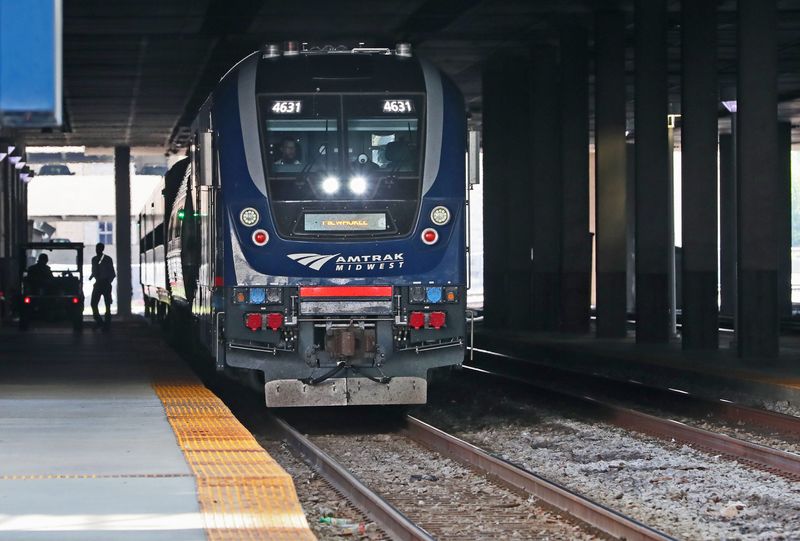
A planned Milwaukee-Madison passenger rail service would cost more than $200 million to build, with Wisconsin taxpayers providing a share of that amount and an annual operating subsidy.
The Amtrak service would initially run two round trips daily, with additional stops in Pewaukee and Watertown – bringing passenger service to Wisconsin’s second- and third-most populous counties. That could increase to four trips daily.

That’s according to Arun Rao, Amtrak’s senior director for network development. He spoke during an April 30 webinar presented by Milwaukee Downtown Business Improvement District and Downtown Madison Inc.
Amtrak has been working on plans for the possible extension of its Hiawatha service, which runs between Milwaukee and Chicago. That new service, dubbed Hiawatha West, could start as soon as 2030.
It would extend Amtrak to three counties – Dane, Waukesha, and Jefferson– where the population has increased 22% since 2000, Rao said. That’s double the statewide population increase.
Hiawatha West also would serve some of Wisconsin’s largest employers, Rao said.
A tentative schedule calls for an early departure from downtown Madison at 6:15 a.m., arriving at Milwaukee’s Intermodal Station at 8 a.m., he said. A later run would depart Madison at 5:30 p.m.
The first Milwaukee departure would be at 10 a.m., arriving in Madison just before noon. There also would be an evening departure.
Amtrak expects around 260,000 annual passenger trips, Rao said. The Milwaukee-Chicago Hiawatha service has around 681,600 annual passenger trips.
Hiawatha West would use existing tracks and bridges – which Rao said would need upgrades. The new service also would need stations or platforms in Madison, Watertown, and Pewaukee.
New service construction to cost up to $275 million
The estimated capital improvements budget would be $215 million to $275 million, Rao said. The federal government would cover 80% of that tab, with Wisconsin paying the remaining share.
Also, Wisconsin would need to provide a $2.5 million annual operating subsidy, he said. The state now pays $5.6 million annually for the Hiawatha’s Milwaukee-Chicago service.
Amtrak will complete its Hiawatha West operating plan in June, Rao said.
A critical step to move the project forward is for the Legislature to include the increased operating subsidy in the 2027-29 budget, he said. The 2025-27 budget is $111 billion.
“We will especially need the business community’s help…to help push that forward,” Rao said.
The Hiawatha West service would have an estimated $46.3 million annual direct and indirect economic impact, he said.
Rao didn’t elaborate, but the Federal Rail Administration defines direct economic impact as activity generated by the construction industry at the construction site, or by the operator at their facilities.
An indirect impact is activity generated by other industries that supply the construction industry or operator with inputs by vendors and suppliers, such as equipment, steel, and concrete.
Tom Daykin can be emailed at tdaykin@jrn.com and followed on Instagram, Bluesky, X and Facebook.
This article originally appeared on Milwaukee Journal Sentinel: Milwaukee-Madison Amtrak line to cost over $200m–if Wisconsin helps out
Reporting by Tom Daykin, Milwaukee Journal Sentinel / Milwaukee Journal Sentinel
USA TODAY Network via Reuters Connect