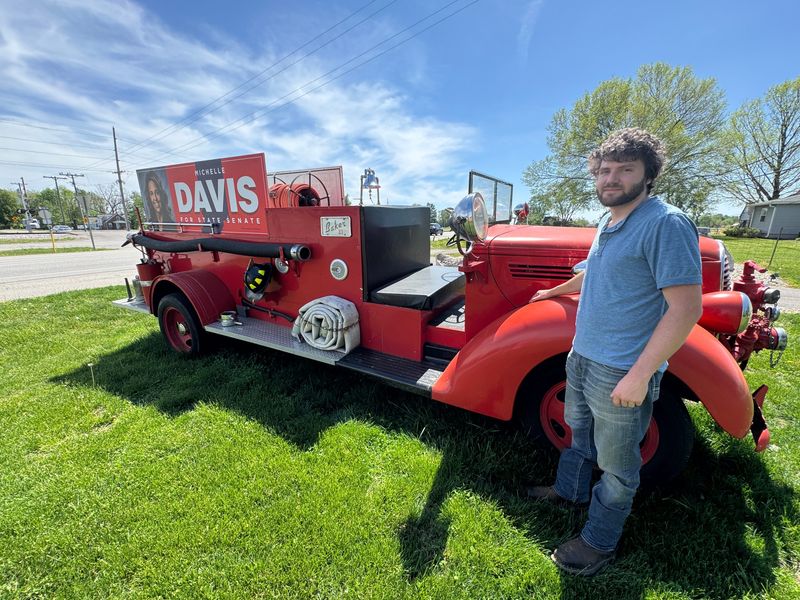
COLUMBUS, IN — The bright red vintage fire truck parked in his front yard, in direct view of fast-traveling traffic along U.S. 31, was an amusing surprise when 24-year-old Alex Kizer returned home on a recent afternoon.
Turns out, it was his dad’s doing. It’s a giant ad for state Rep. Michelle Davis, R-Whiteland, who is challenging incumbent state Sen. Greg Walker for his seat in the May 5 primary election. A few yards in front of it is a sign saying “endorsed by Trump,” the president’s name almost as large as hers.

Kizer thinks it’s relatively simple: These races are basically popularity contests. And Davis has the ultimate boost. It at least makes him think he’ll vote for her.
“It’s a massive opportunity for her,” he said. “She has his endorsement, that’s how she can really put the pedal to the floor.”
That’s the prevailing theory among President Donald Trump and his allies, and one they are betting millions of dollars on. Having taken the unprecedented step of endorsing at such a hyperlocal scale ― challengers to incumbents in seven Indiana state Senate races in retribution for their vote against mid-decade redistricting, plus a candidate for an open seat ― the president is engaging in the ultimate test of the power of that endorsement.
His support has long been the gold standard in primary competitions. Since his iron-fisted grip on the party solidified in 2016, many have catapulted to the top with the aid of a Trump endorsement, including Indiana’s own Gov. Mike Braun during his six-way race. And it would be challenging to find an electorate who has been more loyal to the president than that of barn-red Indiana, where Trump has won by at least 16 percentage points three times.
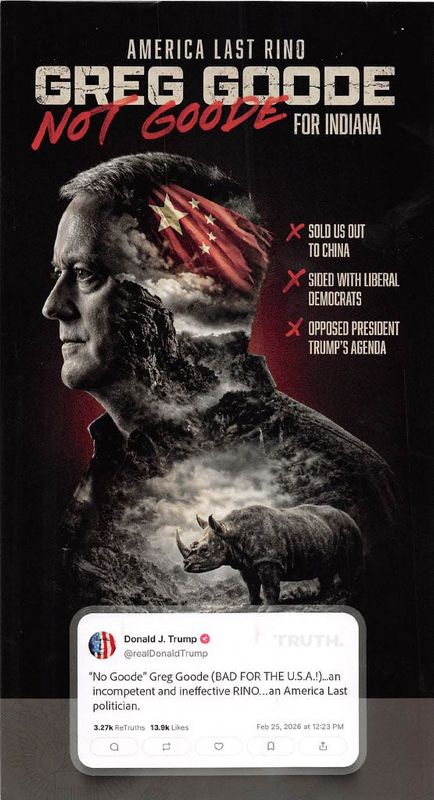
But these races are different. Allied groups like Hoosier Leadership for America and Club For Growth have paid millions to barrage Hoosiers with splashy mailers and TV ads attacking their incumbents in boilerplate ways ― activity that is totally foreign to such hyperlocal races and, for some Republican voters, is a turnoff. Other voters’ feelings toward the president are more complicated than they were even two years ago, in light of recent world events.
In mere days there will finally be an answer to this giant litmus test and Trump’s big bet.
How voters feel about the endorsement
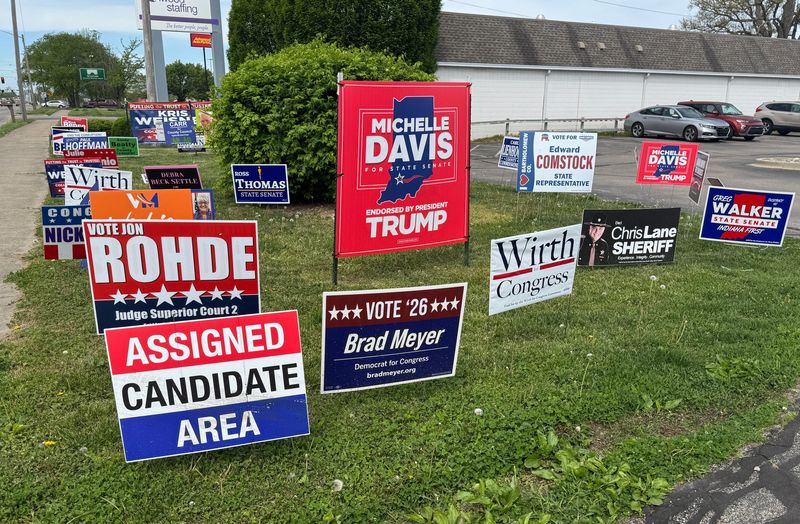
Down the road at Gather Columbus, which is Bartholomew County’s early voting site, the Davis and Trump sign towers over all the other signs in their designated area, including Walker’s.
The Trump endorsement was certainly enough for Columbus resident William Page to decide to vote for Davis. He thought redistricting was justified and was disappointed with Walker’s no-vote.
“I thought he was a Republican, but he’s voted for the Democrats,” is how he, as well as Trump very loudly, interpreted that vote.
Trump’s pollsters are projecting there are a significant number of voters like Page. In the first six endorsements that Trump announced on Truth Social back in January, he attached graphics of polls showing his candidate jumping as much as 40% in favorability after the respondents are made aware of these endorsements. (These polls were conducted before the war in Iran, and he hasn’t posted polling for his more recent round of endorsements of Indiana incumbents who voted for redistricting.)
The out-of-state groups pumping millions into ads believe there will be a return on their investment for homing in on loyalty to Trump.
“Our polling data shows that these are effective in really getting voters to come out and say, ‘OK, we’re going to put somebody new into these Senate positions, somebody who will be part of the team,” said Club For Growth President David McIntosh, who is investing $1.5 million across the eight races where the Senate incumbents rejected redistricting.
On this particular day in Columbus, Page was in the minority. Other Republican voters find these ads as well as Trump’s choice of words, calling Walker a RINO and otherwise bashing him, off-putting.
“You teach your children to show respect, and then you don’t display that same respect, that sends a message,” said 75-year-old Linda McNealy, a farmer in Petersville. “I really hate the name-calling.”
It also matters more to her that she’s seen Walker be present in the community and participatory in local causes she’s involved in ― such as by attending meetings having to do with the issue of solar panels taking up farmland. Though she supports and voted for the president, his brashness of late doesn’t sit well with her.
“I will vote for who I think is the best for the job,” she said. She’s leaning toward Walker.
The Trump endorsement in this race was actually enough motivation for John and Pam Fox, longtime Democratic voters from Waymansville, to pull a Republican primary ballot for the first time just so that they can vote for Walker.
“You caught a unicorn,” John Fox joked. (On this day, though, at least one other voter who leans Democrat said she was doing the same thing.)
The Foxes were passionately opposed to redistricting, estimating they emailed Walker about a hundred times. They figure they should reward him for listening to their concerns.
“It’s a big deal for me to get an R sticker,” Pam Fox said.
Redistricting as the litmus test
McNealy, the farmer, remains confused to this day what the redistricting debate was even all about.
Up in Wells County, where state Sen. Travis Holdman of Markle is defending his seat against Trump-endorsed Blake Fiechter, GOP Chair Preston Wright said he thinks that’s the norm.
“I can count on one hand the number of people in Wells County who reached out to me in support of redistricting,” he said. “I firmly believe the average voter couldn’t care less about redistricting, and people have moved on.”
Wright can’t be accused of being anything less than a conservative Republican. He voted for Trump all three times and previously worked as a staffer for Jim Banks when he was a U.S. representative. But he can’t find the passion for redistricting.
More than that, he said it’s obvious to him and others that the endorsement of Fiechter was “cookie-cutter” and “copy-and-paste” and based only on the litmus test that is redistricting. Trump used a template for each of these Truth Social postings, calling the incumbent a RINO and “America Last” incumbent who, “for whatever reason,” voted against redistricting, whereas the primary challenger will “fight tirelessly to protect Hoosier values.” He took note that Republicans across the political spectrum, from ultra-conservative Fort Wayne Sen. Liz Brown to moderate Lafayette Sen. Ron Alting, got endorsements simply because they voted yes.
“I don’t think voters are dumb,” Wright said. “They see through the politicization of it.”
Meanwhile, some of the senators being challenged by a Trump-endorsed candidate are among the most conservative in the General Assembly. Sen. Spencer Deery of West Lafayette has a 100% rating from the Indiana Family Institute and 89% from Americans for Prosperity for his voting record, but he was also one of the most vocal opponents of redistricting.
“I’m quantifiably one of the most conservative senators in the district,” Deery said. “It’s not about that. I think it’s about allegiance to Washington.”
Though redistricting was the original litmus test, the ads and mailers now bombarding Hoosiers have a few extra elements to them. One prominent claim that’s featured in many of them across all the Senate districts in play is that such-and-such incumbent voted to allow China to own farmland.
There is indeed some anecdotal evidence that this is making an impression among voters, perhaps more than the Trump endorsement. It comes up whenever Sen. Jim Buck of Kokomo, an anti-redistricting incumbent facing a challenger, calls voters and asks what questions they have.
“It’s like the old adage: If you tell a lie enough times, it becomes the truth,” he said.
The ad is referring to House Bill 1183 from 2024, a bill that passed unanimously in the Senate and restricted foreign adversaries from buying agricultural land in Indiana. The more nuanced contention from critics is that the bill did not force divestment from land purchased before 2024. It also exempts renewals for leases entered into before that date.
What a TV ad against Buck actually says, though, is that he “voted to let China own Hoosier farmland.”
“That was a Farm Bureau bill for heaven’s sakes,” Buck said.
Local endorsements face local challenges
There’s another layer to this test of the Trump endorsement: These races might just be too local.
Josh Clarke, GOP chair of Clay County, where Trump won by 57 points in 2024, said he thinks he and others would still lean on the Trump endorsement at higher levels, like for governor. But at the local level, people notice who is putting in the leg work, or they might simply recognize the name of their incumbent senator and go off that.
“People may just be more familiar with [state Sen.] Greg [Goode],” he said. “If Greg wins, it’s because of that.”
In Holdman’s district, Wright said it hasn’t gone unnoticed that Holdman routinely comes to party events, whereas Fiechter has been absent. Fiechter has also been inconsistent about running; he withdrew from the race at one point, then later rejoined.
In the case of Goode’s race against Vigo County councilor Brenda Wilson and network engineer Alexandra Wilson, some locals say the more important issue in the race is whether the county should help the Vigo County school system pay for upgrades.
“If you were to go ask a thousand people in our community what their position was on redistricting, I’ll bet you 900 don’t know what it is or didn’t feel passionate enough to look into it any further,” said Steve Ellis, owner of Top Guns in Terre Haute. “I don’t think that’s a topic they’re going to get out and vote on. What the Trump admin didn’t do is research what is important in our communities.”
He yielded more than 500 responses to an informal poll he put on his local Facebook page, Holding Vigo County Accountable, asking whether a Trump endorsement would cause them to vote for that local or state candidate. Eighty percent said no.
Vigo County GOP Chair Randy Gentry said people have also noticed that when Trump endorsed Vigo County councilor Brenda Wilson ― as well as in the three other times he’s reposted the endorsement ― he mistakenly called her a commissioner.
“The comments seem to be overwhelmingly like, it’s almost like they don’t believe this endorsement, like there’s no way he knows who these people are,” Gentry said. “It’s almost not helpful in a way, because some people are like, ‘This is all fake.'”
Wilson, however, said she believes the endorsement will have an impact.
“I do think that having his endorsement will resonate with voters,” she said. “District 38’s residents have great respect for the president, and he won our district easily. I am honored to have his endorsement, and will be a top ally in our state senate.”
Meanwhile, the White House had been working behind the scenes to make certain that would be the case. Top Trump aides lobbied Alexandra Wilson to drop out of the race, fearing her having the same last name as Brenda Wilson would muddy the waters too much.
The pressure didn’t work. Even after a formal ballot challenge made its way to a courtroom, a special judge ruled that Wilson will remain on the ballot.
Changing the nature of an incumbent’s primary fight
Deery had a different kind of unique challenge the first time he ran for his state Senate seat: a close four-way race where he and everyone else was a newcomer.
This time around, it’s challenging in different ways. He’s no longer new to the game, but there’s a whole lot more money, ads and polling involved. He recently had his first experience filming a TV commercial. Facing the prospect of the millions in spending pledged by outside groups supporting his opponent, Trump-endorsed Paula Copenhaver, he’s been doing a lot more fundraising.
“I probably will be outspent,” he said. “But I’m not going to be outworked.”
The bulk of the spending for these challengers seems to be coming from the nonprofits and Super PACs supporting them, rather than donations to the candidates themselves. In most of these Trump-endorsed races, the incumbents have actually raised far more in their campaign coffers than the challengers, thanks in part to some hefty support from the Senate Majority Campaign Committee.
Deery, for example, reported raising half a million dollars in the first quarter, compared to Copenhaver’s $15,000.
In his nearly 20 years in the Senate, Buck has never had a primary opponent. For him this is basically a matter of replicating what he usually does in the fall ― plus asking his regular supporters for more money than usual. He raised nearly $285,000 the first quarter; his opponent, Tracey Powell, raised $43,000.
“Except, normally, primaries are family food fight,” he said. “This is coming into our back yard and saying we don’t care what your family food fight is. These are the rules we’re setting down for your fight. And people don’t like it.”
Some of these incumbents’ campaigns have fought back with attack ads of their own.
The stakes, in Deery’s and Buck’s minds, are beyond them. To Buck, this is a test of whether the principle of federalism, or the concept of states’ rights separate from the federal government, will survive. This was a core principle for the nation’s founders.
“Now, their worst fear has come to reality, where the federal government now is coming into the states and telling the states how they’re supposed to vote,” Buck said.
Though the challengers tout allyship with Trump as a strength, Deery said he fears that if they win these primaries, the Statehouse will have more willing lawmakers who will take direct orders from the president.
“They’re going to be more inclined to listen to D.C. because D.C. will have demonstrated a proof of concept that they can manipulate an Indiana election if you don’t follow them,” he said. “They’re not trying to silence me. They’re not trying to attack me. They’re attacking Hoosier voters. They’re trying to silence Hoosier voters and reduce their influence over their lawmakers.”
Neither Copenhaver nor Powell responded to requests for comment.
Many voters like to say they’ll make their choice based on the person and their values. Sometimes it’s a different story when faced with the actual ballot.
“The only thing I can tell you is on the night of the primary, we’ll know,” Gentry said.
Contact Statehouse reporter Kayla Dwyer at kdwyer@indystar.com or follow her on X @kayla_dwyer17.
This article originally appeared on Indianapolis Star: The Trump endorsement faces its biggest test yet in Indiana. Will it work?
Reporting by Kayla Dwyer, Indianapolis Star / Indianapolis Star
USA TODAY Network via Reuters Connect