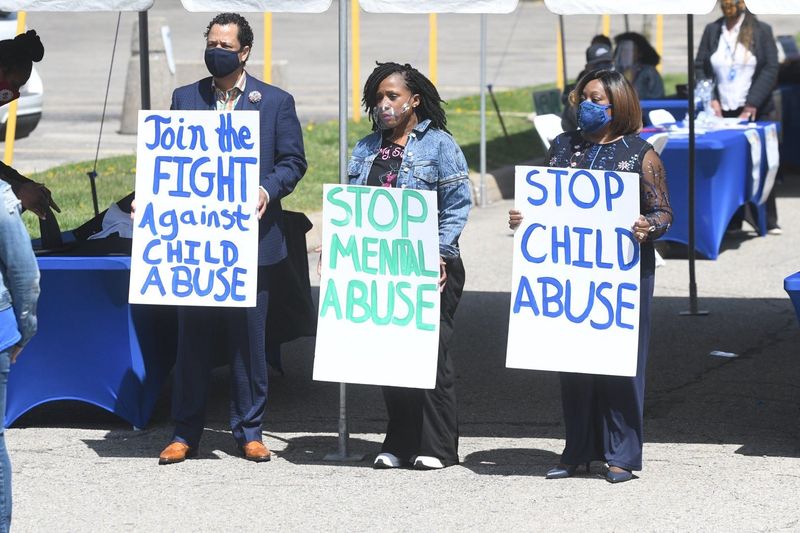
April is National Child Abuse Prevention Month. But for too many children in Michigan, it is simply another month of silence, fear and invisible suffering.
At least 52 children in Wayne County have died from abuse or neglect since 2022. This represents more than one in 10 of all child deaths in the county, and more than two-thirds of these children were younger than three years old — who could not yet fully speak for themselves, who depended entirely on the adults around them to see, to ask, and to act.

That number should stop us cold.
At the Neighborhood Service Organization, our “Don’t Touch Me” campaign is built on a simple belief: Every child deserves to feel safe, heard, and protected. But belief without action leaves children vulnerable. Awareness that stays in April does nothing for a child suffering in May.
So, let’s talk about what actually gets in the way.
Abuse is designed to stay hidden
Child abuse is not confined to any neighborhood, income level, or family type. It crosses every corner of our society — schools, churches, households of every kind. And in the vast majority of cases, it is actively concealed by those causing harm.
One of the most powerful concealment tools is known as DARVO — Deny, Attack, Reverse Victim and Offender, a tactic documented by the National Institute of Justice. An abuser denies wrongdoing, then attacks the credibility of the child and any parent trying to protect them, and then repositions themselves as the real victim. The child is left not only harmed, but disbelieved — and the parent advocating for them can find themselves questioned rather than heard. Without proper training, even experienced professionals can be misled by it.
That’s not a failure of character. It’s a failure of preparation.
We are tasking critical victim advocates and decision makers to make extremely arduous choices without being fully equipped with requisite training and education.
Law enforcement officers, child protective service workers, and mandated reporters are often the only outside contact an abused child ever has. They are, in many cases, a child’s single chance at safety. Yet many enter these roles without training to recognize the subtler, behavioral signs of trauma — or the specific tactics perpetrators use to discredit children, undermine protective parents, and control the narrative.
We require credentials and specialized training in nearly every profession that touches the lives of children. Teachers must be certified. Pediatricians must be licensed. Coaches must pass background checks. So why do we not demand the same rigorous, mandatory preparation for those handling the most traumatic experiences a child will ever face? These are not general roles. They are highly specific, extraordinarily consequential assignments — and the training must come before anyone is permitted to perform them, not as an afterthought once they are already in the room with a suffering child.
NSO is actively engaged in proposed legislation that would change this — requiring comprehensive, mandatory training before child abuse investigators and decision-makers can assume these roles. That training must include understanding age-appropriate trauma responses, the behavioral language children use when they cannot find words, and perpetrator manipulation tactics like DARVO. This isn’t bureaucratic box-checking. It is the difference between a child being believed and a child being sent back to an abuser.
What you can do — starting today
Prevention does not belong only to professionals. It belongs to neighbors, family members, teachers, and coaches. It belongs to all of us.
Learn the warning signs. Have the uncomfortable conversations. And when something doesn’t feel right about a child’s situation — say something. Children rarely disclose abuse in direct terms. They reveal it in behavior, in withdrawal, in fear. We have to be willing to see what they cannot always say.
Contact your state legislators. Urge them to support policies that fund training, strengthen protections, and ensure that those entrusted with children’s safety have the skills to do their job before they are ever called to do it.
And if you or someone you know may be experiencing abuse: help is available, right now. Visit nso-mi.org/get-help or call the National Child Abuse Hotline, 24 hours a day, 7 days a week: 1-800-422-4453.
Fifty-two children. More than one in ten of all child deaths in Wayne County. These are not statistics. They are children who needed someone to see the signs — and act.
This month, be that person.
Linda Alexander Little is President & CEO of the Neighborhood Service Organization, a Detroit-based nonprofit that delivers community-based services and holistic programs for vulnerable populations.
This article originally appeared on The Detroit News: Michigan child abuse deaths demand action | Little
Reporting by Linda Alexander Little / The Detroit News
USA TODAY Network via Reuters Connect