General Motors reported net income of $2.62 billion, down about 6% in its first quarter 2026 earnings report amid lower vehicle sales, except for trucks and crossovers, but bolstered substantially by software and services like OnStar and Super Cruise.
The Detroit automaker on April 28 reported earnings for the period ending March 31 and released an updated full-year guidance for 2026.

GM had a strong performance despite recording several hits to its bottom line, including a $1 billion charge for settling supplier contracts from the automaker’s downsizing of electric vehicle production.
GM also recorded a $500 million benefit to identify money the company expects it will get back following the Supreme Court decision that ruled certain President Donald Trump’s tariffs unconstitutional. GM still paid $900 million in tariffs in the first quarter 2026, down from $200 million in first-quarter 2025.
EV production shifts, tariffs
GM wrote off $7.6 billion in losses last year on downshifting its EV manufacturing footprint. Those losses, taken in waves across the year, accounted for unused EV production equipment and cancelled supplier contracts.
GM also took a $3.1 billion hit from automobile and parts tariffs incurred during three of the four quarters of 2025. While the company expects a similar cost in 2026, the Supreme Court ruling offered some relief.
The court on Feb. 20 overturned Trump’s tariffs in a 6-3 decision that Trump incorrectly invoked the 1977 emergency powers law when claiming the U.S. trade deficit posed a national emergency. Starting April 27, businesses began applying for refunds through a site administered by the U.S. Customs and Border Protection.
GM’s financial guidance is now net income at a range of $9.9 billion to $11.4 billion, lower than its previous prediction, but a higher adjusted net income range of $13.5 billion to $15.5 billion across 2026. GM lowered the range it expects to generate from its automotive business to $16.8 billion to $20.8 billion from $19 billion to $23 billion.
GM’s 2026 financial guidance still includes anticipated capital spending of $10 billion to $12 billion that includes the company’s battery cell manufacturing joint ventures.
Before adjusting for special items, GM reported a net income of $4.25 billion, a 22% increase over first quarter 2025. GM’s earnings before interest and taxes is the metric by which GM’s executives and union workers are paid.
‘Disciplined execution’
CEO Mary Barra attributed the strong financial performance to GM’s “strategic product portfolio and disciplined execution by our teams, dealers, and suppliers,” in her letter to shareholders, noting that the adjusted income figure surpassed expectations.
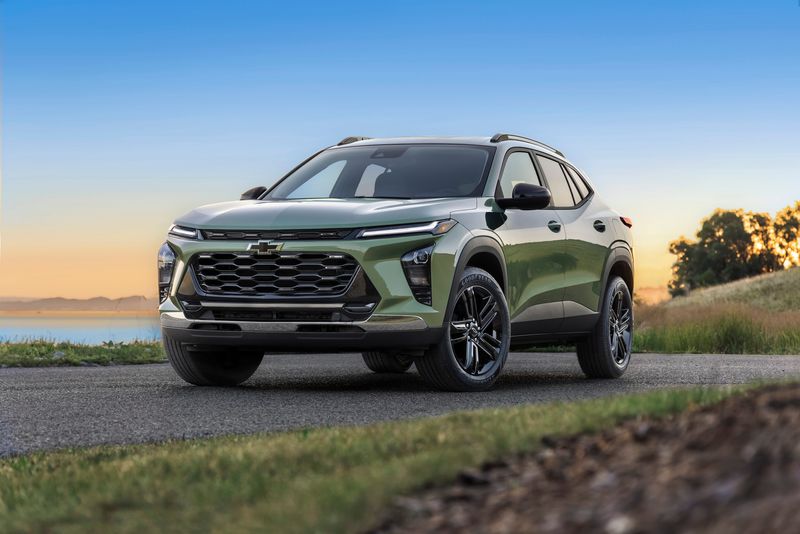
Barra highlighted the sales of crossover vehicles that include the Chevrolet Trax, Equinox and Traverse; the Buick Envista and GMC Terrain and GMC Acadia have grown to more than 46%, up from 40% before GM began refreshing the lineup in 2023.
“Looking forward, we remain focused on delivering 8%-10% North America margins this year; OnStar, including Super Cruise, is contributing to high-margin revenue growth; and we are advancing automated driving technology in ways that differentiate GM,” Barra’s letter said. “We are clearly operating in a very dynamic environment, which isn’t unusual for this industry. That’s why we have had a multiyear focus to ensure we have the right products, the right team, and a strong balance sheet supported by healthy cash flows to achieve our long-term goals and consistently execute our capital allocation strategy.”
Iran war No. 1 issue to watch
GM leaders said on a call with investors later in the morning that the ongoing conflict in the Middle East has caused significant disruption for the automaker and forewarned of ongoing challenges as the Iran war continues.
“The No. 1 that we’re watching is what happens with the Iranian conflict,” Barra said on the call. “Obviously, oil prices affect a lot more that we’re seeing from not only logistics but also other commodity costs. Tell me how high oil prices go, we’ll start talking about what demand is.”
GM reallocated about 7,500 full-size SUVs to the United States from the Middle East to fortify lean inventory at American dealerships, CFO Paul Jacobson said on the call, noting that lower inventory levels contributed to GM’s nearly 10% decline in sales in the first quarter.
GM dealers ended the quarter with about 516,000 vehicles in inventory, a 6% drop from a year earlier.
“We came into the quarter light on our targeted inventory levels, primarily because we had such a really strong December. Then with the storm and other challenges we had, we weren’t able to catch up,” Jacobson said. “We’re optimistic that as we get more product out to the dealers in Q2 that we can help reverse some of the share losses that we saw without getting into heavy discounting across the board.”
Higher gasoline prices haven’t deterred consumer interest in gasoline-powered pickup trucks and SUVs, inventory of which GM is looking to grow this year, Jacobson also noted.
Software highlights
GM noted software and service adoption rates grew in the first quarter, with subscriptions of advanced driver assist system Super Cruise up 70% year-over-year.
GM offers long-term subscriptions with every vehicle purchase. Each new GM vehicle starting with the 2025 model year includes an eight-year basic subscription to OnStar services. GM sells vehicles that offer Super Cruise with a three-year subscription baked into the price. That becomes a monthly or yearly subscription add-on if consumers choose to continue the service.
OnStar ended the quarter with deferred revenue at $5.8 billion, up over 50% year-over-year and recognized revenue over $750 million that was up over 20% on the same basis. GM said Super Cruise is on pace to make nearly $400 million in 2026.
GM said during their earnings report that it expects to surpass 850,000 paid Super Cruise subscribers by the end of the year. There are about 750,000 active Super Cruise customers.
GM noted in January that sourcing alternative semiconductor chips due to the disruptions with Chinese-owned computer chipmaker Nexperia cost GM $100 million in the fourth quarter 2025.
GM had expected another $100 million of “pressure” from buying other semiconductors in the first quarter of this year.
Here are the first-quarter numbers GM reported:
Glossary of Terms:
Earnings before interest and taxes: The metric that companies prefer to use because it doesn’t account for losses incurred in the quarter; therefore it tends to be higher and shows the company in a more favorable light.
Net income: The amount of money a company has left over after paying all expenses related to operating their business.
Net loss: The amount of money a company owes when its expenses exceed income for the quarter or year.
Revenue: How much money a company generated during the designated time before expenses like operating costs or taxes.
Stock value: The value that one share of stock in the company is worth at the end of market close on a particular day.
GM is the first of the Detroit Three to report earnings for the first quarter of 2026.
Ford Motor Co is expected to release its first-quarter results on April 29 and Stellantis, which makes Chrysler, Dodge, Jeep, Ram and Fiat brands, is expected on April 30.
Jackie Charniga covers General Motors for the Free Press. Reach her at jcharniga@freepress.com.
This article originally appeared on Detroit Free Press: GM posts strong earnings for Q1 despite costs from tariffs, suppliers
Reporting by Jackie Charniga, Detroit Free Press / Detroit Free Press
USA TODAY Network via Reuters Connect