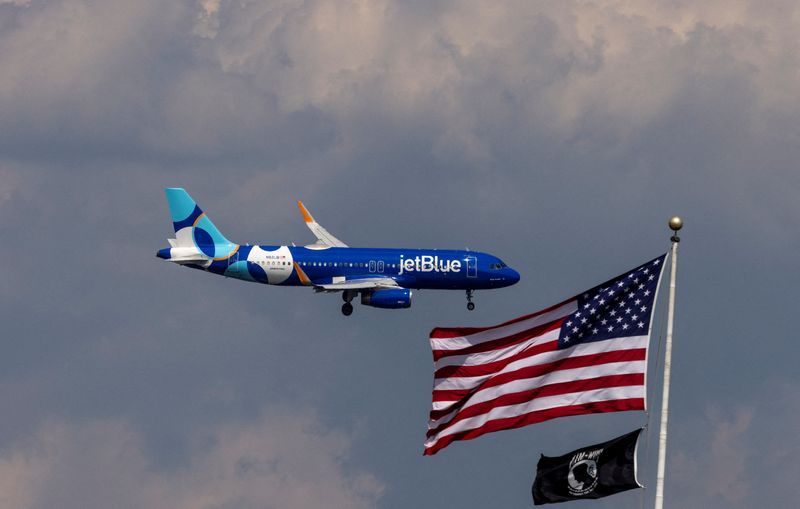
April 28 (Reuters) – JetBlue Airways reported a bigger first-quarter loss on Tuesday, as surging jet fuel costs driven by the Iran war weighed on margins, threatening to derail the carrier’s turnaround efforts.
The U.S.-Israeli attack on Iran has closed the critical Strait of Hormuz, disrupting nearly a fifth of global oil and gas supplies and triggering the aviation industry’s biggest shock since the COVID-19 pandemic.

“While the macro environment, particularly fuel, has become more volatile, we are taking decisive actions to manage what is within our control, including adjusting capacity, optimizing revenue, and maintaining disciplined cost control,” CEO Joanna Geraghty said on Tuesday.
The airline plans to recoup 30% to 40% of the increased fuel costs in the second quarter, with expectations to recover all of it by early 2027.
Jet fuel prices have nearly doubled since the conflict erupted at the end of February, squeezing carriers between spiraling costs and tickets already sold at prices they cannot adjust.
U.S. carriers face added pressure after abandoning fuel-cost hedging. Fuel is the second-largest airline expense after labor, typically accounting for a fifth to a quarter of operating costs.
Rising fuel costs heighten the pressure on smaller carriers like JetBlue, which have limited financial flexibility and greater exposure to uncertainty. Industry executives warn the Middle East conflict could reshape airline industry dynamics.
JetBlue entered 2026 aiming to regain stability and start reaping the benefits of a turnaround effort launched in 2024, focusing on tight cost controls, route optimization and deferring aircraft deliveries. But high fuel costs threaten to derail that plan.
CEO Joanna Geraghty told employees last week that JetBlue was not considering bankruptcy, according to a memo seen by Reuters, adding the carrier had ample liquidity and access to additional capital.
The New York-based carrier recently secured a $500 million debt financing commitment backed by up to 22 aircraft, with an option to raise an additional $250 million using more planes as collateral.
The New York-based carrier reported a net loss of $319 million, or 86 cents per share, compared with $208 million, or 59 cents per share, reported a year earlier.
(Reporting by Shivansh Tiwary in Bengaluru; Editing by Leroy Leo)