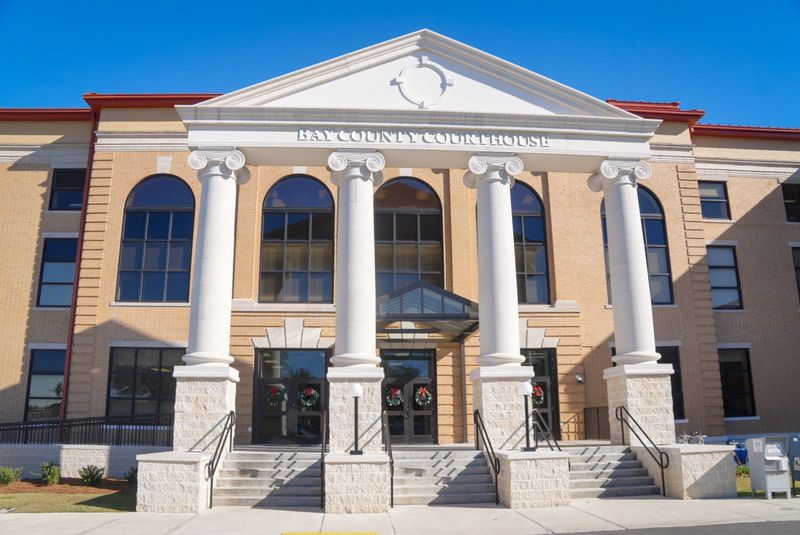
PANAMA CITY— A local historian says there’s an unexpected twist in a locally driven landmark Supreme Court decision, and only people who attend his lecture will know.
Historian Kenny Redd is set to present “Double Homicide and a Twist of Fate” on April 27, at 6 p.m. at the Bay County Public Library, 898 West 11th St. in Panama City.

Gideon v. Wainwright was a 1963 U.S. Supreme Court decision that ruled the Constitution requires states to provide legal counsel to criminal defendants who cannot afford an attorney. In layman’s terms, it’s the reason those charged with serious crimes are guaranteed access to a lawyer.
That decision started here in Bay County, where an unemployed man reportedly broke into a poolroom to steal alcohol, cash and Coca-Cola.
Clarence Earl Gideon was a 50-year-old drifter from Missouri who worked odd jobs between jail sentences. He left school at 14 and ran away from home, often committing nonviolent crimes.
By 1961, he ended up at a rooming house in Panama City. This is essentially bare-bones housing for single adults and transient workers. Although some sources say that Gideon occasionally helped out at the Bay Harbor Pool Room, the facility he stood accused of robbing, he was otherwise unemployed.
He was charged with burglarizing the establishment on June 3, 1961. Because Gideon could not afford an attorney, he asked that one be appointed to him. The judge informed him that a court-appointed attorney was reserved only for capital offenses.
Gideon was be found guilty and sentenced to five years in state prison. While there, he appealed to the Supreme Court, claiming he was denied his constitutional rights. They ruled in his favor on March 18, 1963, permanently changing the legal process across the United States.
After Gideon was retried with an attorney, he was acquitted. New York Times reporting shows that he died at 61 on Jan. 18, 1972, at the Broward Medical Center in Fort Lauderdale.
Redd said that while his feat was impressive, this isn’t necessarily the whole story.
“He was able, or at least the the story goes, that he was able to craft a petition to the Supreme Court simply by visiting the Law Library in Rayford, where he was incarcerated,” Redd said. “For decades, no one knew that he actually had some help with his petition to the Supreme Court.”
Winton Frederick Turner was the attorney on Gideon’s side during his retrial. Before Turner died in 2003, he revealed that Gideon had some help with his petition to the Supreme Court.
Redd explained that in 1955, there was a double homicide in Palm beach County that went unsolved until 1959.
“As a result of this double homicide and the trial, the pieces were put in place for Gideon to receive the help that he needed to craft his petition to the Supreme Court, and of course, wind up being very famous for his successful appeal,” Redd said. “So I’ll be telling the behind-the-scenes secrets that Judge Turner revealed in 2001 at the University of Florida, and what happened was that Gideon confided in Turner.”
To figure out what exactly the secret is, readers will have to see Redd at the library.
Today, the Bay Harbor Pool Room, which used to stand at 105 Everitt Ave., has been replaced with a parking lot, but the crime that occurred there would change legal history.
This article originally appeared on The News Herald: A Panama City case changed US legal history. Find out how in lecture
Reporting by Dylan Gentile, Panama City News Herald / The News Herald
USA TODAY Network via Reuters Connect