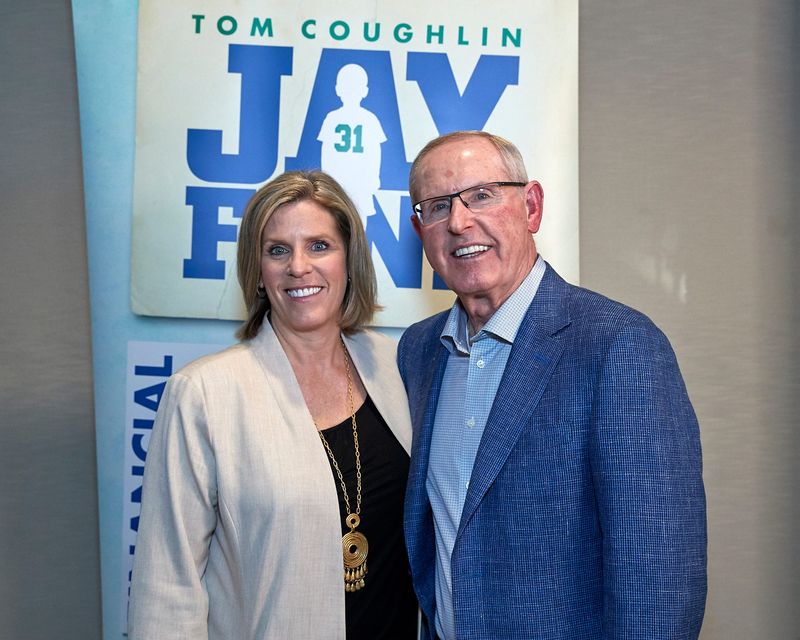
At its annual Humanitarian Awards on April 30, OneJax will give the organization’s highest honor to two people — Tom Coughlin and Keli Coughlin Joyce.
It’s fitting that the father and daughter be honored for what the Tom Coughlin Jay Fund has done since it started in 1996 — helping thousands of families dealing with childhood cancer.

Elizabeth Andersen, CEO of OneJax, said: “Tom and Keli Coughlin embody what it means to lead with compassion and purpose.”
It’s fitting that they be honored here in Jacksonville — a place where the Coughlin family remains a part of the community.
And it’s fitting that they be honored together — because the Jay Fund doesn’t get started here without Tom Coughlin being hired as the Jaguars’ first coach and it doesn’t become what it is today without him being fired as Jaguars coach and Keli Coughlin becoming executive director and CEO.
They’ve told that story before. But the award seemed like a good excuse to meet at the Jay Fund offices in Ponte Vedra, have them tell it again and talk about Tom Coughlin as a father, Keli Coughlin as his daughter, and what they and their Jay Fund team have done in the last 30 years.
A football family
Keli was born during football season. Or, put another way, Tom and Judy Coughlin became parents during football season.
They got married the summer before his senior year at Syracuse University. She graduated from Brockport State Teachers College and got a job teaching. He spent another year at Syracuse, getting his masters and working as a graduate assistant, his first coaching job — before getting his first head coaching job at Rochester Institute of Technology.
“And Keli was born in that very first October,” he said.
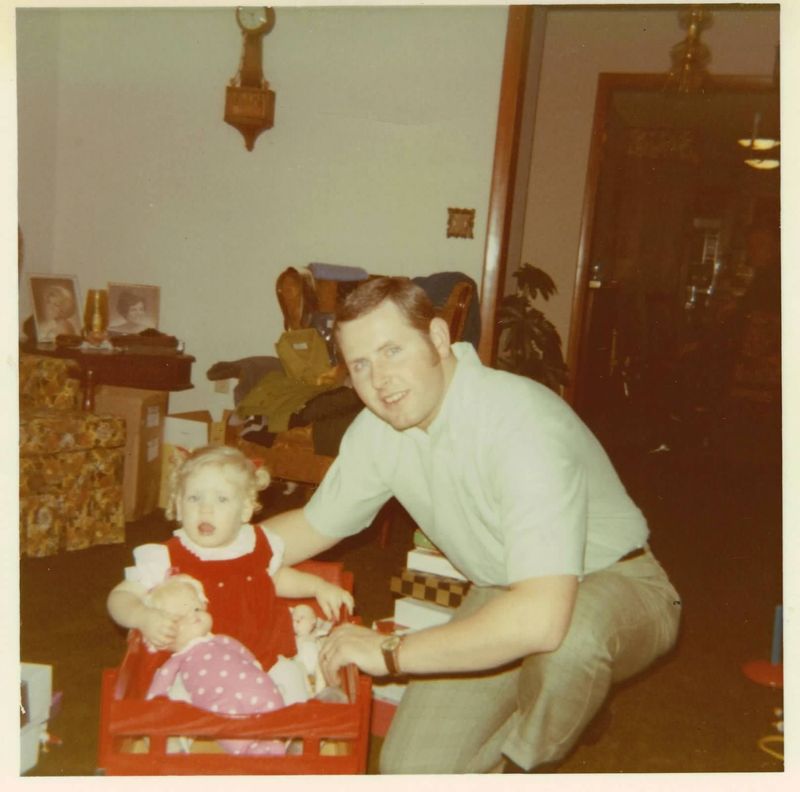
There’s a father-daughter picture, maybe from Christmas or a birthday in the early 1970s, of Keli in a red dress, sitting in a wagon with a doll, her dad kneeling beside her, smiling. And he still smiles when asked about the first of his four children.
“She liked being with me, which was wonderful,” he said. “So every chance I could, I would take her with me.”
They recalled when he was coaching at Syracuse and she was in elementary school and he took her on a spring recruiting trip, how they went down the Jersey shore, making it also a father-daughter trip.
Ask her about him as a father — if the coach who was known as a disciplinarian also was one at home – and she smiles, confirming this was true.
“I mean, I think you knew what was expected of you, and he wasn’t gonna sugarcoat anything if it didn’t happen,” she said, saying it was his personality, not just with football. “It was just him. Structure and routine and expectations.”
Of course, as a coach, he often was working late and gone on weekends. So, Keli says, there was a bit of laxity with their mom.
“But the big threat if you were misbehaving was, ‘I’m gonna tell your father,’” she said.
But, they both agree, when the season ended and the coach briefly had much more time at home, and began acting like he was running the show there, Judy would let him know otherwise.
Coughlin rules
Keli has a favorite story involving her dad’s rules.
Her dad’s team had a bowl game in Florida. Keli was in college and, since it was Christmas break, was able to make the trip, too. At the hotel, there was a room for a team breakfast. It wasn’t a formal thing, with a specific time. Just show up and eat.
So one morning, she rolled out of bed, threw on shorts, T-shirt, hat. That last piece of clothing is key to the story. Her dad had a lot of rules for his players, including that they couldn’t wear hats inside.
“I walk in and he sees me,” she recalls, “and his face gets red and he says, ‘Take that hat off.’”
She protested. She was a girl. Her hair was a mess.
He said, “The rule is no hats.”
So, yes, she took the hat off.
Jay McGillis
Another story from when she was in college, getting her master’s in exercise science at Michigan State, and her dad was in his first year coaching at Boston College: One of his players, Jay McGillis, was diagnosed with leukemia.
As McGillis was battling the disease, linebacker Mike Panos came to Coughlin and said: We have to do something for the family.
The players and coaches went out in the community, held what they called a “lift-a-thon” and raised $50,000 — presenting a check to McGillis at halftime of the spring game.
Keli heard about some of this from afar. And she still remembers July 3, 1992, a family gathering where her father grew up in upstate New York, standing in Grandma Betty’s living room, seeing her dad talking on an old-school corded phone, getting the news that Jay McGillis had died.
Put down roots in Jacksonville
A couple of years later, Tom Coughlin was offered the chance to coach a new NFL team in Jacksonville and, in 1996, he started The Jay Fund, named in honor of McGillis. It was Florida, so they decided to try holding a celebrity golf tournament, even if, when asked if he plays golf, Coughlin responds: “I have clubs.”
“I believe we made $36,000,” he said. “And we thought that was great.”
When Keli moved to Jacksonville that year to become athletic trainer at the University of North Florida, she says she was “voluntold” that she’d be helping with the golf tournament. Not that she minded. She didn’t know anybody here. She figured this was a good way to meet some people.
When she started to meet some of the patients, and talk to the families and social workers helping them, it was “like a light bulb went on.” The Jay Fund was providing financial support, but there was so much more these families needed.
As Coughlin coached the Jaguars for eight seasons, and Keli ran the golf tournament in her free time, the Jay Fund continued to grow. But the biggest inflection point was when he was fired in 2004.
It wasn’t clear what would happen to the Jay Fund here. At a board meeting, Dr. Michael Joyce, a hematologist and oncologist at Nemours Children’s Health, gave an impassioned pitch for why the Jay Fund was needed in Jacksonville, how without it here, children and families would lose that social support.
At that point, it was an all-volunteer organization. But it was decided they needed someone to make it their entire focus, not just a hobby.
“And so I was lucky enough to be asked to do that,” Keli said.
Her dad adds: “We’re the lucky ones. Because the best thing that ever happened was that I got fired and went to New York and she took over the Jay Fund on a daily basis. We needed that kind of leadership.”
Today, the Jay Fund continues in both Jacksonville and New York. It has raised $37 million and helped 6,700 families. And today both Tom and Keli call Jacksonville home.
Keli never left. She says she felt comfortable here right from the start. And she recalls not long after she became executive director of the Jay Fund, starting to date someone who was from Machassetts, who said that maybe he’d like to move back there someday. She told him, “Just so you know, I’m not going anywhere.”
Keli and Chris Joyce got married in 2007. They have two daughters. Jacksonville is home.
When her dad left, he wasn’t thinking like it would be inevitable he’d move back here someday.
“Judy did,” he said.
Even when they ended up in New York, Judy found a townhome, one of the signs she eventually wanted to be back in Jacksonville. She’s the one who, while they were living in Marsh Landing, showed him a house in Atlantic Beach she thought they should buy.
“I said, ‘There is no way that I’m buying that beach house for that amount of money; that’s not going to happen,’” he said. “Two weeks later, we bought the beach house.”
After it was battered by a couple of hurricanes, they built a new one there.
“She called it the forever home,” Keli said.
Sundays and Sundae Blitzes
In 2020, Judy was diagnosed with an inoperable brain disorder that erodes an individual’s ability to walk, speak, think and control body movements. A year later Tom wrote an essay for the New York Times, starting it by describing someone asking why Judy hadn’t been in any photos from Jay Fund events, and going on to explain that while America was gearing up for the start of the NFL season, her decline had put him in a club with tens of millions of other Americans as the primary caregiver for a loved one.
“And I could get help,” he said. “A lot of people can’t.”
Judy Coughlin died Nov. 2, 2022. The Jay Fund expanded something it already had begun, establishing an official caregiver program.
This all is part of the Coughlin legacy in Jacksonville, along with the start of an NFL team.
Some of the former NFL coach’s favorite memories here, and in New York, aren’t from Sundays. They’re from the Sundae Blitz, a day in the spring where Jay Fund patients and families spend a day at the stadium, going behind the scenes, doing workouts, meeting players and, in the end, eating ice cream.
“My eyes were opened about some of the players, because they were so good with the kids,” he said. “It would be, ‘Wow, that’s not what I had pegged for this guy.’”
Mention that the same might be said of him, that some might be surprised to see a softer side to Tom Coughlin, and he shrugs.
Keli says it’s there and the Jay Fund brings it out. But she also believes that a critical part of an organization known for compassion and empathy is some of the structure and attention to detail she learned from her father.
He hears her say this and adds that they’re always evaluating, asking, “How can we do it better next time?”
“We look at the game film,” she says.
In a way, this is another Coughlin team, one where the CEO, now in her 50s, isn’t afraid to push back against the founder who will turn 80 this fall.
“I think we work well together,” Keli says. “I have the privilege of being his daughter, so I know I’m not going to get fired. Well, I guess I could get fired from the Jay Fund, but not from being his daughter. So I can give him a hard time.”
mwoods@jacksonville.com
(904) 359-4212
This article originally appeared on Florida Times-Union: Fitting to honor father-daughter Coughlin team | Opinion
Reporting by Mark Woods, Jacksonville Florida Times-Union / Florida Times-Union
USA TODAY Network via Reuters Connect